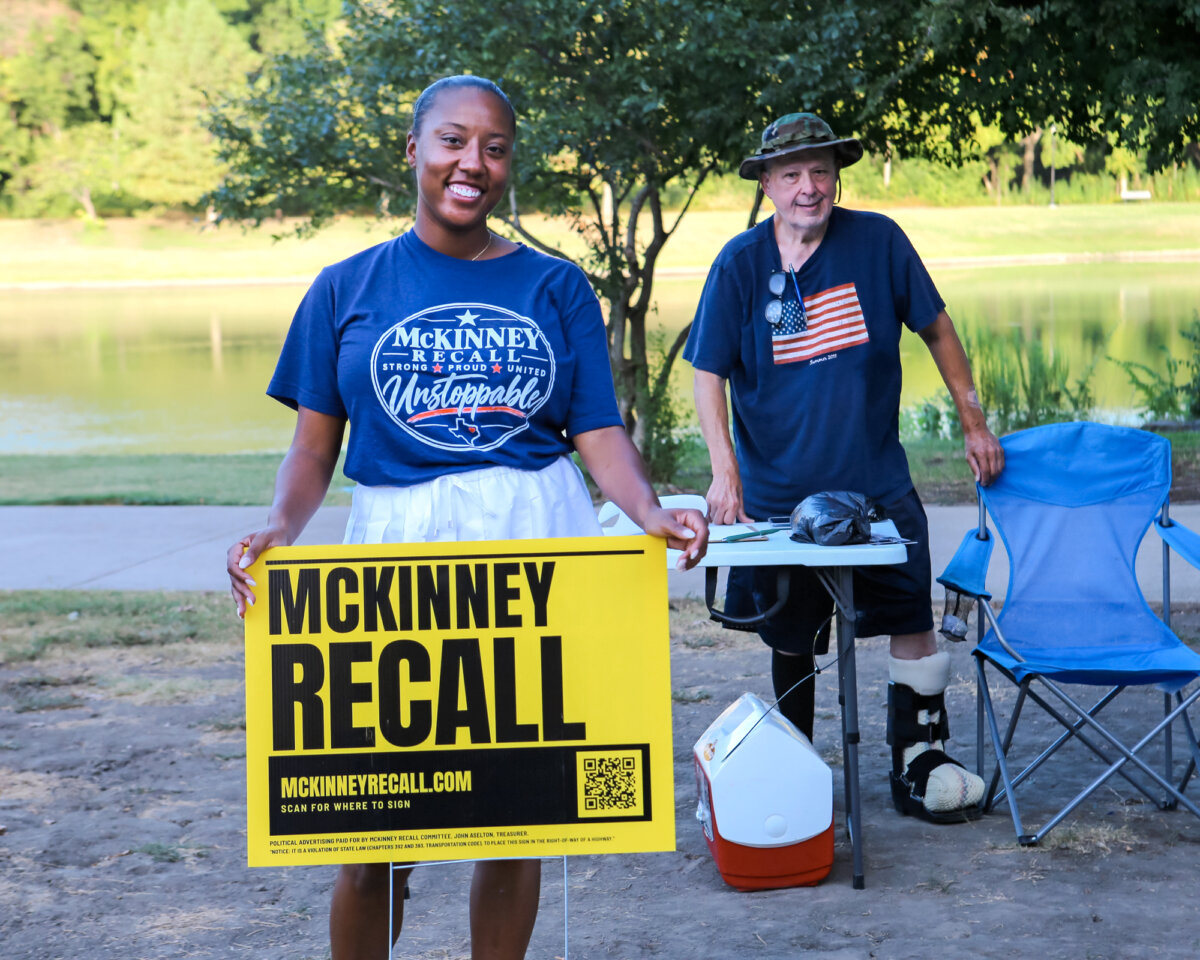

McKINNEY, Texas—In Collin County, home to a growing Muslim population, McKinney residents gathered enough signatures to recall city council members and the mayor who approved a mosque site plan after a tense public meeting in August.
A few miles south, on the 25th anniversary of 9/11, protesters gathered outside a Plano mosque, waving American flags and holding signs about Jesus and “Don’t Mecca My Texas,” as Muslims passed by on their way to prayer.
To the east in the rural part of the county, EPIC city, a 1,000-home Muslim development anchored by a mosque, remains on hold.
Texas Attorney General Ken Paxton sued to stop construction amid public concerns that the enclave would promote sharia, or Islamic law.
Muslims say their freedom to believe is a fundamental right protected by the Constitution, and dismiss opposition as political opportunism or plain bigotry.
Those who oppose the mosque have concerns about Islam’s political aspects, radical Islamic extremism, or the sense that Islam doesn’t belong in a nation built on Christian values.
Perhaps nowhere in Texas has the argument over whether Islam is a religion or political ideology been so visible as in Collin County, part of the suburban sprawl north of Dallas.
The rapid Muslim growth here has met robust local opposition at a time when some Republicans in Texas and on the national stage have made a campaign issue out of opposing Islam’s political aspects.
Cowboy Country and Islam
Texas—land of cowboys, ranches, and barbecue—was home to 224 mosques in 2020, the third-largest number in the nation behind New York and California. Some estimates now put that Texas number closer to 300.
Collin County has seen a sharp rise in Muslim adherents, up from around 6,000 in 2000 to more than 37,000 in 2020, according to one religious survey.
As more Muslims settle in the red state of Texas, strife has grown over Islam as a political movement and is increasingly reflected in election campaigns. Critics call it Islamophobia; others call the concerns justifiable.
A recent headline in The New York Times summed up the friction with a provocative article titled “Islamophobia’s Rise in Texas.”
The story outlined a terrorist threat at a new Islamic center in Houston, a Conroe woman who told Muslim shoppers at a grocery store they weren’t welcome, and anti-Muslim sentiment over the mosque expansion in McKinney.
At the August McKinney City Council meeting, Ashley Marie Louden spoke out.
She vowed to launch a recall against elected officials who, she said, have repeatedly ignored the will of their constituents. Their unanimous vote to approve the new mosque site plan was the last straw.
“When the city council stops answering to the people, the people have a duty to act,” Louden said during the city council meeting. “It’s time to start organizing a recall on every member who has chosen cowardice and silence [over] accountability.”
She told the Epoch Times her phone blew up after the city council approved a site plan for the mosque expansion in a busy part of town.
Louden said that characterizing resistance to a mosque expansion as mere Islamophobia dismisses valid public concerns.
Take, for example, Iran’s Islamic caliphate chanting “Death to America” for almost 50 years. More recently, popular Muslim influencers such as Hasan Piker have proclaimed America “deserved 9/11.”
“I think a lot of residents, and I just think as a nation, a lot of people are starting to see what radical Islam comes with, and they have every right to be concerned because it’s not something that we should just welcome in the name of not being Islamophobic,” Louden said.
Character-Defining Moments
At the same McKinney city council meeting, others said the freedom to build a house of worship is about as American as it gets. The meeting lasted more than four hours and attracted more than 100 people who signed up to speak.
Samad Syed brought a copy of the Constitution with him to the podium.
“This Constitution of America represents the greatest promise: that every person stands equal before the law; that our rights do not depend on our faith, our background, our popularity,” he said.
“Tonight, this council is not deciding what kind of building belongs in McKinney. You’re deciding what kind of city McKinney will be remembered as. … Every generation has moments that define character.”
Others stood up in defense of their Muslim neighbors, saying they deserve to practice their religion just like anyone else in America.
“It’s very disappointing to hear all the racism, Islamophobia, and hate,” Kassey Stanfill said. “I have read the Quran and the Bible, and a lot of things said today were taken out of context.”
Check out the full story for more.
—Darlene McCormick Sanchez
BOOKMARKS
A federal appeals court is taking a second look after a district judge blocked Robert F. Kennedy Jr.’s panel of handpicked vaccine advisers from meeting. “What is the harm that needs to be redressed, or that would justify this kind of intrusive relief?” one of the judges on a U.S. Court of Appeals for the First Circuit panel asked during an oral hearing in the case.
Former President Barack Obama taped two dozen ads last week for Democratic candidates for governor and Senate across the country. He’s also planning to stump for Michigan Democratic Senate nominee Abdul El-Sayed and gubernatorial nominee Jocelyn Benson at a Detroit rally on Oct. 24.
Jim Bakker, who built an evangelical media empire with his former wife, Tammy Faye, during the 1970s, has died at age 86. His second wife, Lori Bakker, said the televangelist died on Oct. 5. She did not provide any details about the cause of death.
What’s happening with the possible plague outbreak in Siberia? Secretary of State Marco Rubio on Tuesday said he wants the Russian government to share more information about it.
Daniel Kokotajlo, former OpenAI researcher and executive director of the AI Futures Project, thinks whoever controls machine learning may rule the United States. Find out what he said by reading Jacob Burg’s latest.
—Stacy Robinson
 Friends Read Free
Copy
Facebook
Tweet