Alexander and his Greek army had defeated Darius III at Issus in 333 B.C. It was one of history’s most consequential battles, forcing Darius, the great king of the Persian Empire, to negotiate peace. He offered all the lands west of the Euphrates River and up to the gates of Babylon. He also offered a king’s ransom for the return of his family, which had been taken prisoner at the battle. But Alexander was no longer just a man. Indeed, he was no longer just a king. He was a god.
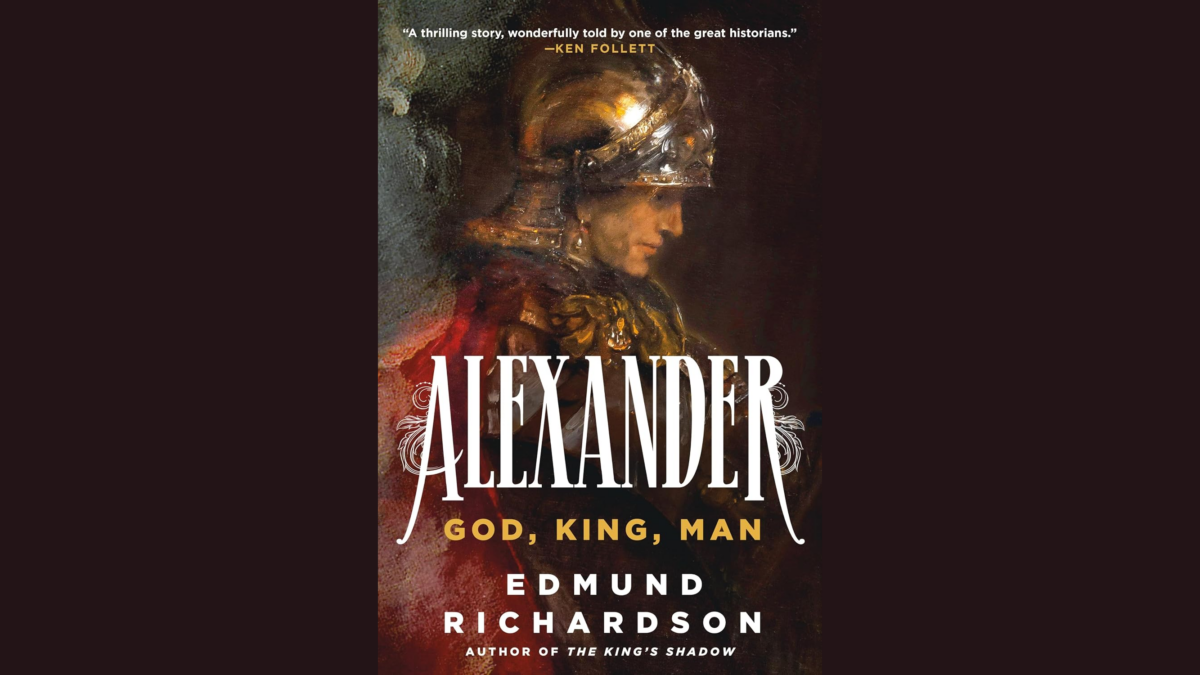
He had just been crowned pharaoh of Egypt, and at Siwa—the Egyptian temple—had been called “son of god” by the priest. For Alexander the god-king, nothing less than all of the Persian Empire would do. Edmund Richardson, in his new biography “Alexander: God, King, Man,” follows the path of history’s greatest conqueror from Macedon to the Hindu Kush, and shows that even after conquering all of Persia, it was still not enough for him.
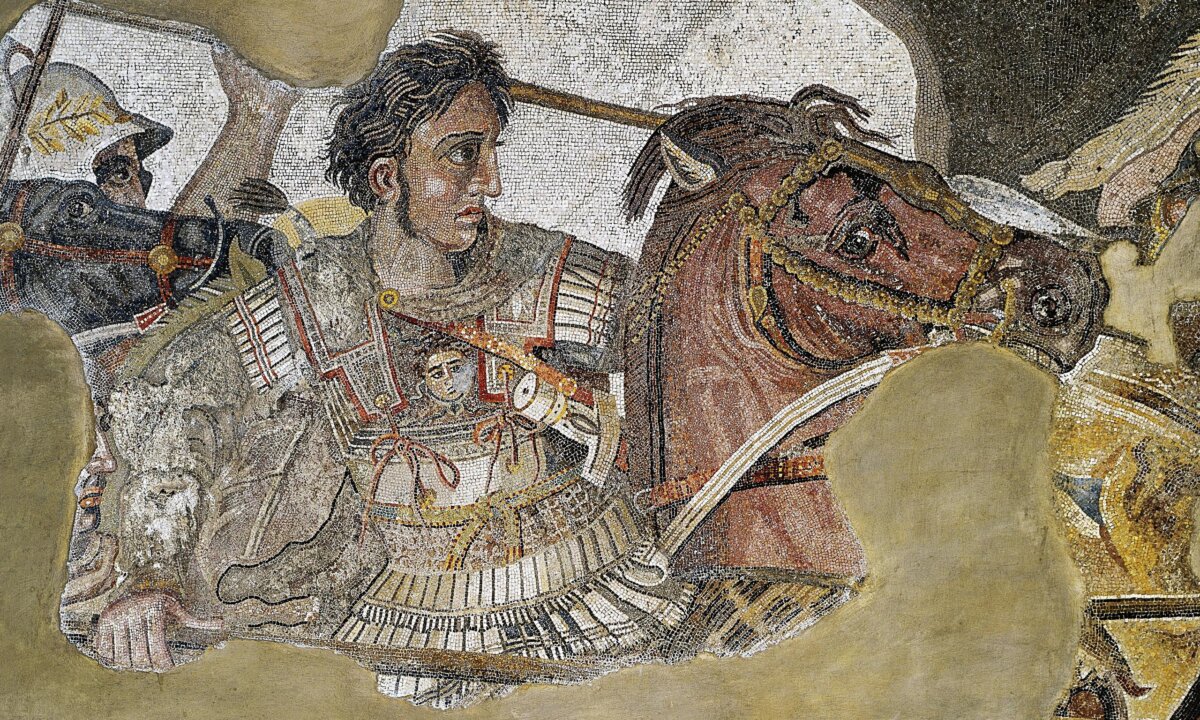
It was “pothos,” the Greek word for an unquenchable desire, that possessed Alexander. “When pothos cannot be appeased,” Richardson writes, “and it never can be appeased—it becomes destructive; it eats away at a person until, eventually, it becomes a desire to die: the only way to make peace with an impossible longing.” Richardson follows Alexander’s destructive path—destructive in ways far beyond the personal—which ended with his death in Babylon.
Myth and Fact
Richardson’s retelling of Alexander’s life uses a mix of ancient historical works, like Arrian, Plutarch, Herodotus, and Quintus Curtius Rufus; modern scholarly works; and archaeological discoveries. These sources are certainly enough to relay the story, but Richardson adds one more element to give the book an aura of devastating beauty.
The story of Alexander—no matter how straightforward one tries to tell it—is imbued with myth and legend. It is a story with moments where fact and fiction mingle, and after millennia, there is no recourse but to do as one man stated: “When legend becomes fact, print the legend.” Thus, Richardson not only weaves this real-life mythical story, but he embraces the use of other cultural myths, beliefs, and prayers, like those found etched into Assyrian cuneiforms, on the walls of Babylon, printed on Egyptian papyrus, or written in Mesopotamia’s “Epic of Gilgamesh.”
This layering of myth on myth lets this modern retelling be told in a classical spirit. This doesn’t mean that Richardson never corrects the historical record. He often does. His use of myth in the biography is not a dereliction of historical accuracy. The author knows that readers can, or should, distinguish between that aforementioned fact and fiction. To try to disentangle them, though, would destroy the story itself.
Furthermore, consider a man who believed he was destined to conquer the world, had escaped death countless times, had defeated seemingly undefeatable enemies, was identified as a living god, and had guided thousands of soldiers into what was considered the unknown world; there is ample evidence that even the facts seem fictional. Richardson does right by the great Macedonian king by letting the facts and myths live together.
It is fitting that even nearly 2,500 years ago, myth and fact should have been intertwined. It is a consequence of “pothos.” If one feels compelled to accomplish a task until death separates him, then nothing but death can stop the compulsion. When that compulsion is to conquer the world, one’s story will certainly defy logic, perhaps even nature itself—at least for a time. For this reason I describe the book as devastatingly beautiful.

Genius and Brutality
As Richardson follows Alexander’s life, we witness his political acumen in the effort to act quickly after his father’s death—Philip of Macedon. His claim to the throne was an act of courage, though his early boast that he would conquer the Persians was less of courage and more of desperation. Maintaining an army required an economy of war, and maintaining that economy required military success. According to the author, it was a razor-thin edge Alexander walked.
“As with Philip, the question of why he should be the one to lead such a campaign hung in the air, unspoken,” Richardson writes. “The mood was brittle and icy. Philip had been feared, but Alexander was barely tolerated.”
After the destruction of Thebes, more Greek cities fell in line behind Alexander. The path, however, was far from paved. But he began to see it bend in his direction, specifically after the battle at the Granicus River against a Persian army. Alexander showed impatience and recklessness that nearly cost him his life, yet ultimately led to victory and cemented his reputation for battlefield bravery. This was followed by two myth-building moments: the riddle of the Gordian Knot and the destruction of the seemingly indestructible island city of Tyre.
The latter two demonstrate Alexander’s aptitude: When after failing to untie the knot, he famously cut it with his sword; and his cruelty, when he ended the siege of Tyre with the crucifixion of 2,000 Tyrinians. These are tales of his genius and his brutality, urged on by his pothos—his unrelenting desire to conquer the world. He learned from his impatience at Granicus to be more strategic in places like Gaugamela and Issus. He demonstrated mercy when cities like Babylon surrendered. But more often than not, Alexander left a trail of death and destruction, like in Tyre, Gaza, and Persepolis.
‘The Heart of Darkness’
The plundering and pillaging by Alexander’s army is not uncommon. Such actions are common throughout history. Richardson, however, shows us how such actions change people over time, even those who believe they are divine. It is hard to miss how Richardson’s “Alexander” demonstrates an example of a journey into what Joseph Conrad coined as “the heart of darkness.” Alexander began to transform as his pothos forced him past the edges of the world to the point where even his soldiers questioned who he was. Was he Alexander the Macedonian king? An Egyptian pharaoh? The great king of Persia? A god? The latter identities greatly disturbed many of his commanders and soldiers. Was the campaign about defeating the Persians or elevating their leader to mythical status?
As questions and concerns arose about their leader, the soldiers, now so far from home, began to lose hold of their own identity and humanity. Richardson discusses how leaving such a trail of destruction can impact the human psyche, and how living with their murderous memories tormented them. This impact on the psyche is further demonstrated by Alexander’s change in nature. With fewer enemies to defeat, he began to see enemies in his own camp—real and imagined—to the point that he murdered some of his closest companions.
Richardson, however, makes it abundantly clear that Alexander’s loyalty to his soldiers was forged through every kind of trial. It was, in a word, unbreakable. Even when his soldiers refused to march further after winning the epic battle at the Hydaspes, they did so with a mixture of desperation for home and reverence for their king. Alexander acquiesced, but with plans to renew the campaign against the world with a new army. The reaction to this plan for a renewed campaign further demonstrated their bonds of war, and the book ends with one of history’s most emotionally charged and powerful speeches.
“Alexander: God, King, Man” is one of the finest biographies or works of history I have ever read. The prose is stunningly beautiful for a historical account, yet it never sacrifices accuracy for beauty. Richardson’s gift for capturing the ancient era—its brutality, its beauty, and its beliefs—is exceptional. This is a book that should not be missed, and one that may very well become a classic in its own right in decades to come.
‘Alexander: God, King, Man’
By Edmund Richardson
St. Martin’s Press: Sept. 29, 2026
Hardcover, 480 pages
What arts and culture topics would you like us to cover? Please email ideas or feedback to features@epochtimes.nyc