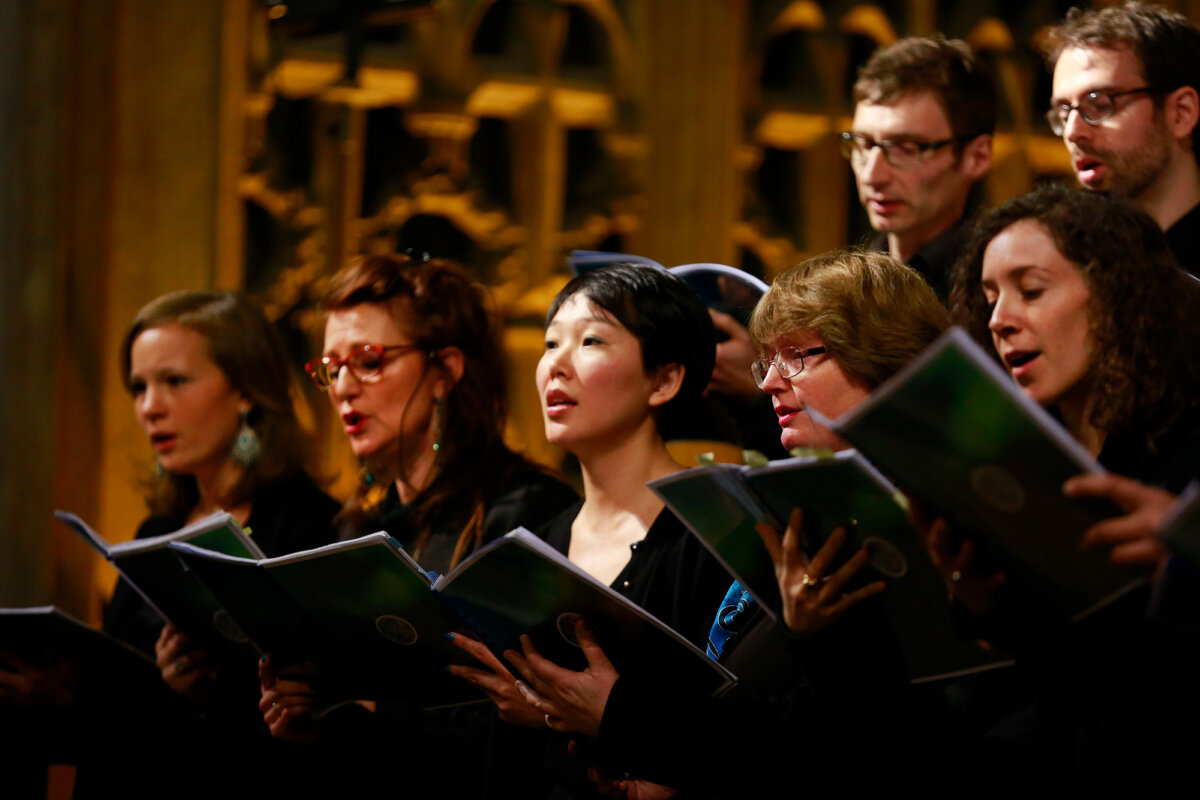
Last fall I had the pleasure of singing in an oratorio about the life of John Newton, who penned the famous hymn “Amazing Grace.” Production is currently underway for a repeat performance of this work, and while I will certainly never be a soloist, I do find immense pleasure in being surrounded by more than 100 other voices as we sing hymns and other songs filled with the message of God’s grace.
Many individuals don’t get the chance to experience such group singing these days, even in their own churches, as the following X post explains.
“I was chatting with a pastor today and he explained to me that he made sure the sound system was loud enough that people didn’t have to hear their neighbor singing,” Annie Crawford wrote. “I have so many thoughts about this.”
I, too, have thoughts—and they’re not what I would term favorable. By hindering others from singing with one another, we negatively affect not only our churches, but also our culture at large.
For the Joy of Singing
For starters, singing in general lifts spirits as it releases dopamine and endorphins, which in turn reduce pain and boost immunity. In an age besieged by depression and mental health troubles, we could sorely use more of the happiness that singing brings. But if we turn up the instrumental volume so loud that we can barely hear ourselves sing, let alone our neighbors doing the same, won’t that discourage us from engaging in an activity that can bring joy and lightheartedness?
Collective Voices
Singing also creates community, a sense that it’s not just us against the world but that we stand shoulder to shoulder with others. Research underscores this, finding that singing creates “larger cohesive groups,” as a 2016 study states. My own experience demonstrates this as well, for when I first joined choir last year, I barely knew a soul. This year, coming back together felt like returning to summer camp and reuniting with old friends, particularly with those who were my close seatmates last year. However, I can only imagine how much that cohesion would diminish if the sound system were turned up so loud that it drowned out those who sang by my side.
In a similar fashion to community, singing also fosters unity, dissipating our differences. One of my memories of Sept. 11, 2001, is watching congressional members stand on the steps of the U.S. Capitol and spontaneously burst into singing “God Bless America.” There they were, Republicans and Democrats who were at odds more often than not, standing side by side and singing with no thought except that they were united against the forces of evil that had attacked our country. If you look back at the video of that instance, you’ll hear at least one voice that is monotone and even off-key—the type of singer that people may legitimately want to use an amped-up sound system to cover. Yet doing so would significantly destroy the blessed unity of that moment.
Today, unity in our country, churches, and communities is far less than it was at that point in time. Perhaps it’s because we don’t engage in such unifying activities as singing—or when we do, it’s covered by an amplified sound system—that we have so much trouble coming together and agreeing on even the simplest of things.
Musical Truths
Another reason it’s important to engage in group singing is that it enables us to ingrain truth into our hearts. Regarding the church music situation mentioned in the above X post, the scenarios that blast the audience out are often the result of a performance-based approach to group singing, which alienates the group at large while propping up the one leading the song. As such, the audience is hindered from learning and understanding the lyrics.
Perhaps this doesn’t matter as much in modern music, which is filled with relativistic ideas and all the “feels,” but for older music, such as folk songs or hymns, the audience misses out on lyrical poetry that conveys deep truths and important food for thought. If those in the group don’t have an opportunity to sing those words, they have less of a chance to process and meditate on the life truths the words convey. And when the time comes when those same people need hope or something encouraging to remember, those words won’t be stored away in their hearts, implanted there by the catchy tune that has stuck in their heads.
A Tragic Loss
Finally, when we discourage singing by drowning out voices, whether in church or other group gatherings, we gradually diminish the population’s ability to sing thanks to lack of practice and familiarity. With that decline in ability, we lose valuable cultural memory—knowledge of old tunes, poetry, truths, history, and so on—and the more cultural memory we lose, the faster our society is likely to decline.
G.K. Chesterton once decried the incessant emphasis of our scientific civilization’s need for experts to do everything, even singing.
“Once men sang together round a table in chorus; now one man sings alone, for the absurd reason that he can sing better,” he noted in his 1905 work “Heretics.” Perhaps it’s time then to engage in more singing—singularly and communally—if only to remind us average folks that we have an important part to sing in the choir of life.