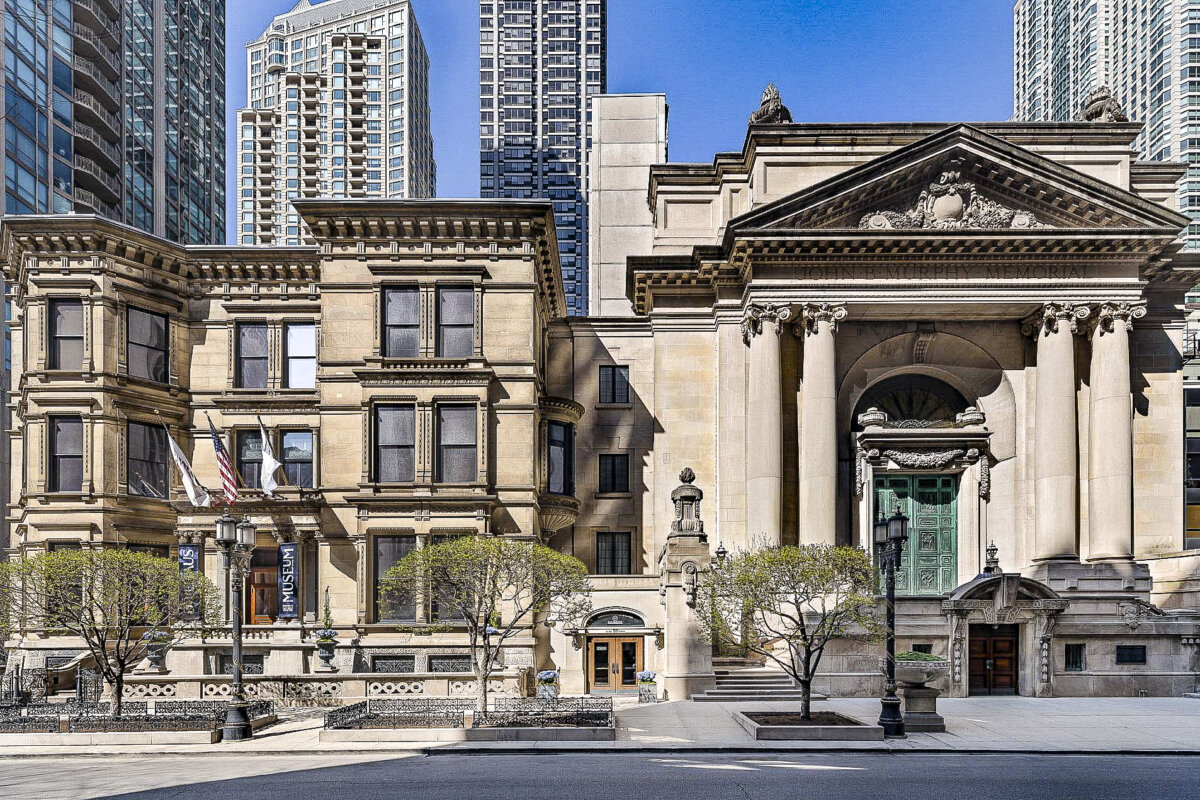
Built after the Nickersons lost their previous home in the Great Chicago Fire of 1871, this mansion was designed with fire resistance in mind and faced in limestone and sandstone. The Driehaus Museum’s original Italianate wing features tall windows with ornate stone trim, while the John B. Murphy Memorial wing embraces the Classical Revival style with elegant architectural details, including Ionic columns and a sculpted pediment. (Copyright The Richard H. Driehaus Museum)
A short stroll from the vast, ocean-like expanse of Lake Michigan sits the Driehaus Museum, a mansion whose walls hold the story of several of Chicago’s most prominent families. Completed in 1883, the three-story, nearly 24,000-square-foot Italianate mansion was hailed as having “reached a standard of excellence never before attained in Chicago.”
It was built for Samuel and Matilda Nickerson, who were among Chicago’s wealthiest and most influential families and were passionate about collecting and promoting the arts. Samuel was a founding trustee of the Chicago Academy of Fine Arts, now known as the Art Institute of Chicago, and Matilda was president of the Antiquarian Society of the Art Institute. The Nickersons sold their home in 1900 to move to the East Coast, but before doing so, they made a huge donation of their art to the Art Institute of Chicago, including paintings, prints, bronzes, and ceramics.
In 1900, the property was purchased by Lucius George Fisher, a successful paper manufacturer who founded the Union Bag and Paper Co. and expanded the business by acquiring manufacturers throughout the Midwest. Fisher brought a distinctly different aesthetic to the house, incorporating his collection of historical weapons and animal trophies. He and his family lived in the mansion until his death in 1916.
After Fisher’s death, the property entered a new phase. In 1919, more than 100 local citizens acquired the building and presented it as a gift to the American College of Surgeons. It was expanded from 1923 to 1926 with the addition of the Classic Revival style John B. Murphy Memorial Building, inspired by the Chapel of Our Lady of Consolation in Paris. The auditorium has served as a meeting space, lecture hall, and event space. The building was listed on the National Register of Historic Places in 1976 and designated a Chicago landmark in 1977, in recognition of its architectural and historical significance.
In 2003, businessman and philanthropist Richard H. Driehaus acquired the property, envisioning a museum dedicated to preserving and promoting classical architecture, design, and the decorative arts. He commissioned an award-winning restoration that included restoring the walls, ceilings, and stained-glass dome, along with the enormous project of removing decades of dark soot from the exterior, returning the building to its historic grandeur.
The Driehaus Museum opened to the public in 2008, and its story continued in 2022 with the acquisition of the adjacent John B. Murphy Memorial Auditorium. The expanded campus opened in 2024, extending the preservation legacy begun by the building’s earlier owners and benefactors.
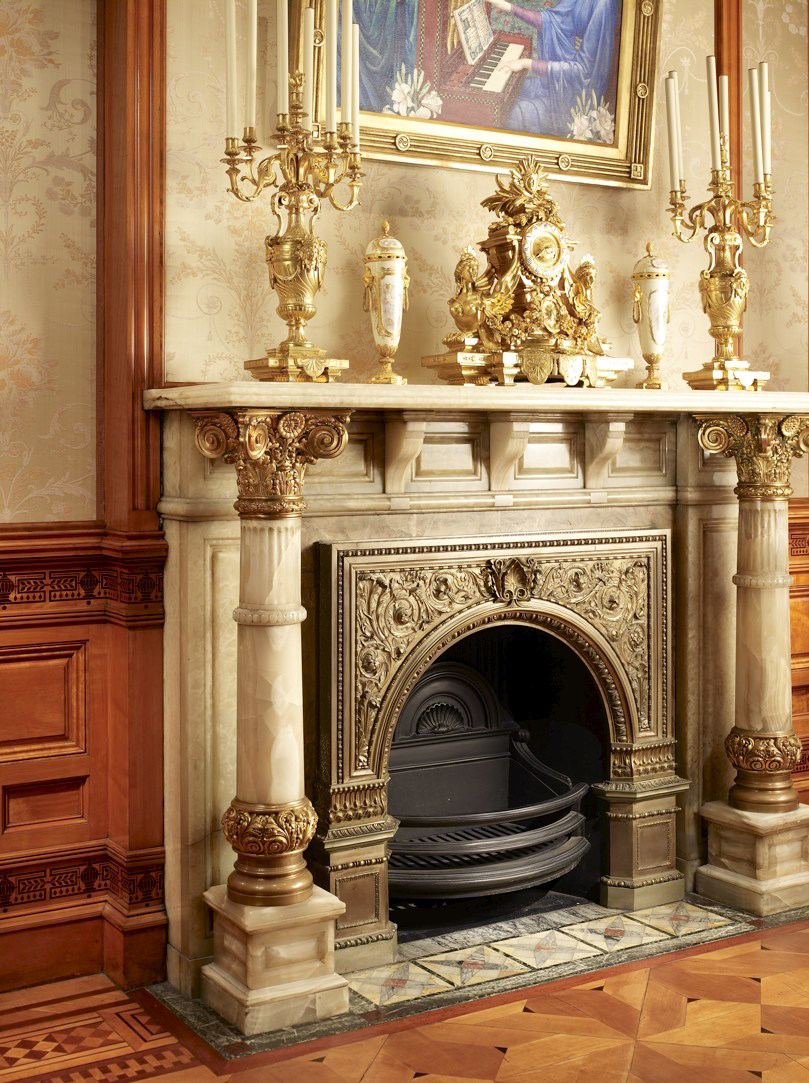
Once known as the Marble Palace, this mansion-turned-museum makes a striking first impression with its two-story Main Hall, adorned with marble and onyx. The Grand Staircase features carved stone balusters decorated with four lion masks connected by floral swags. This motif is echoed throughout the Library, Reception Room, Dining Room, and Maher Gallery, unifying the home’s luxurious interiors. (Steve Hall of Hedrich Blessing/The Richard H. Driehaus Museum) The Drawing Room’s soft, warm palette reflected its role as a feminine space where women would retire after dinner. In the 1880s, informal furniture arrangements, seen here in the neo-Empire armchairs and settee by George A. Schastey & Co., created a more relaxed atmosphere. The grand piano, crafted with satinwood veneer and Macassar ebony, was designed by Chickering & Sons, then the leading piano manufacturer in the United States. (Steve Hall of Hedrich Blessing/The Richard H. Driehaus Museum) The Reception Room was designed to welcome visitors while showcasing the family’s refined taste. Richly appointed, it features decorative walnut paneling along the lower walls, complemented by vivid blue tiles above. A towering mantelpiece presides over the north wall, adorned with five carved ram heads and a striking mosaic depicting an Italianate courtyard. (Alexander Vertikoff/The Richard H. Driehaus Museum) The Dining Room reflects the aesthetic movements of the 1800s, with hand-carved, quarter-sawn oak woodwork featuring hunting and harvest motifs. The Nickersons’ original heavy wooden dining table anchors the room. Atop it rests a dramatic Tiffany & Co. silver punch bowl adorned with grapes, leaves, and Bacchus, the Roman god of wine and revelry. First exhibited at the 1893 World’s Columbian Exposition, the bowl exemplifies the era’s exquisite craftsmanship. (Steve Hall of Hedrich Blessing/The Richard H. Driehaus Museum) Added in 1901 during Lucius George Fisher’s renovation by architect George Washington Maher, the stained-glass dome transformed the mansion’s former art gallery into a trophy gallery. Its naturalistic design reflects the emerging Art Nouveau movement, with four graceful trees arching toward the oculus and autumn-toned leaves forming a canopy against a bright blue sky. The dome remains the room’s most striking architectural feature. (w_lemay/CC-BY-SA-2.0) The first-floor Drawing Room fireplace is crafted from polished marble and onyx, framed by gilded Corinthian columns. A pressed metal sunflower frieze adorns the fireplace surround and the columns beside it. Throughout the design, flowers, leaves, and vines symbolize prosperity and an appreciation of beauty. Matching gilded candelabras, decorative urns, and an elaborate gold mantel clock complete the display. (Steve Hall of Hedrich Blessing/The Richard H. Driehaus Museum) This Tiffany Studios floor lamp complements the Drawing Room’s eclectic mix of designs. Its curtain border pattern, which evokes the vertical folds and fringe of a drawn fabric curtain, is among Tiffany Studios’ earliest and most celebrated designs. Made with signature Favrile glass in rich red, yellow, orange, and green hues, the lamp is distinguished by a shade permanently attached to its base. (Alexander Vertikoff/The Richard H. Driehaus Museum) This striking oriel window projects outward from the southeast second-floor gallery, formerly a sitting room, without touching the ground. Its Moorish-inspired design accentuates bold geometric patterns and jewel-toned stained glass, creating a captivating interplay of color and light. The three windows remain unsigned, leaving their craftsmen and exact origins unknown. (w_lemay/CC-BY-SA-2.0)
What arts and culture topics would you like us to cover? Please email ideas or feedback to features@epochtimes.nyc.
Sarah Isak-Goode is a writer and art historian rooted in the Pacific Northwest. Her name—pronounced EYE-zik-good and meaning “good laugh”—hints at the warmth she brings to everything she does. Equal parts scholar and storyteller, Sarah brings the past to life through a distinctly human lens, exploring what connects us across the centuries. Away from her desk, she feeds her curiosity through traveling, painting, reading, and hiking with her dog, Thor.