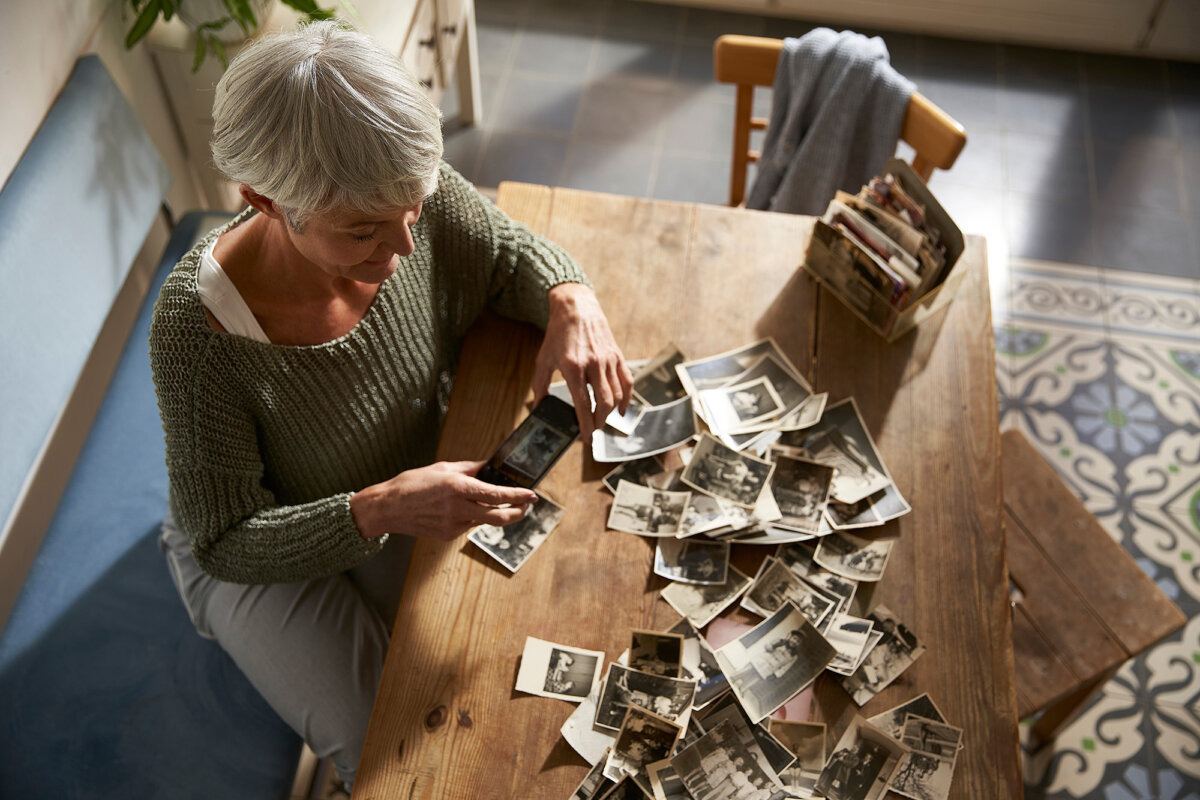
The clink and chatter, the thrum of music, the scent of the jasmine candle, the glow of the lights—then the entire party fades into the background. Even though you are standing in the middle of the room, a coruscating glass of champagne in your hand, your mind is somewhere far away.
Maybe a woman’s dress reminded you of the girl you wanted to build a life with. Maybe that man’s laugh sounded just like the brother you lost in high school. The soap in the bathroom smelled like your mother’s perfume when you were a kid, before life got complicated.
Whatever the trigger, particular memory, or experience—whether euphoric or catastrophic—you find yourself stuck in it once again.
Coming to terms with the past isn’t easy. Past traumas may form wounds that cut to the quick, while past joys leave us pining for beautiful seasons we can never return to.
In F. Scott Fitzgerald’s words, “we beat on, boats against the current, borne back ceaselessly into the past.”
How do we sail past that incoming tide?
Looking Forward, Not Back
There aren’t easy answers, but there are some strategies to achieve some measure of peace about the past. They let us live life more fully in the only timeframe we ever really have: the present.
“If you have a foot in the past and a foot in the future, you are missing your present,” Dr. Petra Pilgrim, a practicing psychiatrist and director of The Steward House at Silver Hill, told The Epoch Times. “You cannot control either your past or your future. It is essential to commit to your present because it is the only part of your life and time in which you can act to affect your future.”
Contrary to expectations, the first step is to stop trying to bury or suppress the past and face up to it. Unresolved emotions surrounding a past experience might need to be processed.
“Memories that keep returning are ones that really haven’t been finished,” psychotherapist and clinical director of Feel Your Way Therapy Arkadiy Volkov told The Epoch Times. “When we think we don’t have the resources to feel those emotions, memories stay active.”
To fully process such memories, Volkov recommends writing the story or telling it to a therapist or another trusted person.
“When we tell or write our story, we can make sense, although we can’t change the fact,” he said. “Some memories never leave. But they become less powerful and more integrated into the story of our life history.”
Danny Gagnon, a licensed psychologist in Montreal, explained that emotions are important sources of information that tell us something about how the experience or memory impacts us. When certain emotions recur, they need to be addressed. Common emotions that prevent us from moving on include guilt, regret, anger, and sadness.
“Leaving these emotions unresolved will make it hard to move forward and live in the present,” Gagnon said.
If the predominant feeling is one of guilt, it may help to extract a concrete lesson from the experience in order to recognize what action you want to avoid in the future. Then, making some form of reparation may bring further healing. If, for instance, you have had a falling out with a family member, Gagnon recommends calling them to try to repair the relationship.
Finishing the Unfinished
Sometimes past events generate regret. This can be even harder to process because it feels like there’s nothing to be done. The moment has passed, the door closed. But there are still actions to take. Gagnon provided a few examples:
“If you have unfinished business, then get to it. Look at what is unfinished and continue where you left off, and even start from the beginning if you need to. … If you regret not telling a loved one that you loved them and they have passed on, write them a letter about how you feel and read it to them at their grave.”
If certain memories shackle us because of the anger they produce, that may require a different approach. As Father Jacques Philippe pointed out in his book “Interior Freedom,” refusing to forgive gives the offender greater power.
“A refusal to forgive also binds us to the person we resent, and diminishes or destroys our freedom,” he wrote.
We might feel that forgiveness would be some form of acquiescence to the evil, but the opposite is true. Like Father Philippe, Gagnon noted that holding onto resentment only prolongs suffering. Letting go doesn’t invalidate the hurt.
“Holding on to the feelings will not change things but make the person suffer longer. Although difficult, learn to let go slowly. The best revenge is a life well lived!” Gagnon said.
Haunted By the … Happy?
In other cases, the memory that haunts us is actually a happy one—recalling it is bittersweet because we can’t return to it. Two attitudes are helpful here. The first is gratitude. Rather than lamenting the impossibility of time travel, we can choose to feel the joy of gratitude that we were able to experience whatever it is that we’re longing for. It could have been otherwise. We might never have tasted this sweetness in the first place. This frames the memory positively.
“There are a lot of words in Russian that express different aspects of sadness and longing. They mean ‘bright sadness’ or ‘luminous sadness,’” Volkov said. “We’re sad but also grateful for something that happened in the past. We miss a period that is gone, but we’re glad it happened. One doesn’t have to cancel [out] the other.”
Moreover, are happy times ever truly “lost” to us? Psychologist Viktor Frankl famously argued otherwise in his classic book “Man’s Search for Meaning.” His beautiful words are worth quoting at length:
“In the past, nothing is irretrievably lost, but rather, on the contrary, everything is irrevocably stored and treasured. To be sure, people tend to see only the stubble fields of transitoriness but overlook and forget the full granaries of the past into which they have brought the harvest of their lives: the deeds done, the loves loved, and last but not least, the sufferings they have gone through with courage and dignity.
“From this one may see that there is no reason to pity the old people. Instead, young people should envy them. It is true that the old have no opportunities, no possibilities in the future. But they have more than that: Instead of possibilities in the future, they have realities in the past—the potentialities they have actualized, the meanings they have fulfilled, the values they have realized—and nothing and nobody can ever remove these assets from the past.”
With this perspective, joys that have passed do not diminish us; they make us richer.
The second key attitude with regard to bittersweet memories is one of hope. Not only can we experience gratitude for the joys of the past, but we can remain confident that wonderful experiences lie ahead. Life isn’t over; the curtain hasn’t fallen. We’re constantly making new memories to store up, and by embracing the present, we might discover that, in fact, we’re in the middle of the best chapter of life yet.
Whether we’re trying to move on from a joy or a sorrow, it may help to perform a ritual to symbolically surrender the past. These meaning-laden actions allow us to honor what occurred, yet also find freedom from it. Through a ritual, we make a concrete choice to acknowledge the past while choosing to live for the present.
These rituals can be simple, such as writing down what you want to let go of and burning it or writing in the sand to let the tide erase it. Of course, for people of faith, prayer is the best ritual for surrendering the past and achieving peace in the present. Simple though such actions may be, they can provide real closure.
And when we have let go? Then what? Then a new light, like the trickle of dawn across a shadowed landscape, begins to grow in your life. New possibilities. New futures. New memories, better than the best of the past. The past isn’t dead nor denied, but it’s behind you: a part of your story, but not the whole of it.
Now, at last, you can drink and enjoy the sparkling, effervescent champagne of the present moment.