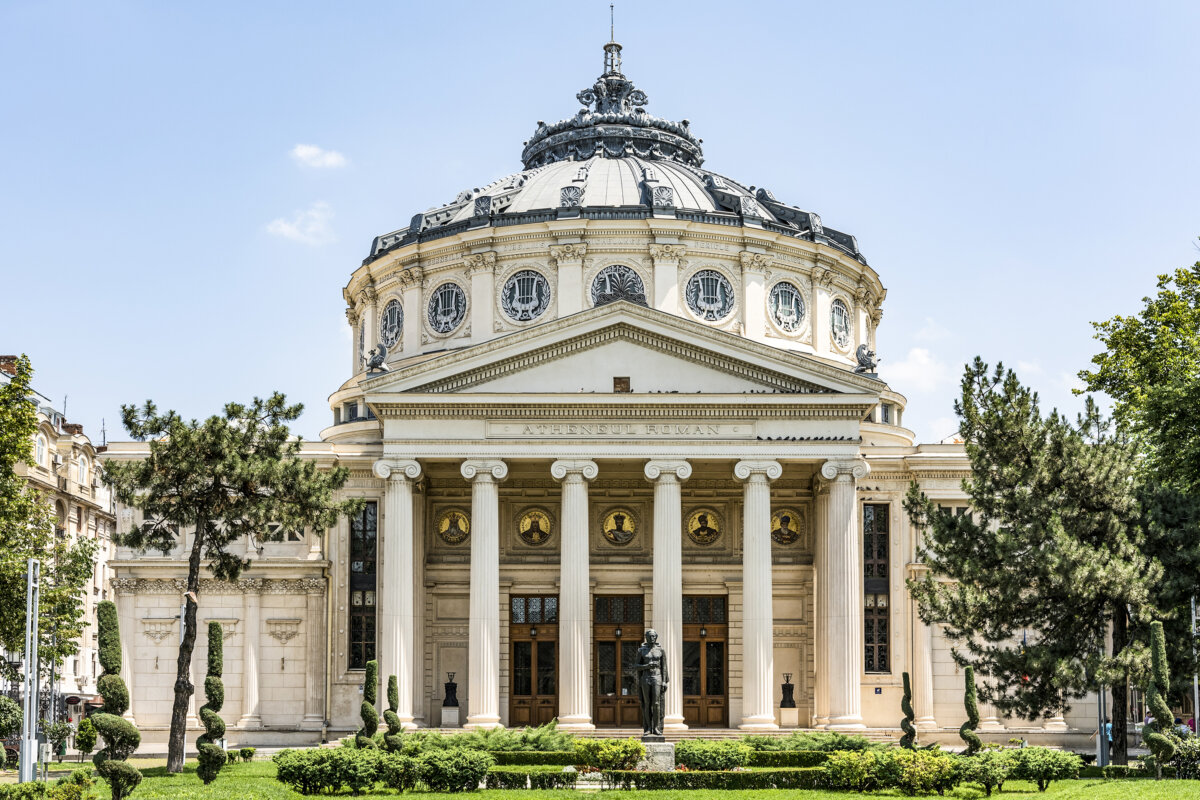
The Romanian Athenaeum's exterior evokes ancient Greek and Roman architecture with its triangular pediment, six Ionic columns, and temple-like portico. Its circular design, approximately 29 meters in diameter, is crowned by a distinctive dome that makes it a landmark of central Bucharest. Five mosaic medallions honoring Romanian rulers adorn the entrance, a fitting tribute to the nation's heritage. (Radu Bercan/Shutterstock)
What does it take for a city to be called “Little Paris of the East”? For Bucharest, Romania, the nickname was earned through a cosmopolitan spirit and deep cultural ties to France.
That reputation crystallized during the Belle Epoque, an era of gilded splendor that swept across Europe in the late 19th and early 20th centuries, radiating outward from Paris. Nowhere is that legacy more visible today than at the Romanian Athenaeum, Bucharest’s answer to Paris’s Palais Garnier.
Established by the Romanian Athenaeum Society under naturalist Constantin Esarcu, it was supported by figures such as Alexandru Odobescu and Nicolae Kretzulescu, who promoted education and culture through lectures, concerts, and the arts. The first stone was laid in 1886, but when the original patrons’ funds dried up, it was public fundraising, in the form of the “Give a Penny for the Athenaeum” campaign, that rescued the project. The Athenaeum was completed in 1888.
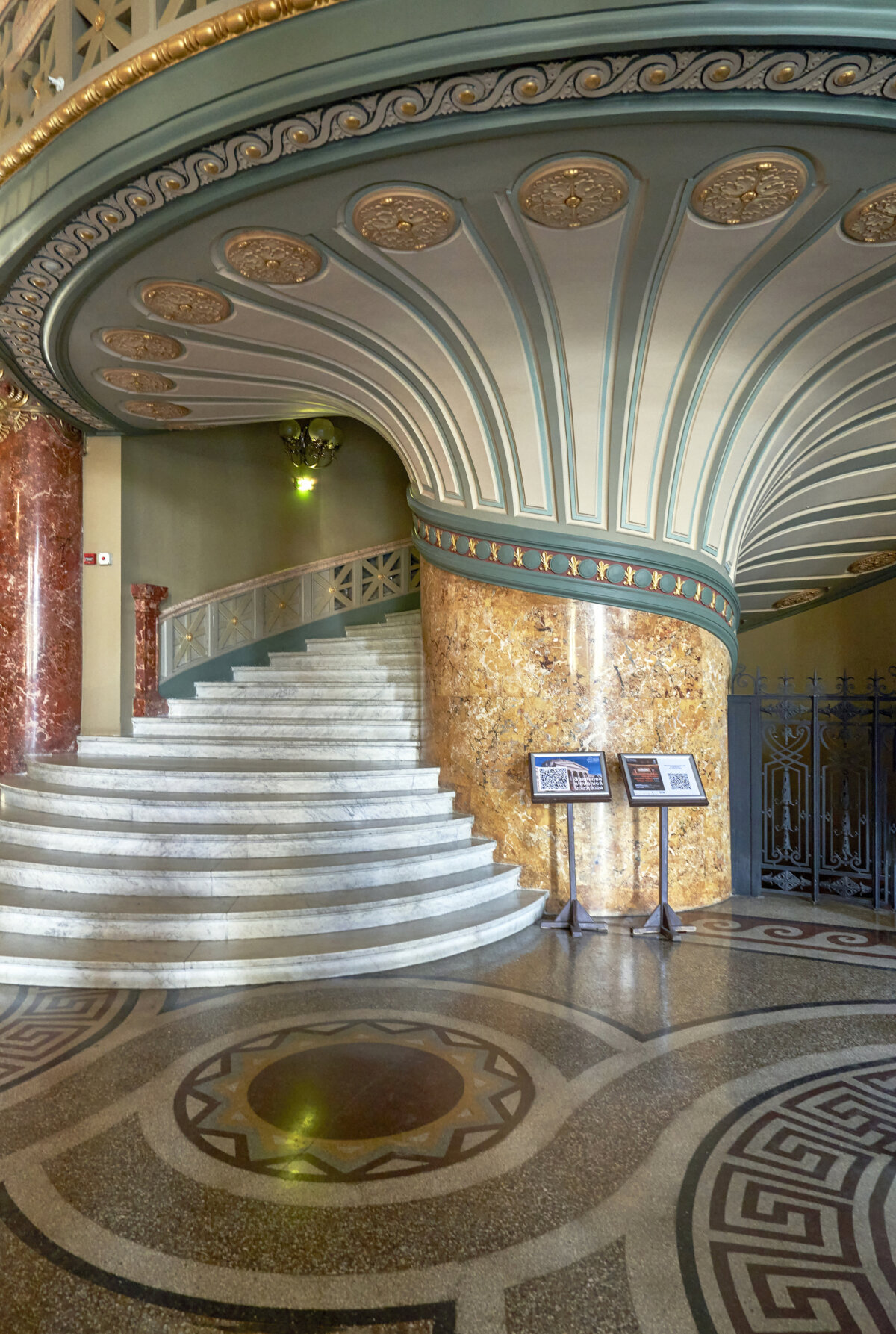
French architect Albert Galleron designed the Athenaeum, with contributions from several Romanian architects. Blending neoclassical, romantic, and French Belle Epoque influences, the exterior evokes ancient Greek and Roman monuments, featuring five mosaic medallions of important Romanian rulers on the facade. Inside, the building is organized around two large circular spaces, the Grand Hall above and the foyer below. Much of the interior features artificial marble, achieved through a high-end decorative plaster technique. This allowed the architect to create the grand, majestic aesthetic befitting a national cultural landmark, without the expense of imported stone.
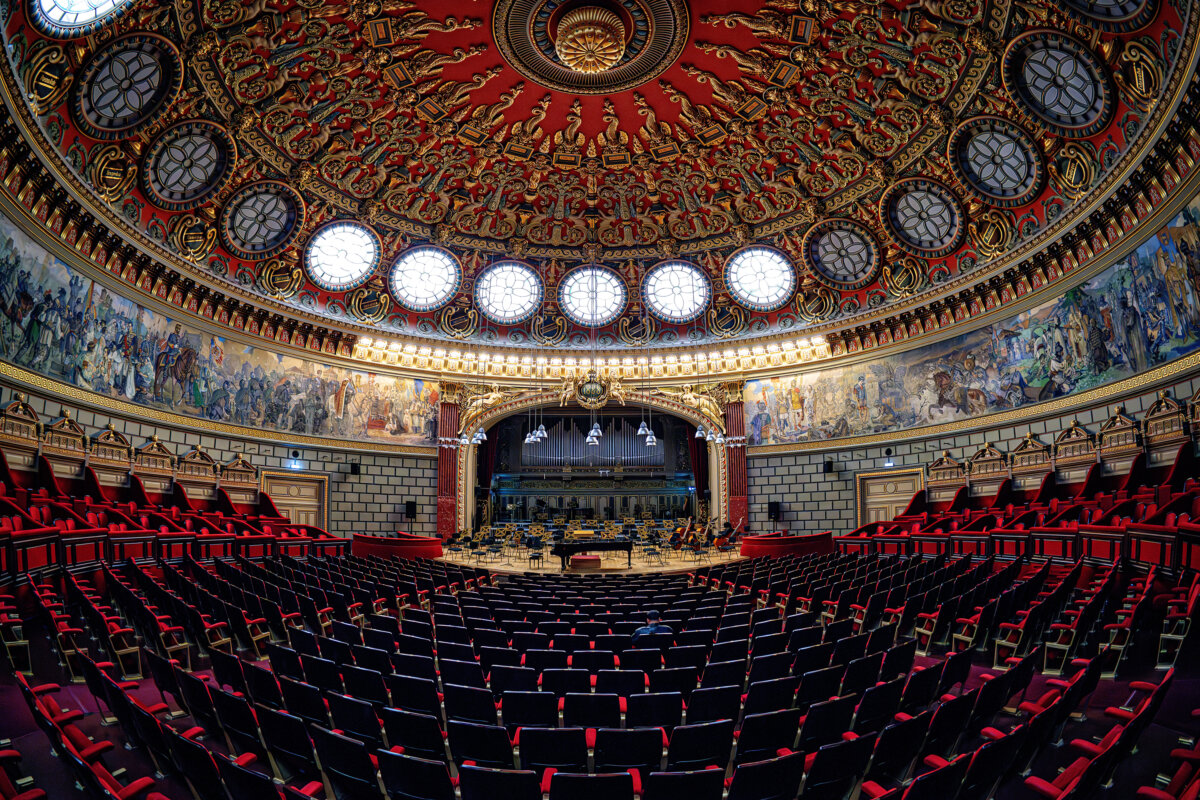
One of the Athenaeum’s most remarkable features is the Grand Hall, nearly 100 feet in diameter, with 794 seats arranged in an amphitheater. Crowning the space is a monumental historical fresco painted by Costin Petrescu and unveiled in 1939. Its carefully chosen sequence of scenes presents Romanian history as a long journey toward national unity, reflecting the importance placed on national identity when the fresco was created.
Today, the Athenaeum remains an active cultural institution and one of Bucharest’s most prestigious concert venues. The 19th-century landmark was formally recognized in 2024, when it was awarded the European Heritage Label for its significant contribution to European culture, music, and shared values. Since 1889, it has been home to the Romanian Philharmonic Society, now the George Enescu Philharmonic, and it continues to host classical music performances, including the internationally acclaimed George Enescu Festival, alongside public exhibitions, conferences, and cultural events that carry forward the building’s original mission of spreading culture and knowledge.
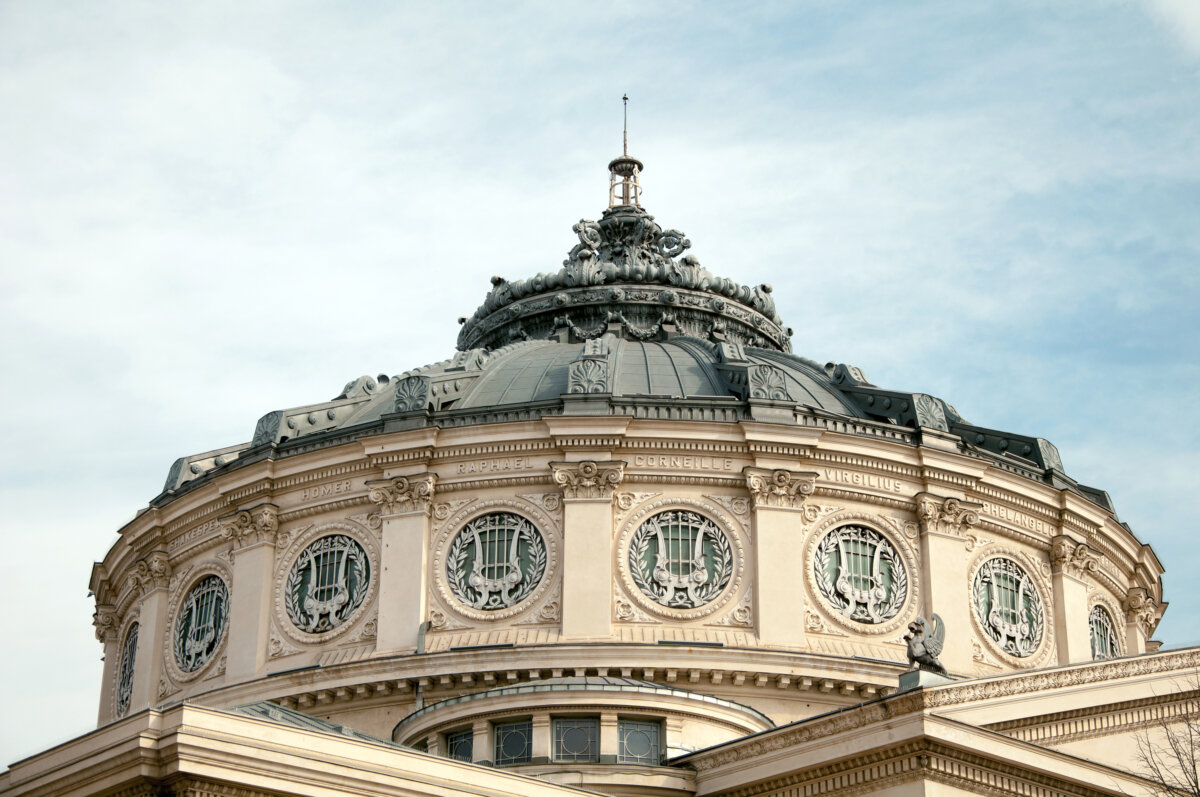
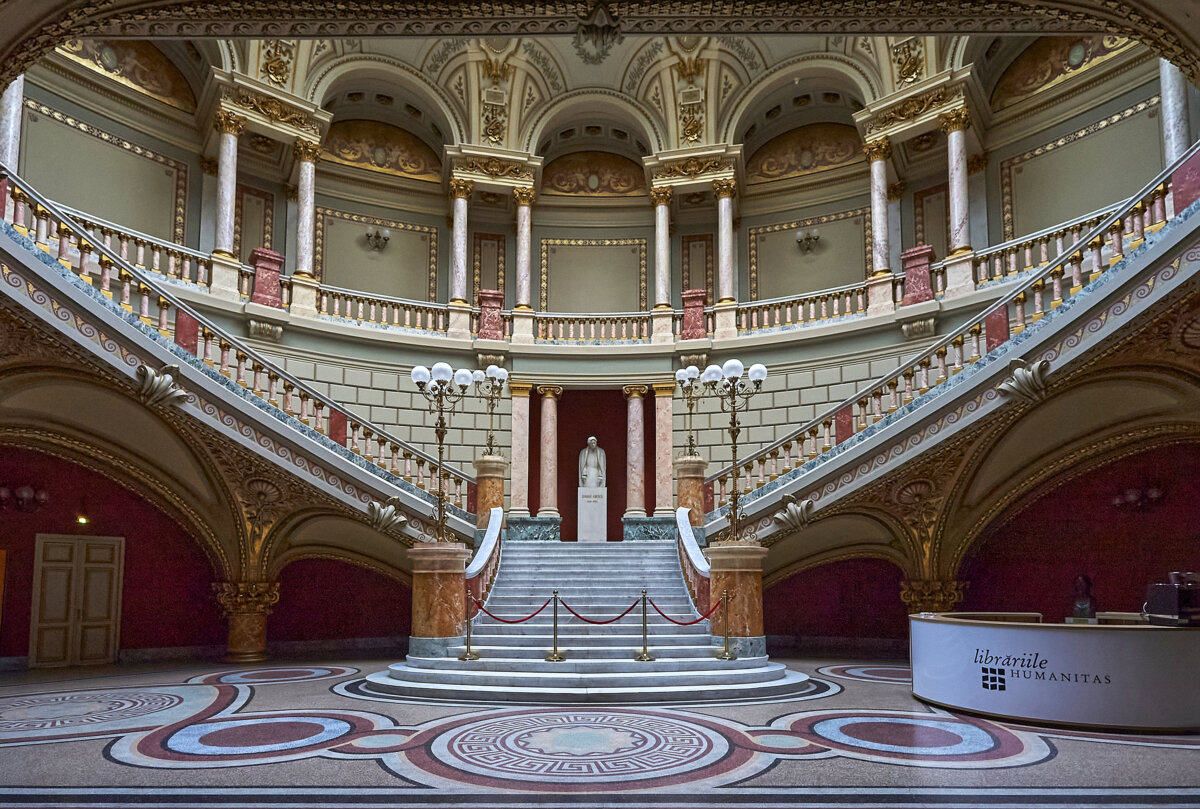
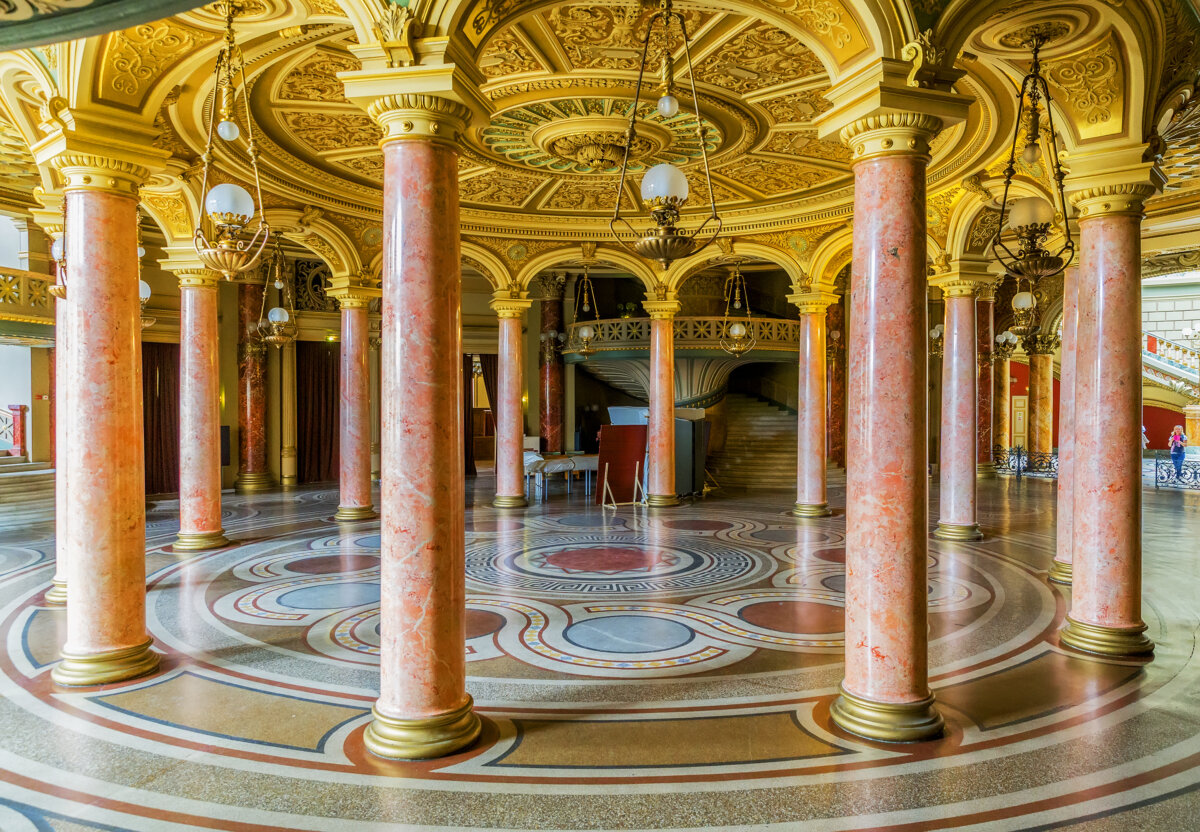
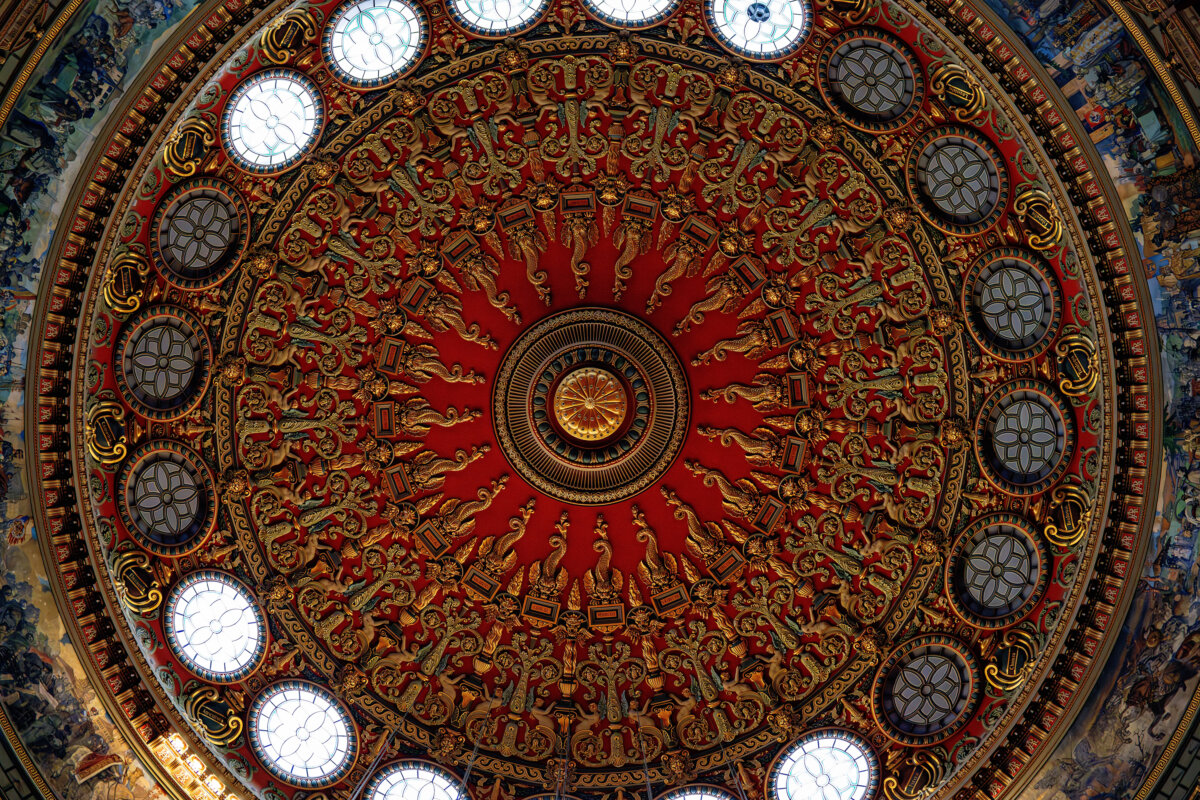
The Romanian Athenaeum’s dome is adorned with music-themed decorations befitting its role as a center for art and music. Above the windows at the cupola’s base, reliefs of lyres framed by laurel wreaths encircle the structure, accompanied by the inscribed names of renowned cultural figures, including Ludwig van Beethoven, William Shakespeare, Homer, Galileo Galilei, and Raphael. (Eduard Constantin/Shutterstock) A magnificent double-curved staircase sweeps upward in two graceful ramps, forming a dramatic focal point at the entrance. On the landing stands a statue of George Enescu, Romania’s celebrated composer, violinist, pianist, conductor, and teacher, renowned for his Romanian Rhapsodies and the opera “Oedipe.” The Athenaeum has housed the Philharmonic Orchestra since 1889; it was renamed the George Enescu Philharmonic Orchestra in 1955. (Yuri Turkov/Shutterstock) Twelve Doric columns, finished in pink stucco to mimic marble, define the foyer’s central rotunda. The floor showcases an intricate geometric and floral pattern typical of late 19th-century French neoclassicism, its motifs radiating outward to echo the hall’s circular form. (Ungvari Attila/Shutterstock) The Romanian Athenaeum’s four spiral staircases lead to grand doors opening onto the concert hall, the building’s crowning space. Each features a mushroom-shaped central column supporting an ornate circular balcony adorned with geometric star motifs, flanked by polished reddish-pink marble columns crowned with gilded capitals. Above, a coffered ceiling displays octagonal and fleur-de-lis patterns, while the mosaic floor traces the classical Greek key, symbolizing unity and infinity. (Yuri Turkov/Shutterstock) The dazzling amphitheater-style auditorium rises in tiers of 794 seats, arranged across the stalls and boxes. Encircling the space is a sweeping 246-foot narrative fresco depicting 25 scenes from Romanian history, beginning with the Roman conquest of Dacia and tracing the nation’s journey through medieval rulers, national heroes, and cultural movements, before culminating in the formation of Greater Romania in 1918. (Cristi Mitu/Shutterstock) Commissioned at the request of Alexandru Odobescu, the minister of monuments and one of the founding members of the Romanian Athenaeum Society, the ceiling reflects his personal input into its design. Elaborate plant, animal, and fantastical motifs, rendered in gilded polychrome relief, draw inspiration from Romanian folklore. Mythical creatures guard 20 individual cartouches, each bearing the name of a distinguished Romanian scholar, poet, or politician. (Cristi Mitu/Shutterstock) Renowned composer George Enescu launched a fundraising campaign in 1935 to install a grand concert organ in the Athenaeum. Built by the German firm E.F. Walcker & Co. and inaugurated in 1939, the organ remains a prominent feature of the Grand Auditorium. Designed as a symphonic concert organ rather than a traditional baroque church organ, it features rich, orchestral tones that complement or substitute for a full orchestra. (Britchi Mirela/CC-BY-SA-4.0)
What arts and culture topics would you like us to cover? Please email ideas or feedback to features@epochtimes.nyc.
Sarah Isak-Goode is a writer and art historian rooted in the Pacific Northwest. Her name—pronounced EYE-zik-good and meaning “good laugh”—hints at the warmth she brings to everything she does. Equal parts scholar and storyteller, Sarah brings the past to life through a distinctly human lens, exploring what connects us across the centuries. Away from her desk, she feeds her curiosity through traveling, painting, reading, and hiking with her dog, Thor.