Internet users have a well-documented obsession with cats. In 2010, an estimated 1.3 billion cat photographs circulated online, a figure now believed to have grown to more than 6.5 billion. Cat videos are just as popular: By 2022, YouTube alone hosted tens of millions. But while the internet has given this fascination a global audience, cats have been favorite artistic subjects for far longer.
Nearly two centuries ago, Dutch-born artist Henriette Ronner-Knip (1821–1909) was already capturing the playful spirit that still charms cat lovers. Her exquisitely detailed paintings showed curious cats exploring their surroundings, each with a distinct personality and expression. They resonated with Victorian audiences, for whom cats increasingly embodied affection and the comforts of home. Now remembered as one of the 19th century’s finest animal painters, Ronner-Knip is celebrated above all for her remarkable ability to convey cats’ individuality.
From an Artistic Family to a Career of Her Own
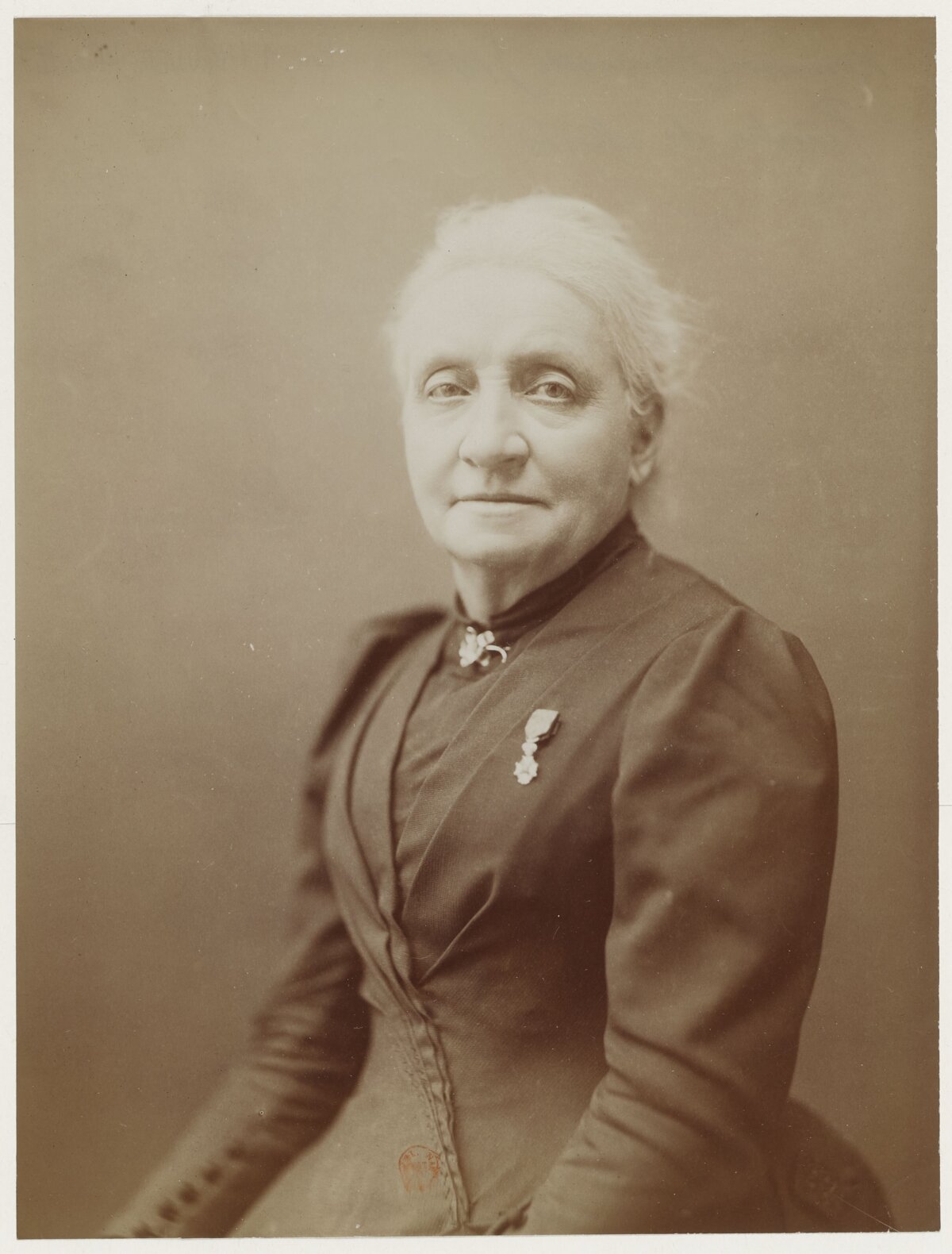
Ronner-Knip was born on May 31, 1821, in Amsterdam. Her father, Joseph August Knip, was a respected landscape painter whose career had taken him to France and Italy. Her grandfather was also an artist, making creativity and artistic pursuits central to her heritage.
She showed an early aptitude for drawing, copying her father’s sketches by age 5 and beginning formal lessons with him at 11. As his eyesight deteriorated and he eventually became completely blind, she took on increasing responsibility for supporting the family through her art. Her father maintained rigorous expectations, requiring her to spend long hours at her easel and study subjects directly from life rather than rely on imagination or secondhand references. Drawing from life trained her eye to catch fine details, including the fleeting expressions of her animal subjects.
She began exhibiting as a teenager, selling landscapes, farm animals, and household scenes. By 18, she was regularly producing paintings for exhibitions in the Netherlands and Germany.
From Dogs to Cats
Although Ronner-Knip initially explored a variety of subjects, animals gradually became the central focus of her work. By the 1840s, she was increasingly devoted to animal painting, particularly dogs depicted as hunting companions, working animals, and figures in pastoral settings. Her technical precision, attention to detail, and carefully composed scenes brought her growing recognition as an animal painter.
In 1850, she married Feico Ronner, and the couple moved to Brussels, where she spent most of the rest of her life. Her husband was often in poor health and could not hold regular work, so he eventually became her manager. She continued to support her household and six children through her painting. Her reputation grew steadily, attracting commissions from middle-class families and even European royalty seeking portraits of their dogs.
Then, like a cat slipping through a half-open door, a new subject entered her life. According to accounts, around 1870 a stray cat wandered into her home, and the curiosity it stirred would come to define her career. She began studying cats closely, watching their movements, expressions, and interactions. The change paid off. She kept painting dogs, but cats increasingly took over, and from then on she produced most of the paintings she is remembered for.
The Cat as a Work of Art
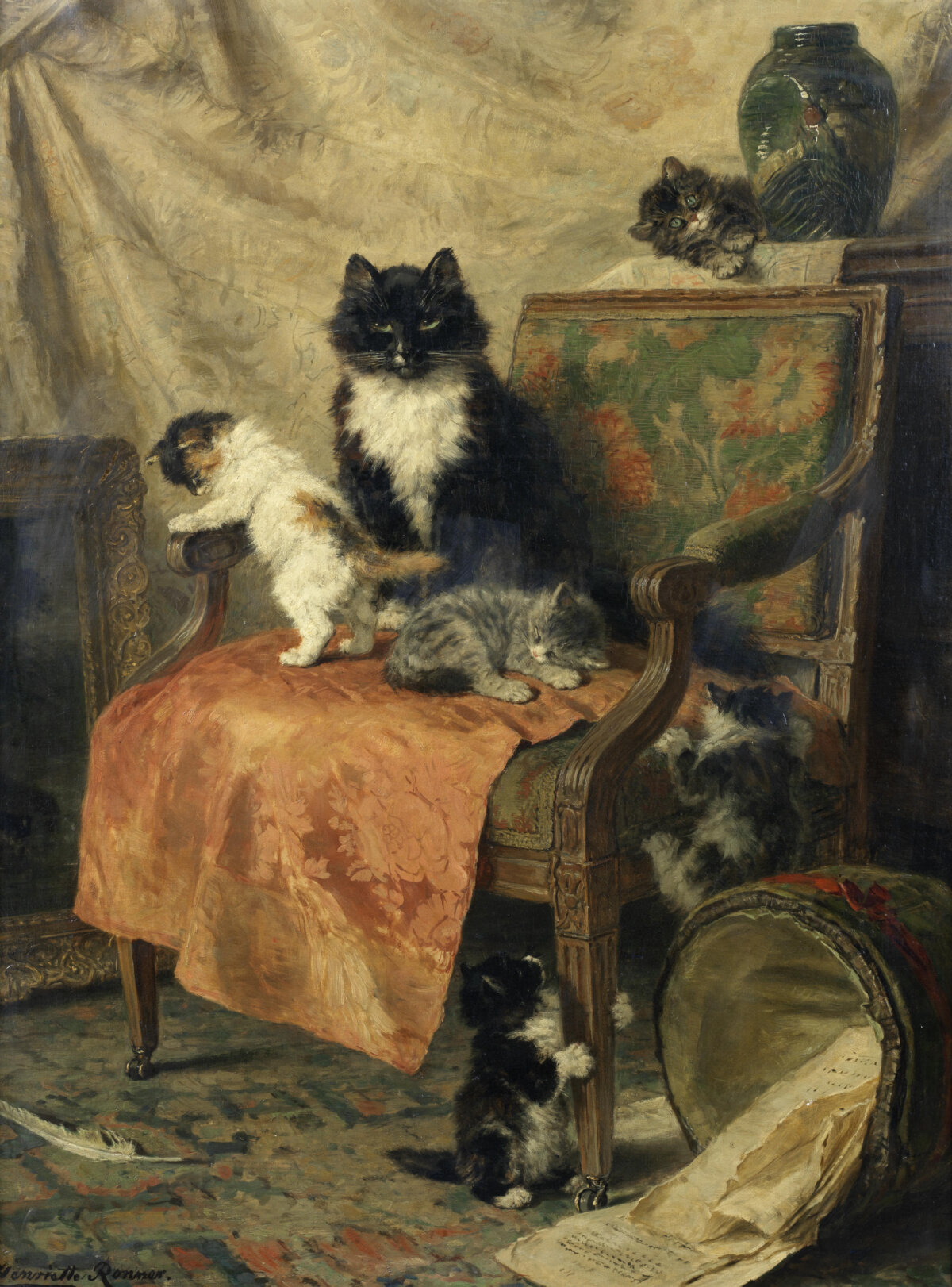
Ronner-Knip’s cats are full of personality. Kittens tumble, climb, and tangle themselves in yarn, while adult cats tend their young or doze in upholstered chairs. In scenes with several animals, each seems to have its own agenda, creating small stories within the larger composition. In “Kittens at Play,” for example, five mischievous kittens knock over a wastebasket, scratch at a chair, and clamber over its upholstery while an adult cat looks on with apparent disapproval.
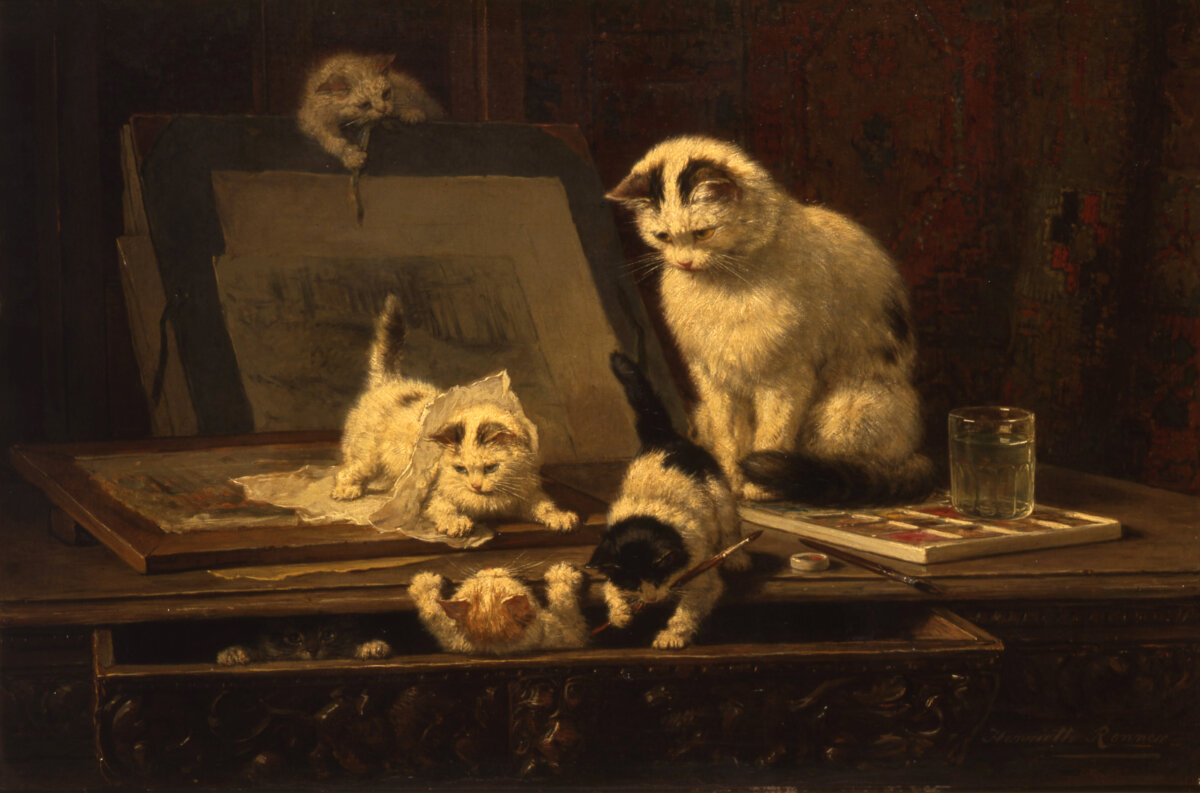
Her attention to detail extends to the interiors, with their richly textured fabrics and elaborate furnishings. In “Immodest,” kittens explore their surroundings with little regard for household rules, their mischievous curiosity on full display. An elaborately carved wooden dresser frames the scene, its polished surfaces and fine detailing contrasting with the soft, delicate fabrics draped nearby. The playful title attributes human immodesty to the kittens, a joke that manners-conscious Victorian viewers would have appreciated.

Despite their natural look, these scenes were carefully planned. Ronner-Knip spent considerable time studying her animal models, which allowed her to paint endearing feline details, from tilted heads to twitching ears. In her later years, she had pet cats, dogs, and even a parrot. She continued to pay attention to their natural movements, sometimes making paper sculptures of animals in specific poses and arranging them alongside furniture or props to plan a painting. This process let her convey believable movement while maintaining control of the overall composition.
The popularity of her paintings reflected a broader shift in how Europeans viewed cats during the 19th century. For centuries, people viewed cats mainly as mousers that protected homes and businesses. But as urbanization, rising middle-class prosperity, and changing attitudes toward domestic life encouraged pet keeping, cats increasingly became beloved household companions. As their domestic presence grew, cats also gained popularity as subjects in art and literature, where they were celebrated for their playful personalities and close association with domestic life.
Recognition and Lasting Influence
By the late 19th century Ronner-Knip’s paintings were exhibited across Europe, and she won numerous awards. She received the Order of Leopold, one of Belgium’s highest honors, in 1887, and the Netherlands’ Order of Orange-Nassau in 1901. She also exhibited at the 1893 World’s Columbian Exposition in Chicago, introducing her work to American audiences. Her children pursued artistic careers as well, and she often exhibited alongside them.
Her paintings stayed popular with collectors, but tastes shifted as modernism rose, and some critics came to see her traditional style as conservative. Even so, her technical precision continued to set her work apart.
Ronner-Knip helped establish cats as worthy subjects of fine art, portraying their individual personalities, habits, and relationships. Her paintings also offer a glimpse of 19th-century middle-class interiors, and her observations of feline behavior capture details that cat owners still recognize today. She died in Brussels in 1909, but her many paintings of cats and other animals continue to charm viewers today.
What arts and culture topics would you like us to cover? Please email ideas or feedback to features@epochtimes.nyc.