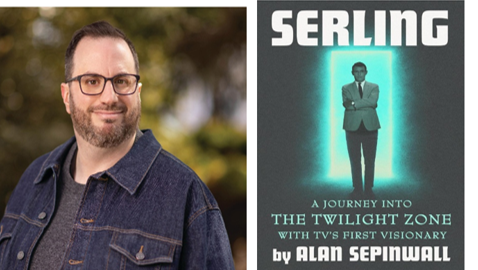
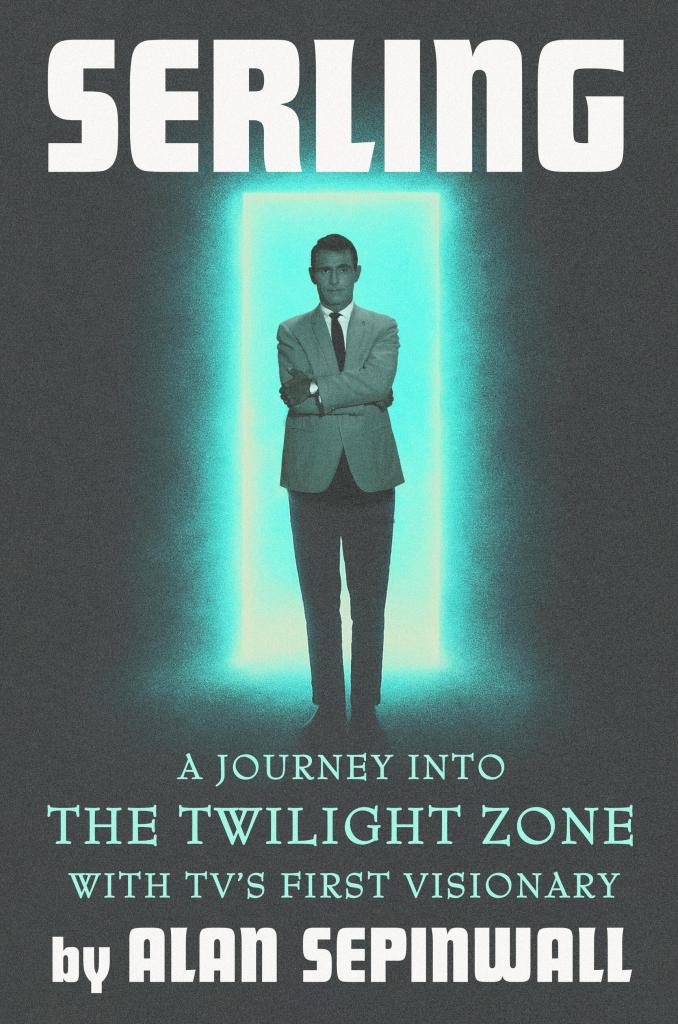
Alan Sepinwall’s new biography on Rod Serling, “Serling: A Journey Into The Twilight Zone With TV’s First Visionary,” presents the celebrated writer as a visionary based on “The Twilight Zone,” his classic television series. The show offered harsh morality tales framed in a horror/science–fiction format.
While that series was an unqualified masterwork, Sepinwall’s book reveals how too much of Serling’s output fell far below the visionary’s level.
Entering Another Dimension
“The Twilight Zone” ran on CBS from 1959 to 1964 and later gained greater popularity in syndicated release. As an anthology series, it offered standalone episodes that tackled some of the harrowing aspects of the human condition.
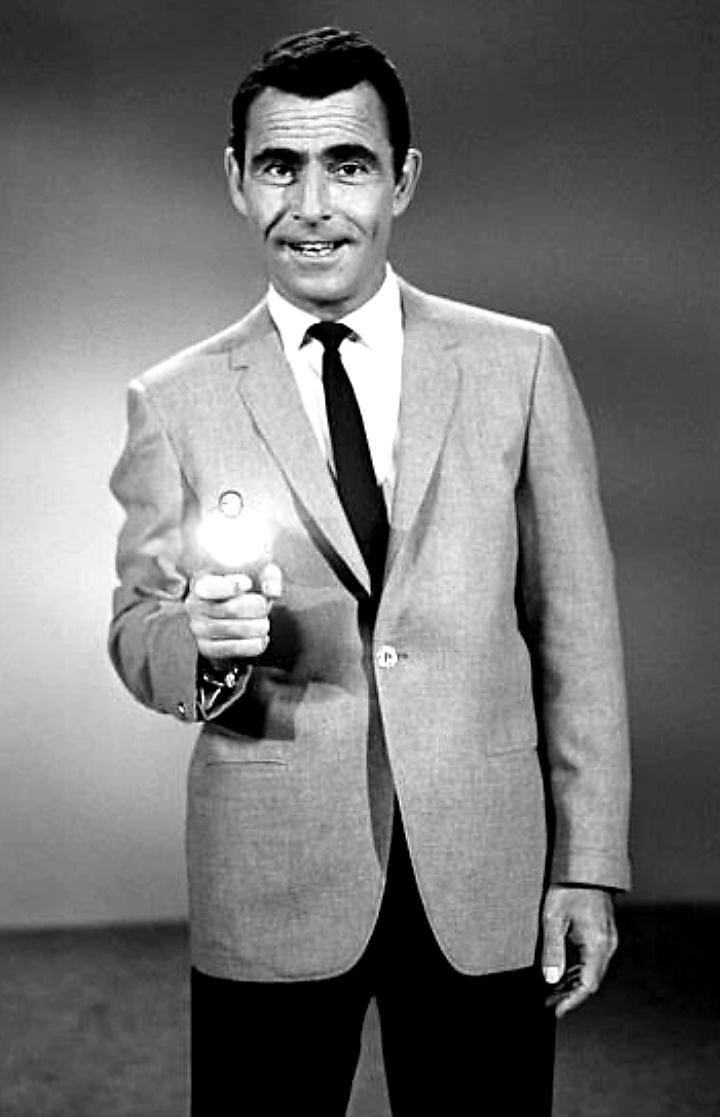
The series also touched on hot-button issues of its time. The episodes often covered the threat of nuclear war, racism, and social conformity. Many of the episodes included a severe twist ending, with cruel punishment often dished out on those undeserving of such treatment.
Besides writing episodes, Serling produced the show and did double–duty as the on-camera host. His stern gaze while delivering eerily cerebral episode introductions in a distinct, measured cadence set the perfect tone for the show’s troubling stories.
Sepinwall harvests input from numerous contemporary filmmakers who offer lavish praise to the influence of “The Twilight Zone” on their work. These filmmakers include Steven Spielberg (who conceived the 1983 film “Twilight Zone: The Movie” based on the series), Guillermo del Toro, J.J. Abrams, and Vince Gilligan.
While this A-list input reaffirms the artistic value of the series, it also veers into overkill when the praise begins to feel endless and excessive.
Outside the Zone
When Sepinwall detours away from “The Twilight Zone,” he discovers that Serling’s career was erratic.
After his World War II service in the Pacific, Serling landed work as a continuity writer at the Cincinnati radio station WLW. Among his duties were writing commercials and churning out scripts for a sitcom called “Leave It to Kathy.” The show’s star, Rosemary Kelly, complained that Serling was “terrible” at writing comedy, although he possessed a gregarious sense of humor.
Serling gained national attention when his script for “Patterns” aired in a 1955 live broadcast on “Kraft Television Theatre.” A study of the machinations behind an executive suite shake-up, “Patterns” created such a sensation that a second live show was staged one month later. This was in the pre-videotape years, when live broadcasts weren’t recorded for reruns.
Serling followed “Patterns” with a flurry of memorable television plays, including “Requiem for a Heavyweight,” “The Rack,” “The Comedian,” and “The Velvet Alley.” He won Emmy Awards and was hailed for his dramatic genius.
That’s not to say he was a perfect writer, however. Sepinwall bluntly states that Serling’s work often became bogged down in heavy-handed verbosity and melodramatics. Even Serling himself admitted that his 1956 “Noon on Doomsday,” a drama inspired by the 1955 murder of black teenager Emmett Till in rural Mississippi, was an “overwritten” work. He said he was “so anxious to point a finger and make a case that too often [his] drama became simply rhetoric.”
Other Lesser Endeavors
Oddly, Serling’s genius was never duplicated beyond television. He lamented that he was unable to get backing for a Broadway show based on his writing, while his occasional forays into movie screenplays were mostly forgettable. (Does anyone remember the 1959 Western “Saddle the Wind” or the 1963 thriller “The Yellow Canary,” starring Pat Boone?)
Serling shared screenwriting credit with Michael Wilson on the 1968 “Planet of the Apes,” but very little of his input was deemed viable. Sepinwall shares a Serling-penned exchange between the story’s stranded astronaut and an ape taxi driver that’s jaw-dropping for its sheer awfulness. (“You look like the wrong end of a banana,” the man tells the ape.) Serling conceived of using the Statue of Liberty to reveal the planet’s identity, but not in the devastating manner of the film’s jolting denouement.
Even worse for him, Serling found little success on television after “The Twilight Zone.” His 1964 television film “Carol for Another Christmas” reworked the Charles Dickens holiday classic into an advocacy for the United Nations, but it generated a negative reaction from many viewers.
Serling’s Western series “The Loner” limped through the 1965–1966 season, while his return to horror/science-fiction with the wildly uneven “Night Gallery” series from 1970–1973 failed to duplicate his “Twilight Zone” triumph.
In the 1970s, Serling was more visible as a talk show guest and as a commercial pitchman for several consumer brands, often spoofing his “Twilight Zone” persona. He briefly hosted the game show “Liar’s Club” and narrated the long-running nature series “The Undersea World of Jacques Cousteau.”
At the time of his death in 1975 at the age of 50, he was still creating scripts but couldn’t find producers interested in his work.
Today, of course, interest in Serling seems stronger than ever. Whether the continuing impact of “The Twilight Zone” can be used to cancel out the less than stellar points of Serling’s career can be debated.
Still, Sepinwall offers an engaging biography of a writer whose classic works continue to intrigue audiences with feats of audacious imagination.
‘Serling: A Journey into The Twilight Zone with TV’s First Visionary’
By Alan Sepinwall
Grand Central Publishing: Oct. 13, 2026
Hardcover, 400 pages
What arts and culture topics would you like us to cover? Please email ideas or feedback to features@epochtimes.nyc.