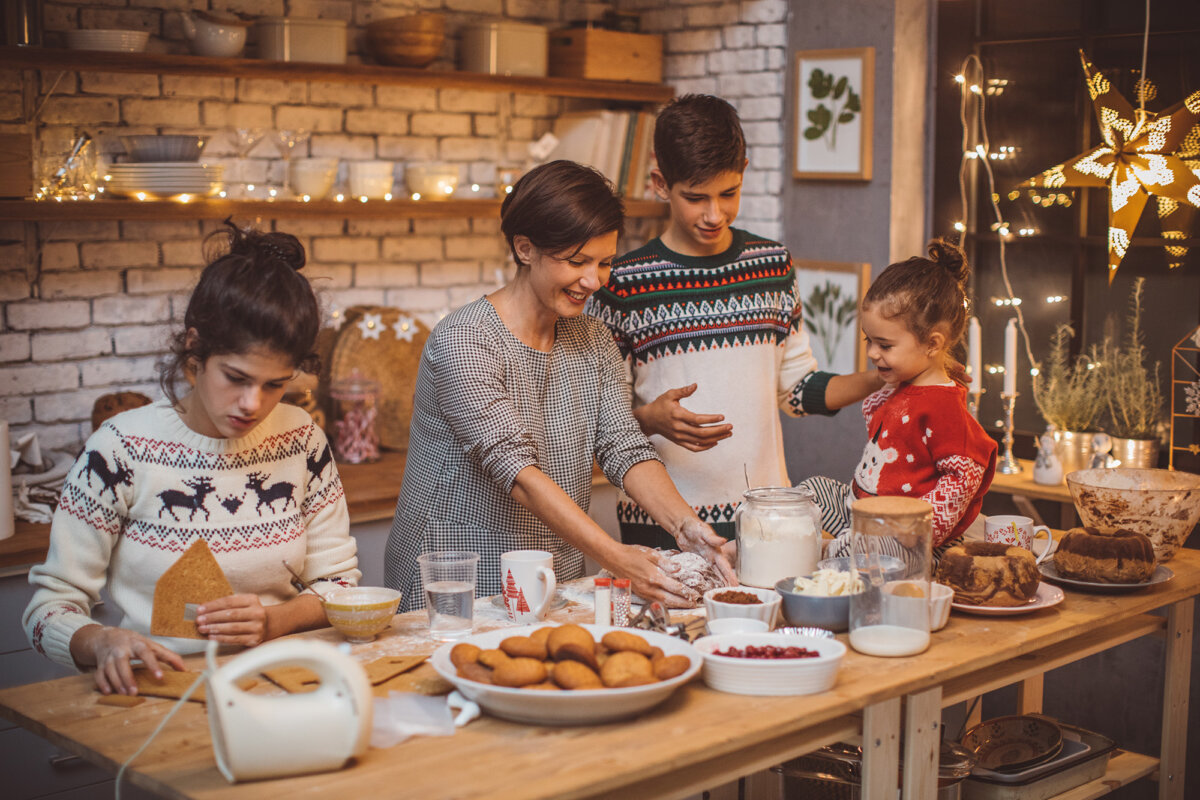
In 1928, British writer Hilaire Belloc wrote a brief, enchanting essay called “A Remaining Christmas,” which dwelt lovingly on the ancient family Christmas traditions carried out in an English country house of the era. Belloc began the essay by giving a sense of the house’s age, since parts of it dated from the 14th century. Some wings of the house were first built in the era of crusades and cathedrals, while others were of more modern composition. Yet they fit together nonetheless.
“The tradition is so strong that you would not tell from the outside, and hardly from the inside, which part is old and which part is new,” Belloc wrote.
“For, indeed, the old part itself grew up gradually, and the eleven gables of the house show up against the sky as though they were of one age, though in truth they are of every age down along all these 500 years and more.”
This description of the house represents the essay’s deeper theme: how family traditions provide important domestic continuity across time and generations. Just as the various rambling additions to the house merge into a cohesive whole, family traditions can link eras of family history and form a bulwark of consistency across decades or even centuries.
What Tradition Is
The family traditions Belloc described transcend time and imbue family life with a rhythm, pattern, and meaning—from the Yule log to the Christmas turkey to a New Year ritual in which all the doors and windows of the house are flung open so “the old year and its burdens can go out and leave everything new for hope.” He commented on these traditions: “Man has a body as well as a soul, and the whole of man, soul and body, is nourished sanely by a multiplicity of observed traditional things.” He also wrote that those without traditions “lack sustenance.” Consequently, “our fathers who founded all those ritual observances were very wise.”
Minds and hearts—like bodies—need to be fed. Traditions provide spiritual sustenance, satiating our hunger for meaning. Traditions, which are a kind of ritual, involve actions gilded with symbolic meaning, each repetition of which invokes the memory of the prior time it was done. When a family engages in them, they experience the joy of meaning shaping their lives, strengthening their bonds, and deepening their identities.
Traditions are more than quaint curiosities or familial idiosyncrasies. These repeated rituals maintain identity, organize time, and transmit values. They play a key role in the development of people’s relationships to each other, the environment, and history. Philosopher John Cuddeback noted:
“Ritual observances are literally in-carnations of deeply held convictions, the expression of which can deepen those convictions, bringing them to life. Such expression connects us: to those around us, to our physical place, to our own past, and to loved ones who are gone. Such connections are life-giving, not to be underestimated.”
Impact on Families
It’s not just traditional wisdom that emphasizes the importance of holding on to family customs. The scientific literature says the same thing. For instance, a 2015 study involving approximately 250 teenagers found that having family rituals and traditions played an important role in increasing their social connection and reducing anxiety and depression.
Healthy, strong families maintain traditions received and—if need be—create new ones to be bestowed on future generations as a legacy and heirloom. The benefits for children are incalculable. As Justin Coulson wrote for The Institute for Family Studies, “Family traditions help life make sense to our children. Like routines, they provide predictability and a sense of security and safety. Family traditions help children feel as though they fit in somewhere … countering alienation, and offering steadiness and certainty.”
These family traditions don’t have to be elaborate. Something as simple as a regular Sunday roast or family game night lends ordinary family life greater vitality. These are the practices children will remember decades later. These are the pillars of stability and identity and togetherness that remain with children like a sweet smell long after childhood itself has given way to adulthood.
Reaching for Immortality
Belloc believed that traditions, particularly those tied to religious seasons, could help families make sense of the passage of time and even death. He wrote, “Moreover, there is this great quality in the unchanging practice of Holy Seasons, that it makes explicable, tolerable, and normal … the mortality of immortal men.”
He went on to explain that the beautiful and ancient Christmas traditions practiced in the English country house were a counterweight to the perpetual change of life. He wrote:
“Not only death … but that accompaniment of mortality which is a perpetual series of lesser deaths and is called change, are challenged, chained, and put in their place by unaltered and successive acts of seasonable regard for loss and dereliction and mutability.”
The home where traditions are honored takes on a faint glimmer of eternity. “This house … has suffered all the things that every age has suffered. … But its Christmas binds it to its own past and promises its future; making the house an undying thing.”
The beautiful thing about traditions—especially those that are held sacred and perpetuated for many generations—is that they take on a life of their own. They are almost immortal. Families that embrace such traditions join a story even bigger than their own.