Commentary
The story of the Tower of Babel appears in Genesis 11:1–9. After the Flood, “the whole earth had one language and the same words.” People migrate from the East, settle on the plain of Shinar (Mesopotamia), and say: “Come, let us build ourselves a city and a tower with its top in the heavens, and let us make a name for ourselves, lest we be dispersed over the face of the whole earth.”
In the text, God observes that they are one people with one language and adds: “This is only the beginning of what they will do. And nothing that they propose to do will now be impossible for them.” Therefore, he confuses their speech so that they cannot understand one another and scatters them “over the face of all the earth.” The place is then named Babel.
I was recently in Vienna and went to the Kunsthistorisches Museum. While looking at Pieter Bruegel the Elder’s famous painting “The Tower of Babel” (1563), it struck me: Is our artificial intelligence race rhyming with antiquity’s building of that infamous tower?
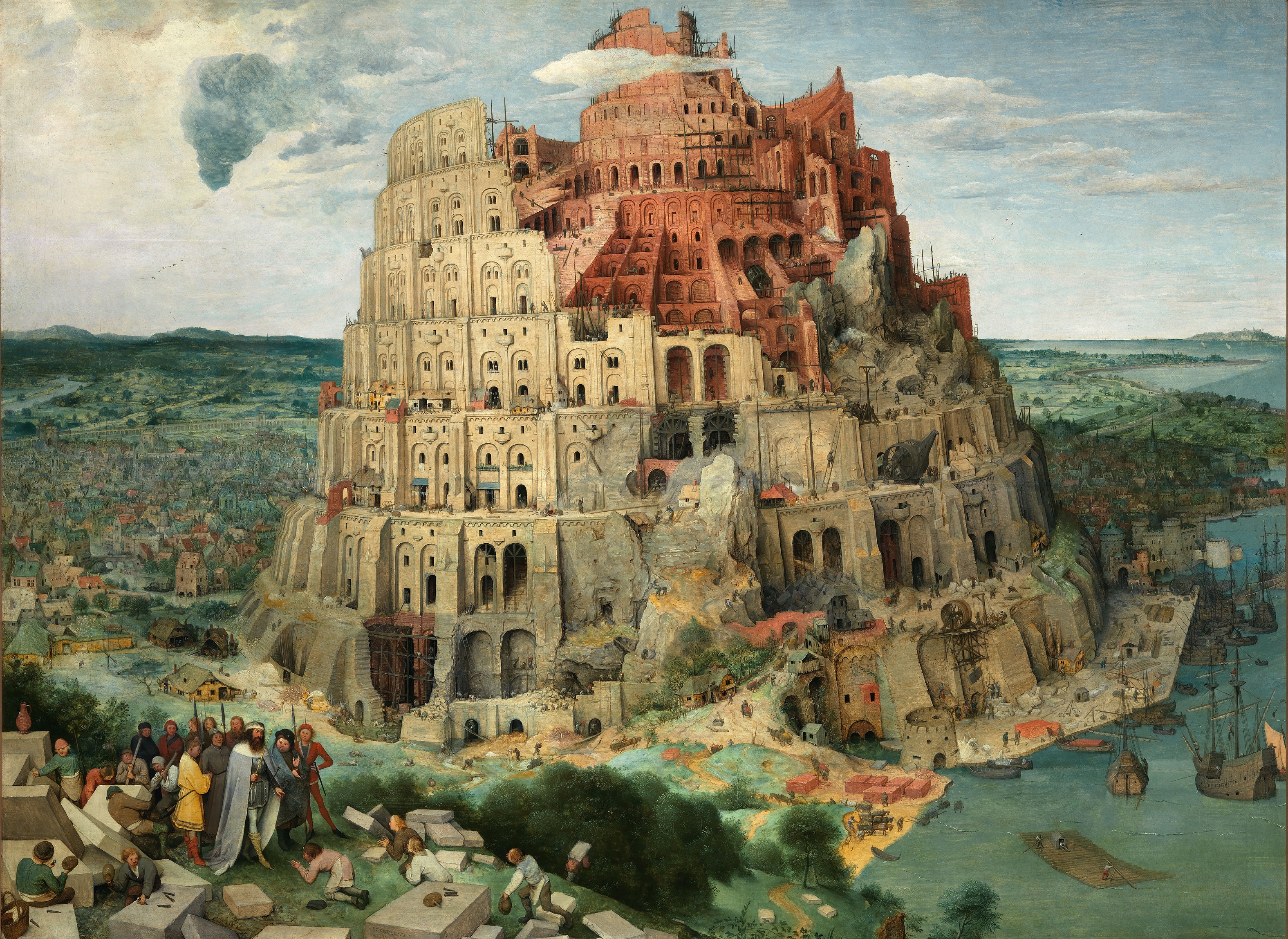 “The Tower of Babel (Vienna Version),” 1563, by Pieter Bruegel the Elder. (Luciano Romano/Kunsthistorisches Museum, Vienna)
The Moral
Common readings of the moral implications of the story refer to several issues.
Pride and Self-Exaltation: The builders want to “make a name for themselves” rather than honor God’s name. The tower reaching heaven is often taken as an attempt to storm or equal the divine realm.
Refusal to Fill the Earth: God had told Noah’s descendants to “be fruitful and multiply and fill the earth.” Settling in one place and building a single monumental city is read as defiance of that command.
Limits on Concentrated Human Power: God’s own words, as quoted in the text, are striking: “nothing they propose … impossible.” The scattering is, therefore, not only a punishment but a check—preventing a single, unaccountable human project from overstepping human boundaries.
The story diagnoses a recurring pattern: technological and organizational skills used for self-glorification rather than for the purposes God had given.
The Checklist
We can now assemble a checklist to see whether any phenomena in our time exhibit most of it: one speech plus unscattered plus reaching heaven and “nothing will be impossible” plus name-making plus fear of being left off. One caveat: Most large human endeavors will encounter one or two of these items. The essence of the test is to get as much of the bundle as possible.
Let us now examine the frontier-AI stack as a civilizational project, and see what we come up with.
One Speech: High-value coordination in 2026 increasingly runs through a small number of model families, English-heavy training distributions, and shared benchmarks (Abstraction and Reasoning Corpus for Artificial General Intelligence, FrontierMath, “computer use”). Instant translation is spreading—Google, Meta, carriers embedding speech-to-speech in the network—but that often increases dependence on one interlingua sitting under the many surface languages. The many tongues still exist; the work of planning, coding, science, and agent-to-agent action is being pulled onto a few protocols. That is closer to “one language and the same words” than skyscrapers are.
Refusal to Scatter: Whether agents, credentials, and actions live under one recognizable stack (global registry, national root, or a handful of labs’ application programming interfaces) or many incompatible ones. China published a national agent-interconnection standard; the International Telecommunication Union and industry groups are working to make human and agent identities mutually recognizable across borders; enterprises are told to pick a root or be ungovernable. “Fragmentation” is named as the failure mode. That is the Babel fear in modern dress: Stay on one plane, or the project dies.
Heaven-Reaching: Limits once taken as given (death, scarcity of intelligence, the need for a judge outside the system) are now treated as engineering problems.
“Nothing They Propose Will Now Be Impossible”: This is no longer only the critics’ language. Lab and executives’ speeches in 2026 treat artificial general intelligence/artificial superintelligence as akin to the discovery of fire or electricity, a “new age,” the saturation of general tests, with internal systems that some executives are already willing to call artificial general intelligence. Definitions are still fuzzy and contested, but the self-description is telling.
Make a Name Plus Fear of Dispersal: Every company and country races to win glory and power, and part of the argument is that if we do not stay on this trajectory, then we will be left behind by another lab, another country, another stack. Ambition and the fear of being dispersed are paired.
It seems like we’re onto something.
Conclusion
If there is anything material in the above analysis and comparison, it is that they bring to bear the implications of the second half of the biblical story—of God stopping the building, scattering the people, and confusing their languages. Whether treated as actual divine intervention or as natural law, perhaps like entropy, the story seems to suggest that such a vainglorious enterprise either is doomed to eventual failure or is less than it is made out to be.
There is an old Chinese saying: When a thing reaches its extreme, it reverses. As we live in interesting times, we shall undoubtedly see.
Views expressed in this article are the opinions of the author and do not necessarily reflect the views of The Epoch Times.
 Friends Read Free
Copy
Facebook
Tweet