
Commentary
It’s said that Sigmund Freud discovered the psyche by isolating a feature of human life that eludes detection and causation traceable to either moral volition or biological malady. Such claims are inevitably an exaggeration, but he certainly deserves credit for having popularized the idea. It was an important discovery, and it caused both spiritual counselors and physicians to become more aware of the inner life of the human mind and heart.
It is unclear to me whether he knew that he was merely rediscovering a way of thinking that traces back more than two millennia. I’m speaking of what the medieval scientists and theologians called the four temperaments. Call me old-fashioned if you want, but they still strike me as intuitively meaningful, useful, and even plausible as descriptions of the types of personalities that exist.
More than that, there is poetry in this model of thinking. The temperaments overlay with the seasons and reflect their conception of the elements. It goes awry with the biological theory of humors—which sadly became the basis of the bloodletting therapy that lasted all the way to the 19th century—but we can dispense with that and still be in awe of the wisdom.
The four temperaments are one of the oldest ideas in Western thought. Modern psychology ended up reconstructing something very close to their structure. (And by the way, modern psychiatry invented a debunked theory about serotonin levels that mirrors the same errors as humoral theory.)
The scheme comes out of Greek natural philosophy. Empedocles proposed four elements: earth, air, fire, and water. The Hippocratic treatise “On the Nature of Man” (c. 400 B.C.) mapped these onto four bodily fluids, or humors. By the second century, it had become a full medical system. It was called temperamentum in Latin, meaning “proper mixing.”
The medieval period is when the types acquired full personalities. Composer and poet Hildegard of Bingen’s “Causae et Curae” (12th century) contains vivid character sketches of the types, down to how each behaves in love. By the late Middle Ages, the temperaments were common knowledge. Chaucer could signal a character simply by calling him “colerik” or “sangwyn” and expect his audience to understand.
But really, these four categories have been commented upon by nearly every important philosopher, poet, and spiritual writer for 1,000 years. That alone should tell you something. They must describe something genuinely important and enduring. I’m inclined to tack toward them rather than the latest personality test, much less a check-box survey from a psychiatrist’s office.
It goes as follows. And notice how it follows the seasons of the year and the traditional elements.
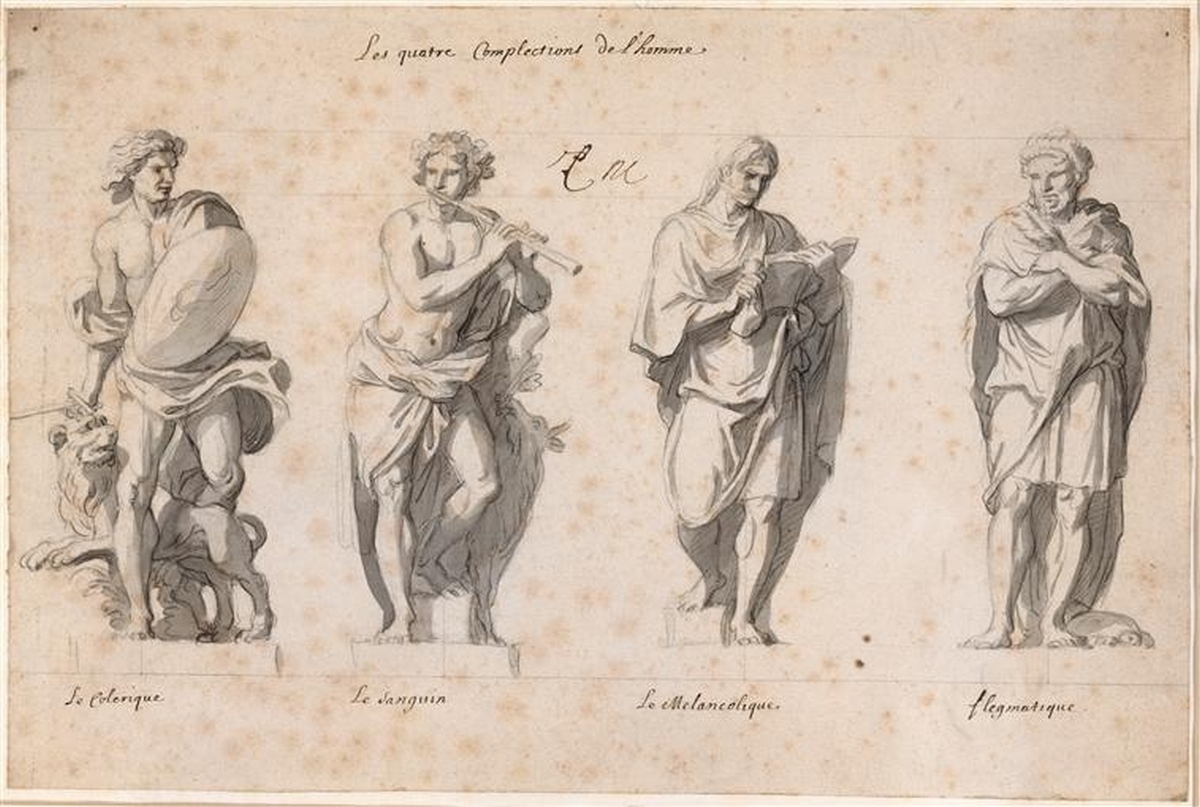
1. Sanguine. The “humor” here is said to be blood with a quality that is hot and moist. The element is air and the season is spring. The age to which it most pertains is childhood and youth. The critical features here are the personality traits: cheerful, sociable, amorous, and a bit scattered. If you are reading carefully, I’m guessing that someone you know has already come to mind. Optimistic, maybe a bit naive, ready for a gathering, always falling in love with something (music, a book, a task, a person), and not entirely well organized.
2. Choleric. The humor is said to be yellow bile with the quality that is hot and dry. The element in common is fire. The season is summer with the blasting sun. The life stage is young adulthood. The character traits you can already guess. This choleric person is ambitious, bold, irritable, judging, and commanding. You know this person, too.
3. Melancholic. The humor here is black bile that is cold and dry. The element is earth and the season is autumn. The associated age is maturity. The personality traits are now obvious. This person is thoughtful, solitary, and exacting. Seems like the person I want to be but probably am not, certainly not on weekends. But we all know the person characterized by melancholia.
4. Phlegmatic. The humor here is phlegm, as one would expect, which is cold and moist, while the element is water. The season is winter and the life stage is old age. The personality type is calm, steady, slow, and placid. To be sure, some people are this when they are young, but it might more typically describe the elderly. This person is not unproductive but just very deliberate and thoughtful.
Each type has a characteristic virtue and a characteristic vice. The sanguine person is generous but shallow and often silly. The choleric is a natural leader but given to temper, rash decision-making, anger, and even wrath. The melancholic is deep but prone to despair, which shades into sin—yes, that’s every black-pilled person you know. The phlegmatic is peaceful, warm, and deliberate, but inclined toward sloth.
All of these temperaments come with suggestions for managing them and counterbalancing them. A choleric man should avoid hot spices and anger, and work on training his temper. A melancholic should seek company, music, and sunlight. A phlegmatic needs some adventure and action, trips to the park, or concerts.
This was personalized categorization plus lifestyle medicine.
These categories have advantages over stricter modern systems of personality classification. You can be a combination of both depending on life circumstances. A Sanguine can turn Melancholic upon personal betrayal or deep disappointment with love lost. A Phlegmatic can turn Choleric in the event of an emergency (a fire or a danger) when someone needs to step up.
Plus, and obviously, we all have elements of all these things. But I’m guessing that as you read these descriptions, you already know which one you are. And think about others you know.
The biomedical aspects of this are likely wrong. That said, there is more truth even in the way the seasons mirror human personality than we know.
It’s the types that intrigue me. They seem right, righter than most modern post-Freudian systems of classification that I’ve seen. I say we return to them and stick with them. Our personalities all default to something, but that something is correctable, inclined toward mutations, and adaptable by circumstances of time and place.
You can set aside the biological claims and still rally around the intuition here. Philosophers and poets for centuries did.
Here we are with our psychological inventories and surveys, pushing them on kids and adults, and thinking that check boxes can reveal some drug that we need to fix our maladies. It’s all absurd. Tendencies and temperaments are not maladies. They reflect individual differences and nicely mirror the seasons of the year and the seasons of life.
The medievals wrote wisely, seeking to elucidate realities within ourselves that we observe in others. This strikes me as a more humane and discerning way of approaching psychology than anything cataloged in the Diagnostic and Statistical Manual of Mental Disorders. Neither system qualifies as hard empirical science, but only one is consistent with the gradients of complexity we observe in real human life.
Views expressed in this article are the opinions of the author and do not necessarily reflect the views of The Epoch Times.
 Friends Read Free
Copy
Facebook
Tweet