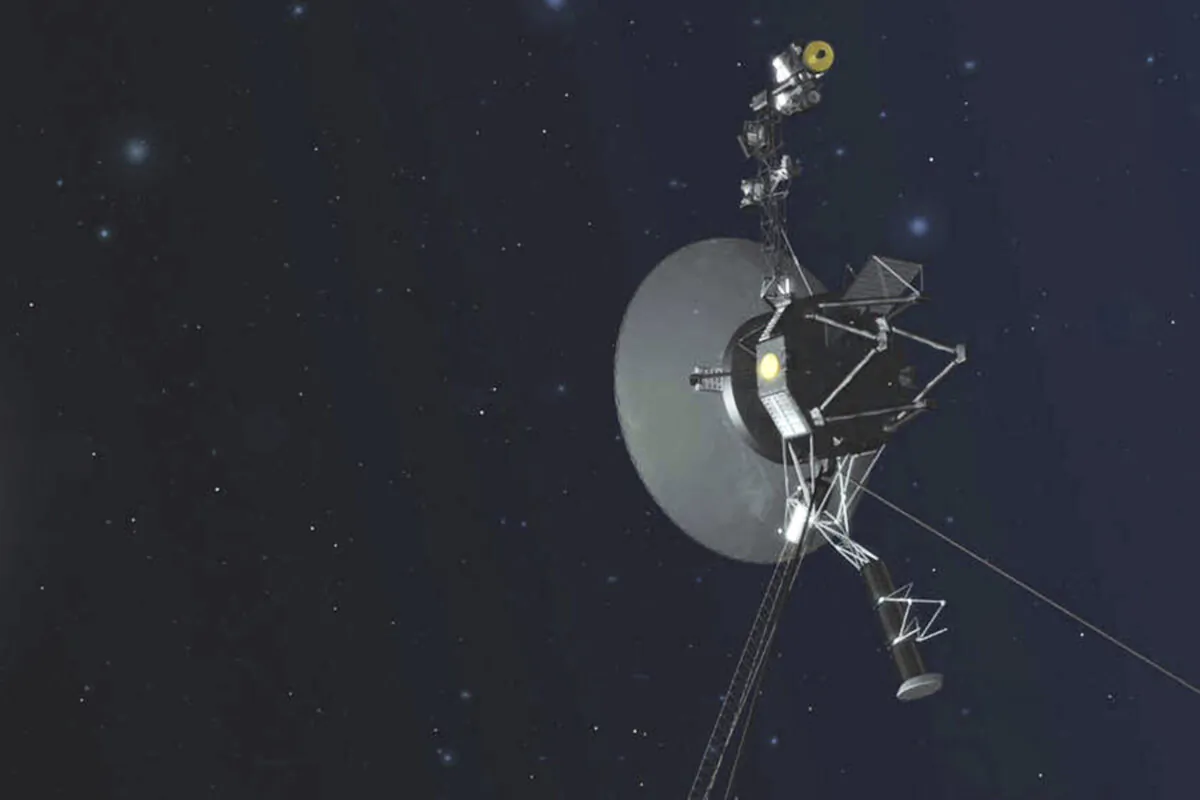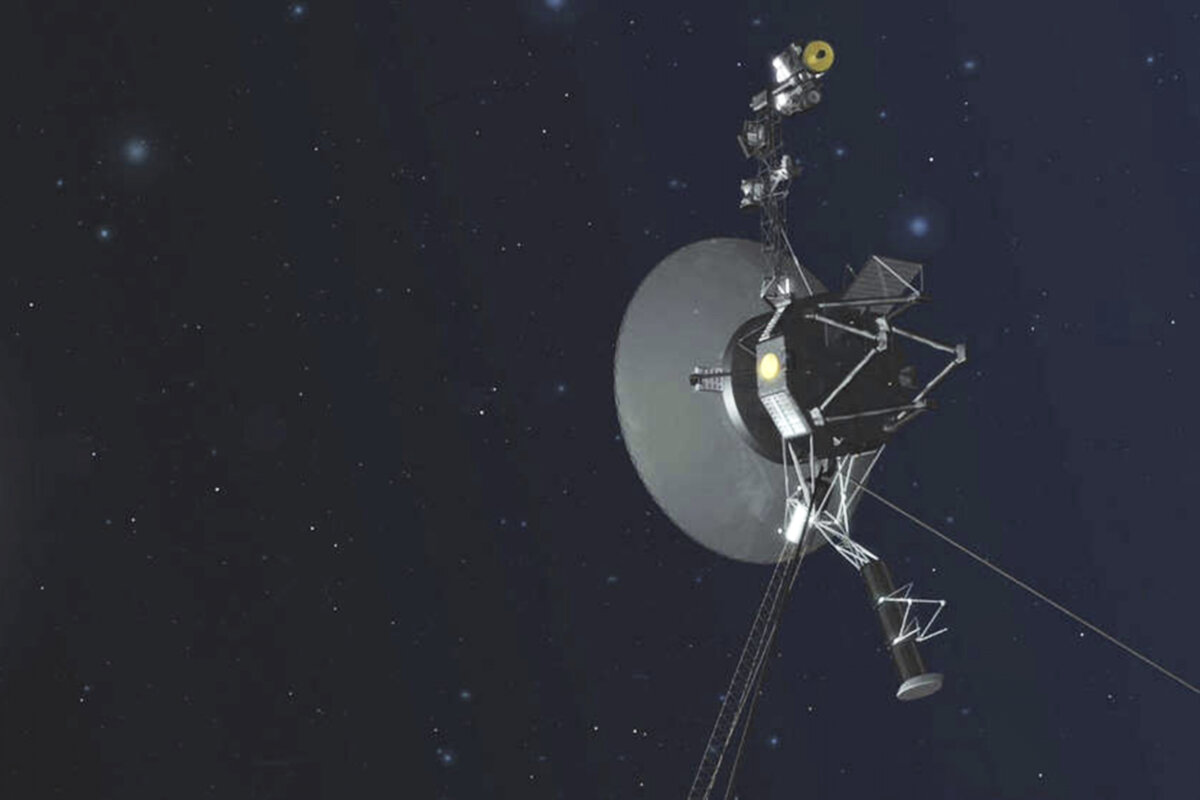

For the first time in human history, an interstellar spacecraft has journeyed a full light-day away from Earth.
Voyager 1 left Earth from Florida’s Space Coast on September 5, 1977, on a mission to Jupiter, Saturn, and, ultimately, interstellar space, reaching its current speed of 38,000 mph.
At 5:16:07 a.m. ET on Nov. 18, 2026, it crossed a threshold of 16 billion miles away from home—a distance that takes light a full 24 hours to travel.
“Voyager 1 is exploration at its best,” Dr. Eric Christian of NASA’s Goddard Space Flight Center told The Epoch Times. “You build something and you send it out into the unknown, and, you know, I think the public knows that Voyager is one of the most popular missions, uncrewed missions that NASA has ever done, and it’s not just the longevity; it’s the, it’s the science return, and this is exploration.”
Christian joined the Voyager team in 1986 as a graduate student and has worked on the mission in various roles over the last 40 years, including serving as the program scientist at NASA headquarters for seven years.
He said he studies the “non-chunky” parts of space. He celebrated the fact that there were two probes out there studying more than just the planets. The Voyager probes were studying the space between planets and solar systems and the heliosphere—a comet-shaped, bubble-like region created by the Sun that completely envelops and marks the start of interstellar space, and that Christian described as a sun’s atmosphere.
Voyager’s Mission
The Voyager Interstellar Mission officially began on New Year’s Day 1990.
On Feb. 17, 1998, it overtook the Pioneer 10 probe, becoming the most distant human-made object. Pioneer 10 has depleted its power and is no longer functioning.
On Aug. 25, 2012, Voyager 1 became the first spacecraft to ever reach interstellar space, breaking free of the heliosphere.
Voyager 2 crossed over the cosmic barrier on Nov. 5, 2018.
But before that, both Voyager 1 and its twin sister Voyager 2 gave the world a glimpse of Jupiter, Saturn, Uranus, and Neptune with a suite of 11 different scientific instruments, according to NASA, that helped rewrite the astronomy textbooks.
As Voyager 1 studied Jupiter between Jan. 6, 1979, and April 13, 1979, and Saturn between Aug. 22, 1980, and Dec. 14, 1980, its instruments collected data on the planets’ and their moons’ atmospheres, magnetic fields, radio wave emissions, surface compositions, and provided insights into how they interacted with the solar winds. It then used Saturn’s massive gravity field to sling itself on a course for interstellar space.
Voyager 2, meanwhile, stayed behind, becoming the first and only spacecraft to visit all four gas giants. After performing its own flyby of Jupiter on July 9, 1979, and Saturn on Aug 25, 1981, Voyager 2 became the first probe to fly by Uranus on Jan 24, 1986, and then Neptune on Aug 25, 1989, before also setting off for interstellar space. No probe since has visited Uranus or Neptune.
A Cosmic Messenger
At the same time, Voyager 1 is arguably remembered best as a historic photographer and the first cosmic representative of humanity. Its portfolio includes the first-ever single-frame image of the Earth-moon system, tens of thousands of images of Jupiter, Saturn, and their moons—including confirmation of Jupiter’s rings—and the distant image of Earth known as “The Pale Blue Dot.”
By 1990, the cameras were permanently turned off to optimize the power it had left. Prioritized systems included those measuring cosmic rays, low-energy charged particles, and a magnetrometer.
Onboard sits a golden disc that gives anyone who may find the probe instructions on how to find Earth and the solar system, and how to play an LP record. That record features various sounds of Earth such as animal noises, ocean waves, musical selections, 115 encoded images, and spoken greetings in 55 languages. The recorded English greeting says simply, “Hello from the children of Planet Earth.”
Upon exiting the solar system, Voyager 1 is unlikely to directly interact with another planetary body for tens of thousands of years. This proverbial message in a bottle would only be received by another spacefaring civilization.
That record album has been exposed to deep space for nearly 50 years. But Christian told The Epoch Times that if someone found that record today, and they followed the directions, it should still be playable.
“There are dust impacts that you have to worry about,” he said. “The cosmic ray impacts are probably, you know, pretty minor. But you know, it’s a question of how far in the future dust impacts make it unreadable.”
“But I have no doubt that at this stage you could still play back the golden record,” he said.
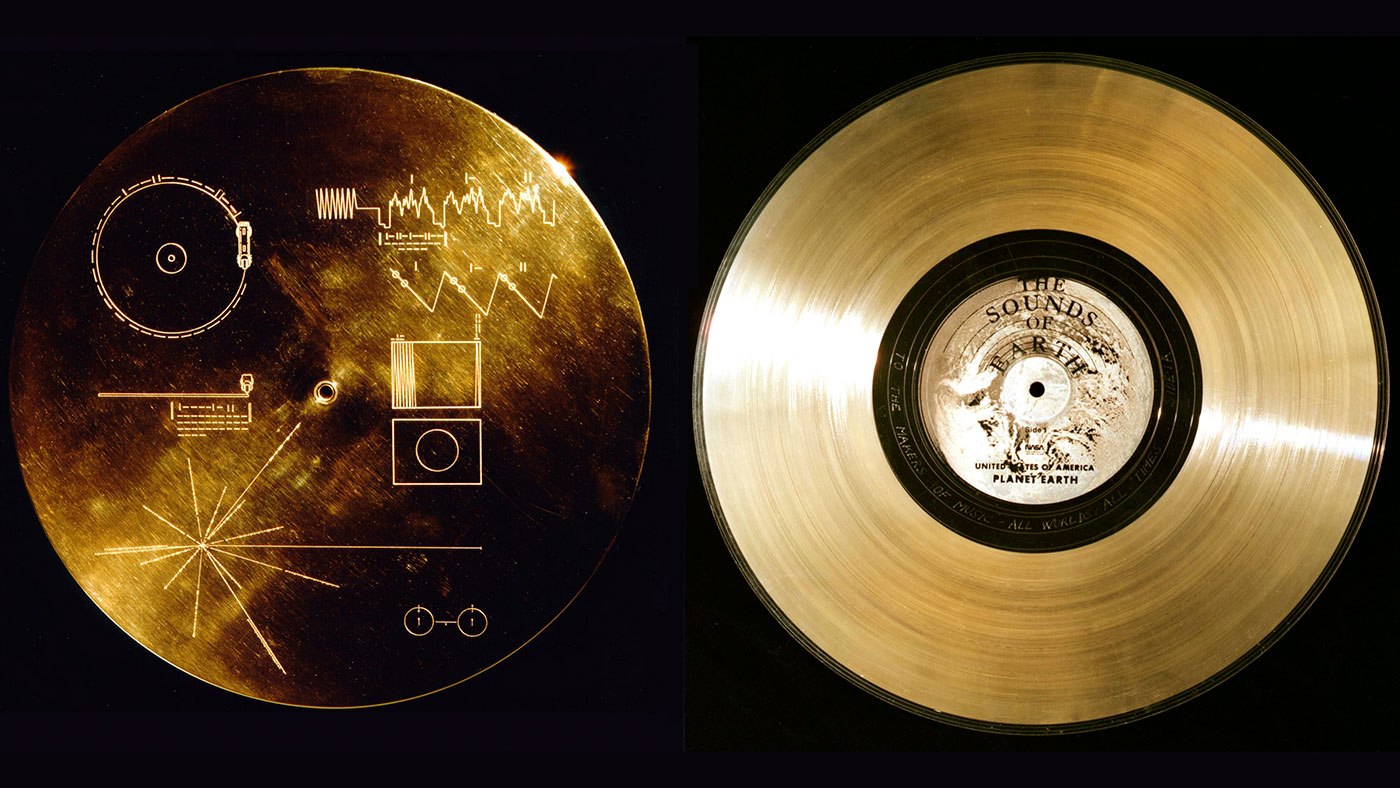 The ‘Golden Records’ placed in Voyager 1 (NASA)
Keeping the Mission Going
Voyager 1 is nuclear-powered. Onboard is a radioisotope thermoelectric generator that stores decaying plutonium. Heat given off from that decay is used to generate power. As the plutonium depletes, each probe loses about 4 watts of power a year.
In order to keep the nearly 50-year mission going as long as it has, systems have had to be shut down. Out of Voyager’s 11 scientific instruments, only two are still operating: one measuring magnetic fields, and the other studying plasma waves.
On top of the dwindling power supply, the probe is now experiencing temperatures far colder than it was ever tested at on Earth.
Voyager 1 was previously expected to run out of power in 2025, but teams have put together a gradual power-down plan that has the potential to get a few more years out of it.
The next man-made probe to leave the heliosphere will be NASA’s New Horizons spacecraft. It was the first spacecraft to visit Pluto, and is expected to reach the edge of the solar system sometime in the mid 2030s or early 2040s. However, Christian was doubtful that it would still be transmitting by that point.
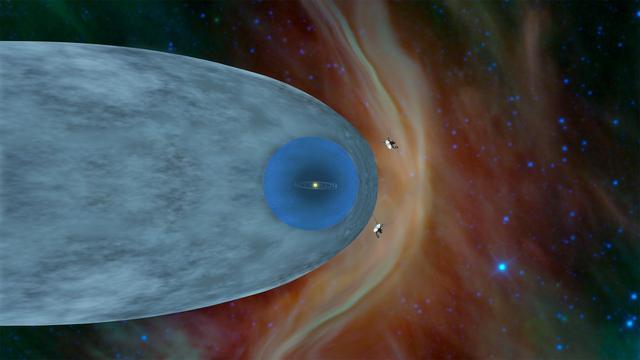 NASA illustration shows Voyager 1 (top) and Voyager 2 (bottom) beyond the edge of the heliosphere shown in blue as of December 10, 2018. (NASA)
“But they have a couple of instruments … that measure the solar wind, slightly higher energy particles, and those would be really interesting to get a third track out of the solar system,” he added.
Christian also said that Voyager 1 is nearly as far from Voyager 2 as it is from Earth, illustrating how vast the cosmos is and how limited humanity’s perception of the realm beyond the solar system remains. There were still too many unknowns to discuss sending more specifically focused missions. Any additional mission would likely yield new discoveries.
“When I talk to students, I liken it to trying to determine the weather on the Pacific Ocean only having two weather stations,” he said. “Space is really really big, and we’ve just got two tiny little probes, billions of miles apart and billions of miles from Earth, and we’re trying to figure out what’s happening at not only right at them but what’s happening in between as well, and we don’t understand it all yet.”
 Friends Read Free
Copy
Facebook
Tweet