
Most people who know their history can identify Charles Lindbergh as the first pilot to make a successful solo flight across the Atlantic Ocean. But arguably, few people can name the first pilot to make a successful flight across the Pacific Ocean.
That honor belongs to Lester Maitland with a historic 1927 flight from California to Hawaii that took place five weeks after Lindbergh’s journey from New York to France. Liam Callanan’s “Stone Age Astronaut” highlights this long-forgotten aviation pioneer and the many strange twists that shaped his life.
Joining the Army
Maitland was born in Milwaukee on Feb. 8, 1899. During his youth, he was captivated by local aerial exhibitions featuring daredevil stunt pilots in biplanes.
The teenage Maitland secured an appointment to West Point, but instead rushed to enlist in the Army when the nation entered World War I in 1917. He was eager to go into battle and felt he’d miss the war studying at West Point.
Ironically, he remained stateside throughout the war and was assigned to the Army’s Aviation Section (now called Aviation Branch). He trained on unreliable aircraft, with 10 of his first 14 flights terminating in forced landings from engine failure.
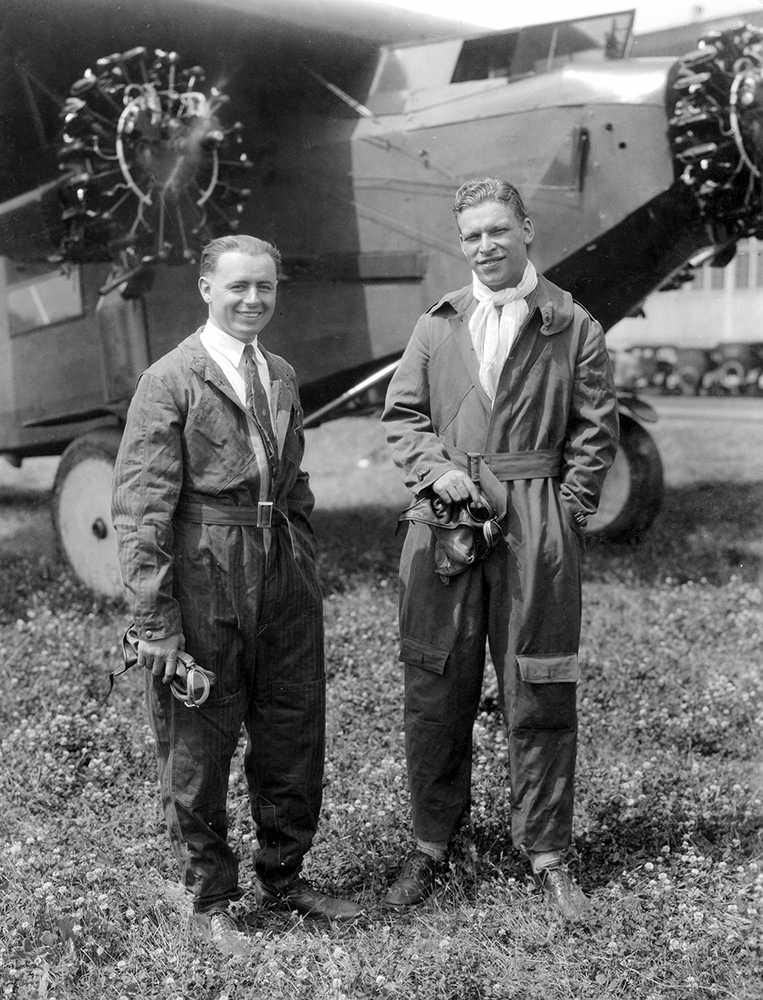
Maitland made the Army his career, focusing on aviation. In 1923, he broke a speed record at 239.95 miles per hour in an open-cockpit wooden biplane.
A Daring Goal
Callanan effectively details the post-World War I military’s failure to embrace aerial defenses, with the Army and Navy pursuing separate, lethargic strategies. The author recalls efforts by Billy Mitchell, an Army officer and pilot, to alert the public on the value of air power; Maitland was briefly his aide.
Mitchell overplayed his hand by publicly criticizing his superiors and was court martialed in 1925. Maitland was more diplomatic with his military superiors, patiently lobbying to make a flight from California to Hawaii, where the nation was expanding its military presence.
By 1927, Maitland (who held the rank of first lieutenant) received the go-ahead to pilot an Atlantic-Fokker C-2 tri-motor transport aircraft on this historic flight. Another first lieutenant, Albert Hegenberger, was assigned as the navigator for the aircraft, dubbed the Bird of Paradise.
On June 28, 1927, the duo took off from Oakland Municipal Airport. Minutes after their departure, a rival flight by civilian aviators followed them skyward with the same goal, only to return 10 minutes later with a collapsed navigator’s windshield.
Bound for Glory
The most thrilling aspect of Callanan’s book involves the 2,400-mile journey, during which multiple problems erupted. Less than two hours into the flight, the radio navigation system failed. That was shortly followed by a breakdown of the aircraft’s induction compass.
The aviators then discovered that the Thermoses of hot soup and coffee that were supposed to be on board for them had not been loaded. If that wasn’t bad enough, one of the engines briefly conked out.
Hegenberger was forced to rely on steamship tables for guidance, hoping to find vessels crossing the Pacific to Hawaii. The Bird of Paradise made it to Hawaii, but the flight arrived ahead of schedule in the early morning darkness when no one was expecting them. After delaying its descent until sunlight illuminated Oahu’s Wheeler Field, the Bird of Paradise touched down after 25 hours and 50 minutes in the air.
Maitland and Hegenberger returned home to a hero’s welcome, meeting President Calvin Coolidge and receiving medals and awards. Maitland enjoyed a brief flurry of attention with a book deal, an aviation-based comic strip he co-authored, and talk of being drafted for a congressional race. Yet his fame and good fortune proved to be short-lived.

A Difficult Life
Callanan sadly details how Maitland’s life crumbled in 1930 with a divorce from his wife of nearly eight years, an automobile accident that resulted in a pierced lung and broken ribs, and an arrest and subsequent military hearing on a public drunkenness charge.
Maitland withdrew from public view and remained with the Army into World War II, rising to the rank of colonel. He was part of the U.S. military command in the Philippines, forced to evacuate following the Japanese invasion in December 1941; he later flew dangerous missions across France. He was forced into retirement in early 1944 when his excessive drinking became too disruptive to ignore.
In his post-military years, Maitland held state-level aeronautics and civil defense positions in Wisconsin and Michigan. After witnessing atomic tests in Nevada in 1952 and 1955, he shifted careers and became an Episcopal priest in 1957.
“I had done a lot of bombing, and the time had come to do something productive rather than destructive,” he said, serving as a priest until 1983. He died on March 27, 1990.
Callanan’s book is wonderfully researched and written in a crisp manner that effectively recalls a bygone era. Maitland emerges as a flawed but decent figure whose obscurity is wholly undeserved.
If there is one problem here, it is the book’s title. “Stone Age Astronaut” sounds more like a Fred Flintstone caper than a serious study of a historic aviator. Hopefully, this weird title will not impede to keep readers away from Callanan’s compelling accomplishment.
‘Stone Age Astronaut: The Astonishing Adventures of America’s Forgotten Flier’
By Liam Callanan
Wisconsin Historical Society Press: Sept. 1, 2026
Paperback, 208 pages
What arts and culture topics would you like us to cover? Please email ideas or feedback to features@epochtimes.nyc.