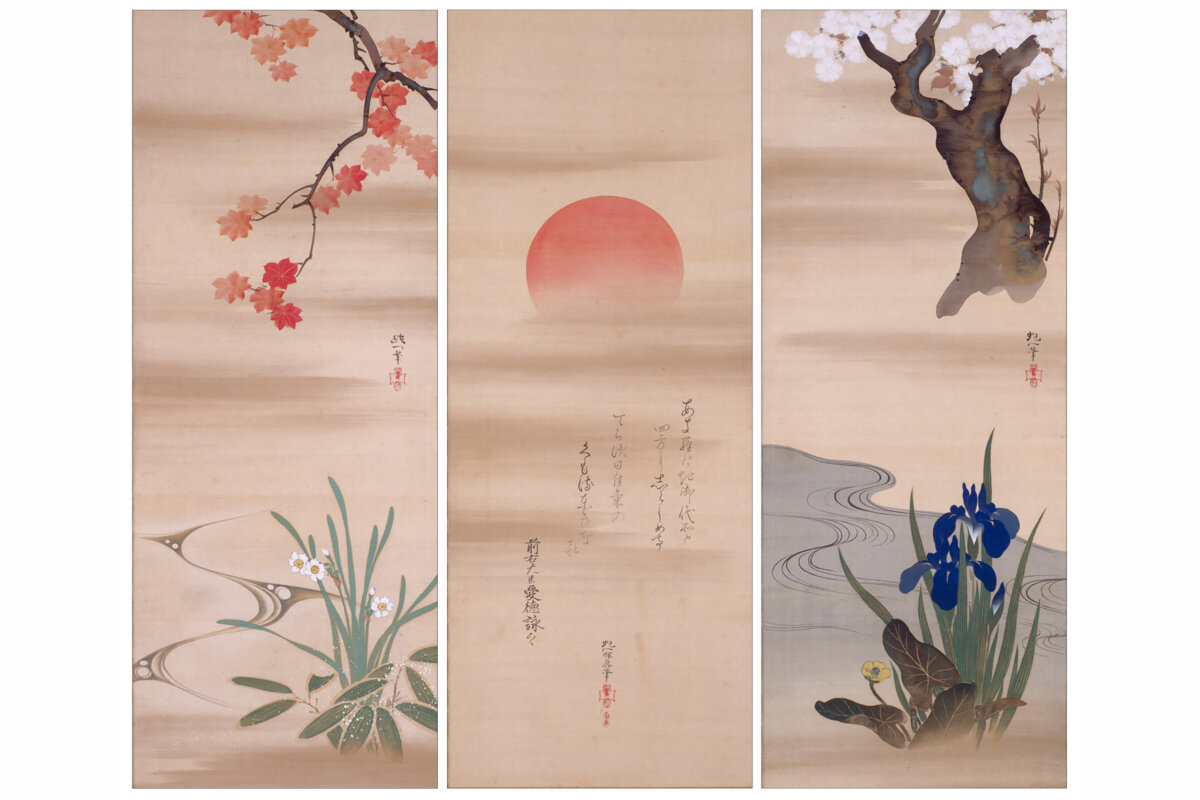
You have likely encountered the Rinpa art style many times without ever knowing its name. Its look is distinctive: naturalistic images set against lavish gold-and-silver backgrounds, rendered in pigments so vibrant they seem to glow. Yet its origins and evolution are far more intricate than they first appear.
Now one of the most comprehensive collections of Rinpa art in the West is coming to New Orleans, offering a rare chance to trace that story firsthand. “Second Nature: Japanese Rinpa Paintings From the Gitter-Yelen Collection” opens Oct. 2, 2026, at the New Orleans Museum of Art (NOMA). The exhibition brings together nearly 60 works spanning scrolls, folding screens, fans, albums, and ceramics, showing just how far the Rinpa aesthetic reached.
The Beginnings of Rinpa
The exhibition is curated by Dr. Yukio Lippit, a leading scholar of Japanese and East Asian art. His research shows the intricate relationships between Rinpa’s artists and origins.
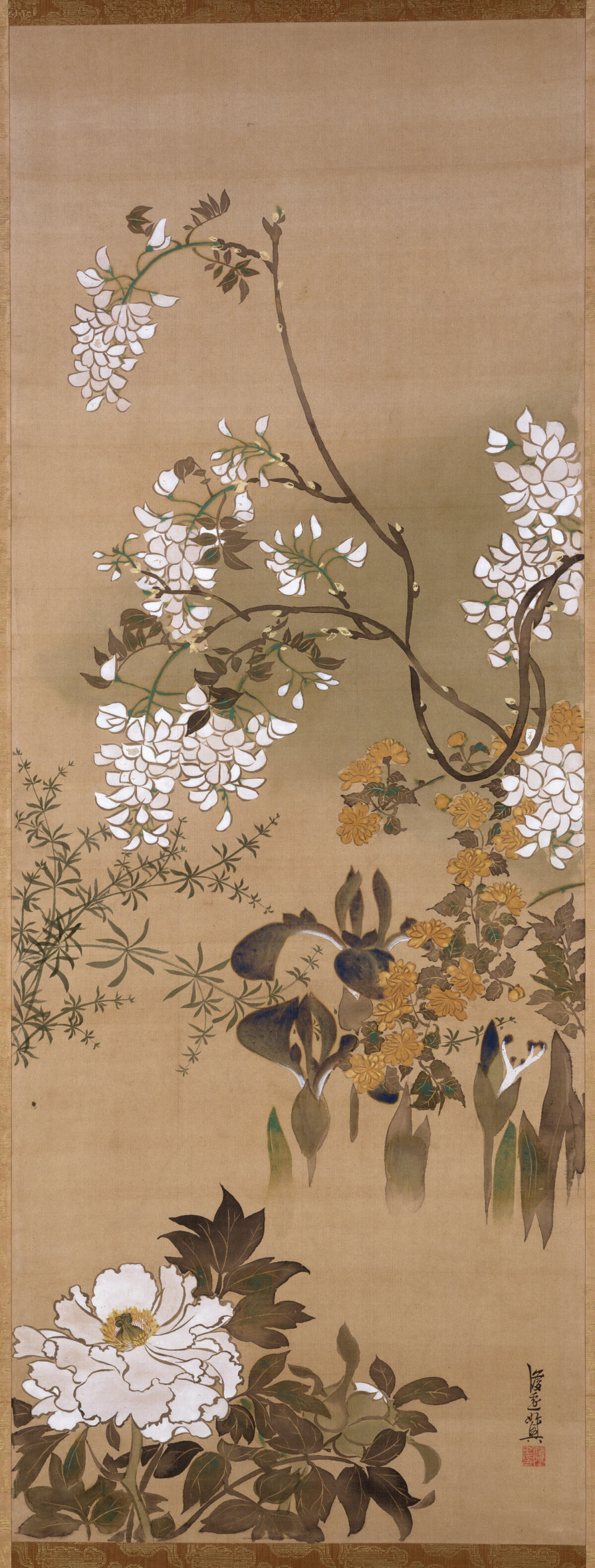
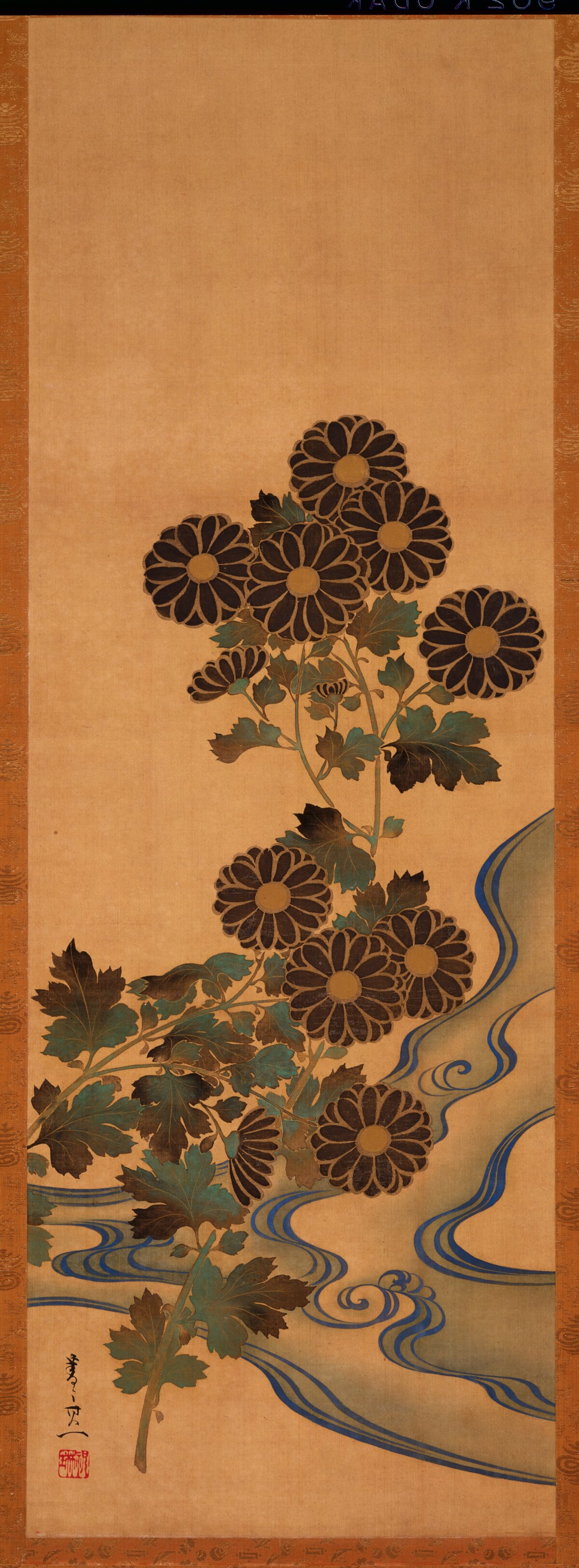
The style first emerged in 17th-century Kyoto through the work of Hon’ami Koetsu and Tawaraya Sotatsu. Rinpa was an unconventional art movement in that its artists were not connected through direct instruction or a formal lineage. Instead, they shared an interest in earlier works, which they studied, adapted, and reinterpreted through their own artistic visions, simplifying, enlarging, repeating, or rearranging forms. Artists often emphasized bold compositions with gold and silver leaf, setting natural forms against expansive metallic fields, contrasting muted imagery with adorned surfaces.
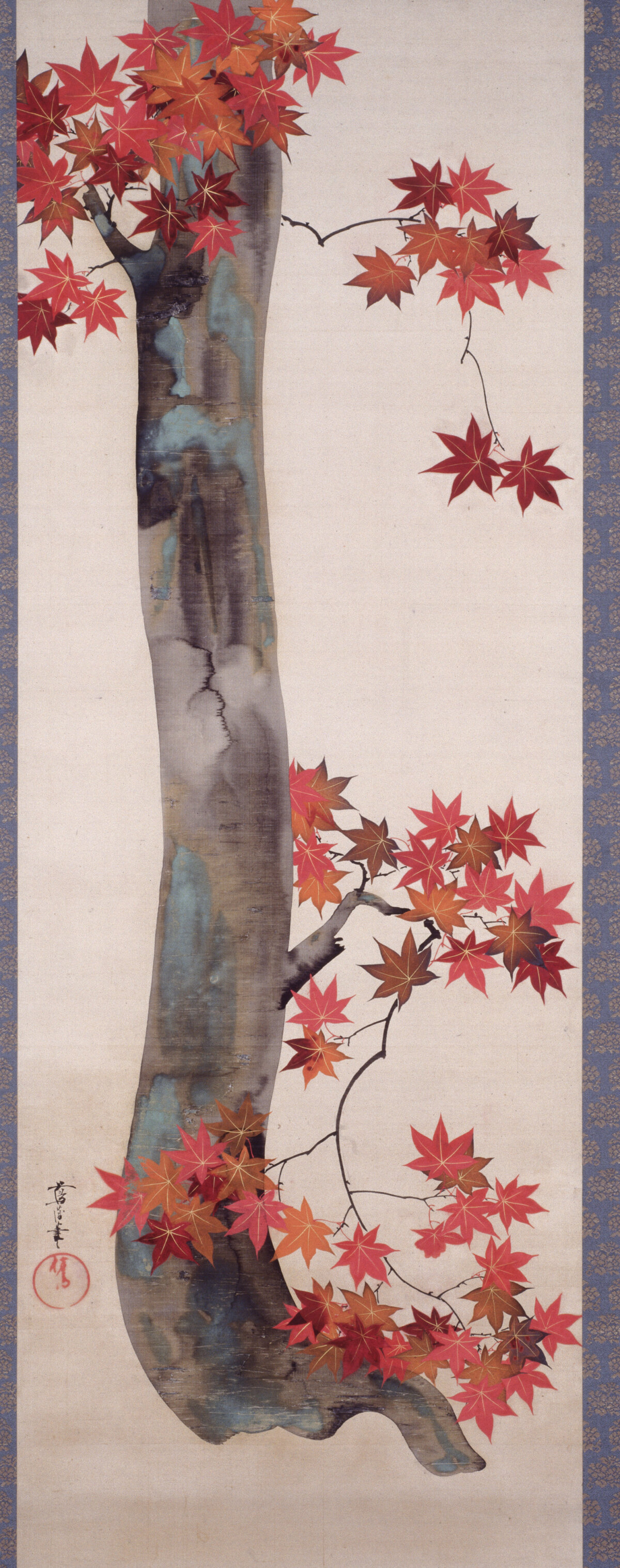
One of the movement’s signature techniques was tarashikomi, or “dripping in,” which involves applying wet ink or pigment to an already-wet surface, allowing the colors to pool, bleed, and spread into soft, organic patterns with subtle variations in tone. Artists used the technique to create a particularly striking effect, as in Sakai Oho’s “Autumn Maple,” where brilliant red and orange-brown foliage tops a trunk of mottled bark rendered in the delicate tarashikomi method.
Keeping an Artistic Tradition Alive
Roughly half a century after Rinpa emerged, Ogata Korin helped establish its recognizable visual language, simplifying the natural world even further, at times almost to the point of abstraction. The compositions were arranged in unexpected ways, blurring the boundaries between representation and pattern. His designs extended beyond painting into textiles, lacquerware, and ceramics. The term “Rinpa” itself derives from his name, a mark of how central he became to the tradition.
This tradition resurfaced when Sakai Hoitsu immersed himself in Korin’s work. In 1815, he marked the centennial of Korin’s death by organizing a memorial exhibition of his predecessor’s works in Edo. He also compiled and published “Korin hyakuzu” (“One Hundred Paintings by Korin”), a woodblock-printed album reproducing Korin’s paintings, along with “Ogataryu Ryakuinpu,” a seal-reference album cataloging the stamps that artists in the Ogata lineage used to mark and authenticate their work. The first edition of “Korin hyakuzu” included works from the exhibition as well as additional paintings, allowing Korin’s designs to reach a much wider audience. These publications helped preserve and circulate his artistic style, making it available to artists who could study and reinterpret it. “Korin hyakuzu” was later expanded and republished in 1826, further spreading his influence and helping establish the artistic lineage of Rinpa.
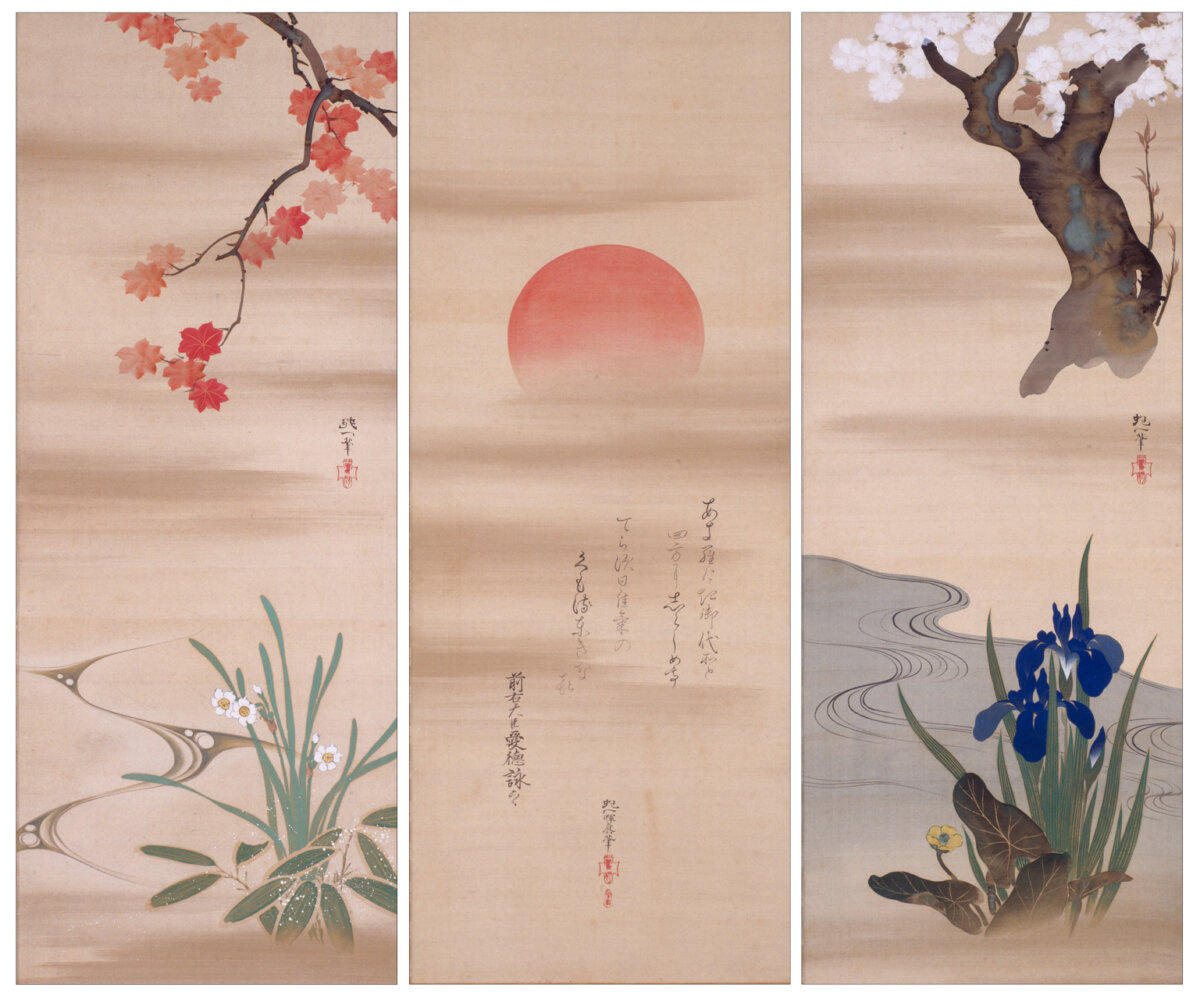
Beyond reviving Korin’s legacy through scholarship and print, Hoitsu also brought a fresh perspective to Rinpa’s practice. This comes through in his “Triptych of Flowers and the Rising Sun,” created after 1824. Across three hanging scrolls, seasonal blossoms bloom beneath a radiant sun, rendered with the fluid brushwork and refined composition that defined Hoitsu’s style. The work is widely regarded as one of the finest examples of Rinpa painting outside Japan, a testament to how thoroughly Hoitsu had made Korin’s aesthetic his own.
Hoitsu’s approach carried into the 19th century through students like Suzuki Kiitsu, who brought heightened naturalism to floral subjects, and Sakai Oho, whom Hoitsu adopted at age 10 and trained as a devoted disciple.
In the 20th century, artists reworked Rinpa’s principles into original styles, including Nihonga and, indirectly, Western movements such as art nouveau and modernism. “Second Nature” traces this succession, from Koetsu and Sotatsu through Korin, Hoitsu, and his students to artists working in the modern era, a lineage made visible in New Orleans largely through one collecting partnership. That partnership belongs to Alice Yelen Gitter and the late Dr. Kurt A. Gitter, whose collection supplies most of the works in “Second Nature,” alongside a selection from NOMA’s own holdings.
Building a World-Class Collection
For more than 50 years, the Gitters have been dedicated supporters of NOMA. Over the past five decades, they have donated nearly 350 works to the museum and inspired many others in their circle to contribute to its collection as well. Through their efforts, they have helped build the museum into one of the foremost public collections of Edo period Japanese painting outside Japan. Dr. Gitter joined the museum’s Board of Trustees in 1973 and was later named an Honorary Life Trustee. Alice Yelen Gitter, an accomplished art educator and curator, now stewards the Gitter-Yelen Collection, which spans the Nanga, Zenga, Eccentric, Ukiyo-e, and Maruyama-Shijo schools, modern Japanese ceramics, and works by American self-taught artists. Their commitment to scholarship continues through the Gitter-Yelen Art Study Center, an initiative promoting Japanese and self-taught American artists.
The “Second Nature” exhibition brings together centuries of Japanese artistic history, from the foundations established by Koetsu and Sotatsu to Korin’s vision and the interpretations of Hoitsu, Kiitsu, Sekka, and later artists. Through the Gitter-Yelen Collection and NOMA’s Japanese holdings, visitors can observe how artists continually explored new possibilities within a venerable visual tradition.
“Second Nature: Japanese Rinpa Paintings from the Gitter-Yelen Collection” at the New Orleans Museum of Art will be on view from Oct. 2, 2026 to Feb. 14, 2027. To learn more, visit noma.org.
What arts and culture topics would you like us to cover? Please email ideas or feedback to features@epochtimes.nyc.