On Nov. 1, many Christians observed All Saints’ Day. Italian Renaissance artist Fra Angelico (circa 1395–1455), “the Angelic Friar,” rendered many sublime sacred works that honor the saints and aid contemplation.
Artist and art historian Giorgio Vasari wrote in “Lives of Artists,” “It is impossible to bestow too much praise on this holy father [Angelico], who was so humble and modest in all that he did and said, and whose pictures were painted with such facility and piety.”
Pope John Paul II blessed Angelico with an “equivalent beautification” in 1982 and declared him the patron saint of Catholic artists in 1984. The pontiff praised Angelico in a 1999 letter to artists: “An eloquent example of aesthetic contemplation sublimated in faith are, for example, the works of Fra Angelico.”
An Unusual Predella
One of the Dominican friar’s most outstanding works of saints was on the predella of the main altarpiece of the Convent of San Domenico in Fiesole, Italy—his convent.

Normally, the predella, which is the lowest part of the altarpiece, shows episodes of the saints’ lives that feature in the main altarpiece. But Angelico depicted heaven. “The Dominican Blessed,” revered figures within the Dominican order, flank the three main panels: “The Virgin Mary With the Apostles and Other Saints,” “Christ Glorified in the Court of Heaven,” and “The Forerunners of Christ With Saints and Martyrs.”
“Christ Glorified in the Court of Heaven” celebrates the resurrected Christ surrounded by angels.
Saints, Martyrs, and More
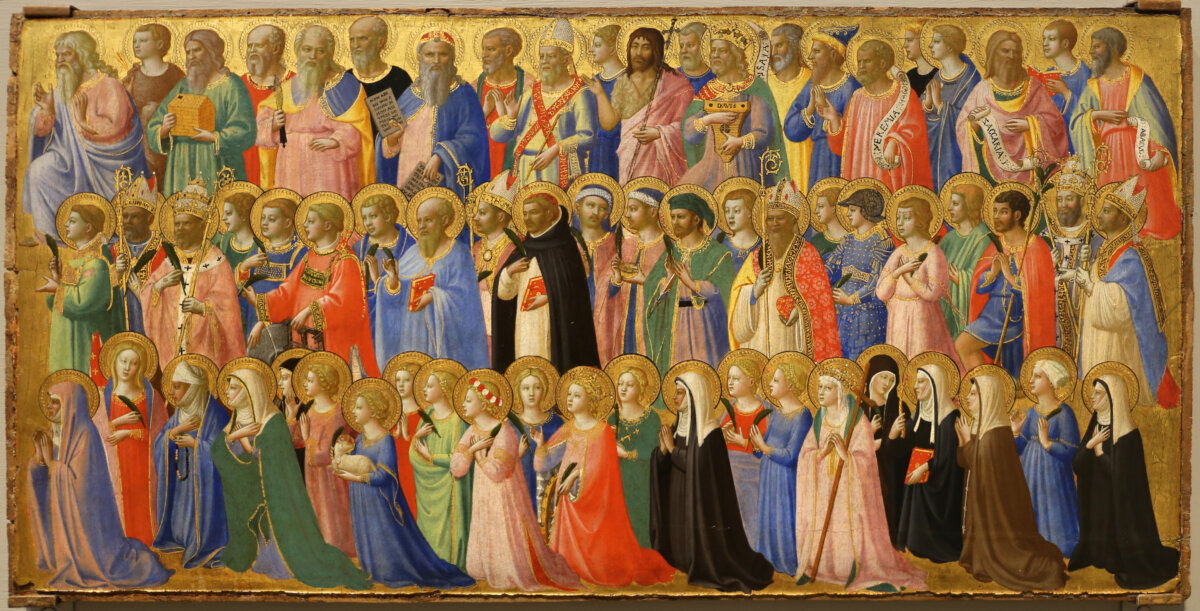
In the top row of “The Forerunners of Christ With Saints and Martyrs,” Adam leads the procession of Christ’s precursors, which includes Noah holding his ark and Moses presenting the Tablets of Law.
Male and female saints line the middle and bottom rows. As per Christian tradition, Angelico depicted each saint with a palm frond, the motif of martyrdom, along with motifs identifying each figure and sometimes how they died. Pious Catholics could therefore instantly identify each saint.
The first Christian martyr, Saint Stephen leads the male procession, with a stone on his collar symbolizing his stoning. In the center, Saint Peter Martyr, also known as Saint Peter of Verona, holds a red book, while his bloodied head stains his habit. Saint Christopher holds his staff and wears a short robe to wade through water.
The Virgin Mary’s mother, Saint Anne leads the female saints and looks up to the main altarpiece. Nun and Saint Bridget of Sweden holds a book and a lit candle. Saint Agnes holds a lamb representing Agnus Dei, the “Lamb of God.”
The heavenly predella from the main altarpiece of San Domenico convent is encased in glass and on permanent display at London’s National Gallery.
What arts and culture topics would you like us to cover? Please email ideas or feedback to features@epochtimes.nyc.