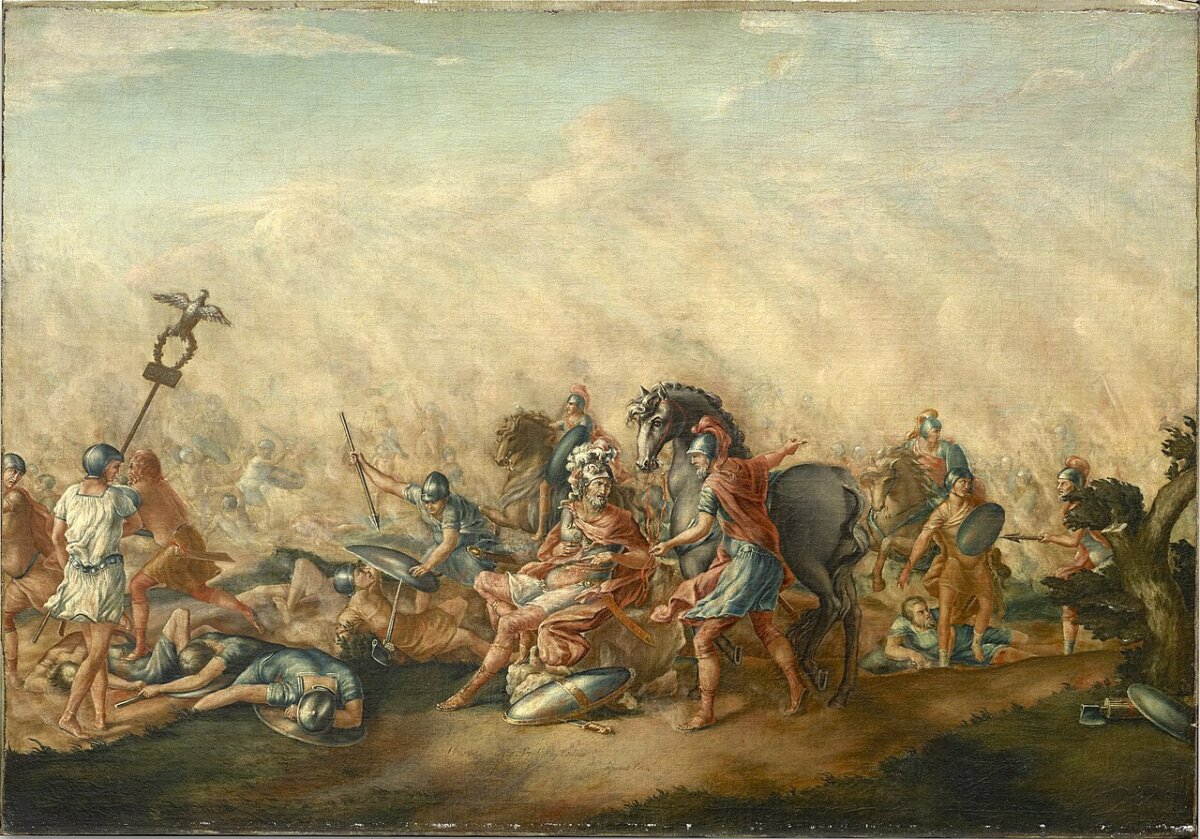
The Battle of Cannae, fought in August of 216 B.C. as part of the Second Punic War between Rome and Carthage, is still studied in military academies today and imitated by modern commanders. As Gen. Dwight D. Eisenhower put it, “Every ground commander seeks the battle of annihilation; so far as conditions permit, he tries to duplicate the classical example of Cannae.”
Cannae is a legendary instance of a genius general compensating for inferior manpower with clever envelopment tactics, employed to their full, devastating effect. In this battle, the Carthaginian general Hannibal Barca decimated a larger Roman army commanded by Lucius Paullus and Gaius Varro on Roman soil, handing the Romans their most stunning and terrifying defeat and pushing Roman civilization toward the precipice of collapse.
The story of Cannae is often told with an emphasis on Hannibal’s battlefield brilliance and the devastating defeat the Romans suffered because of it. That’s certainly an important part of the tale. But the defeat wasn’t the end of the story. Despite Hannibal’s astonishing victory, the Carthaginians did not inherit the Mediterranean world—that destiny was bestowed on the Romans, who prevailed despite this incredible setback.
What the Romans learned from their loss at Cannae, and how they recuperated, is just as significant as the battle itself. In fact, were it not for this humiliating rout the Romans might have ultimately lost the Punic Wars, and the history of civilization would have looked very different indeed. Sometimes, defeat is a building-block of victory.
But in 216 B.C., that victory was, as yet, far off, and the two mighty Mediterranean powers had already been grappling with one another for half a century. The Roman Republic and Carthaginian Empire first crossed swords over the islands of Corsica and Sicily in 264 B.C., resulting in the First Punic War. This war concluded with Rome acquiring Sicily as its first province and forcing Carthage to pay a sizeable indemnity.
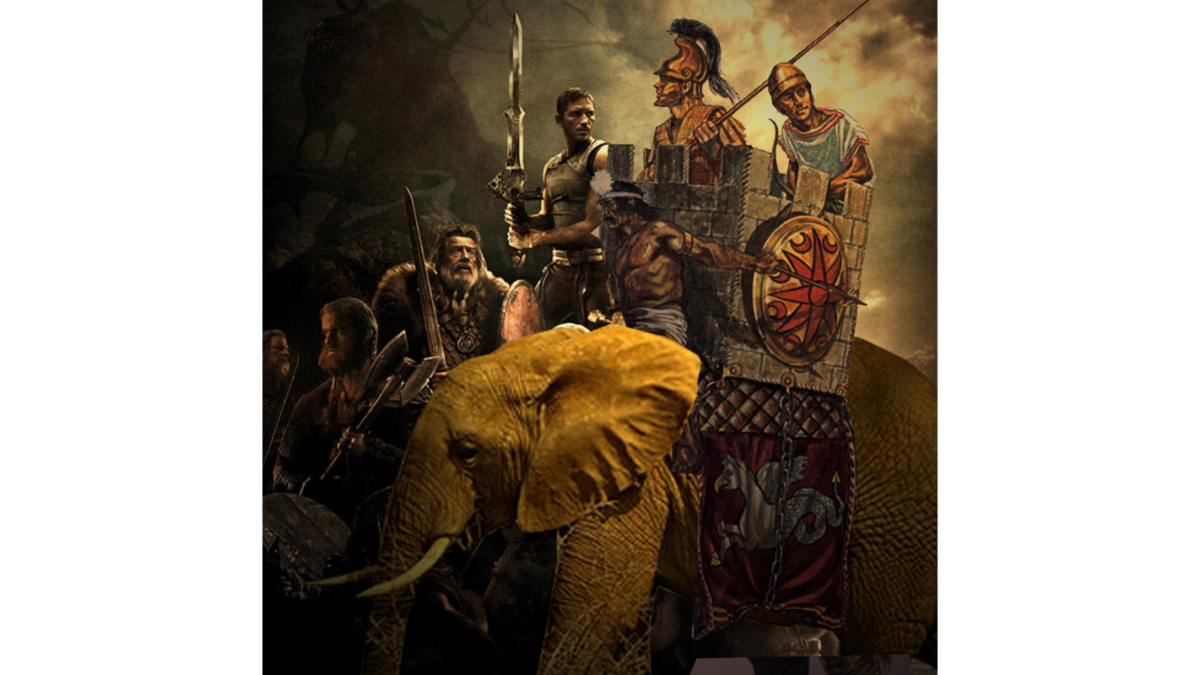
The Carthaginians retaliated in 219 B.C., when Hannibal first attacked the Roman-allied town of Saguntum in Spain, sparking a new war, and then crossed the Alps into Italy in 218 B.C., striking at the heart of Roman power. Then Hannibal won a pair of dramatic victories—at Trebia and Lake Trasimene—quickly establishing himself as a formidable opponent.
By 217 B.C., Hannibal held all of northern Italy, and his undefeated army menaced Rome itself. The Roman consul and dictator at the time, Quintus Fabius Maximus, favored a war of attrition and delay, skirmishing and cutting supply chains, rather than a confrontation with the mastermind Carthaginian general. But the Roman Senate wanted to solve the Hannibal problem once and for all, and they sent a new consul, Minucius Rufus, to finish the job. But he, too, was outwitted and defeated by Hannibal.
In the summer of 216 B.C., Hannibal and his army were harassing towns in southern Italy largely unchecked. Hannibal captured the supply depot of Cannae, and the Romans, beginning to panic, abandoned caution and sent that year’s two consuls, Paullus and Varro, to confront Hannibal. The Roman consuls commanded one of the largest armies Rome had ever fielded, an impressive force of 80,000 men, compared to Hannibal’s mere 50,000.
An initial skirmish ended favorably for the Romans, which emboldened the younger consul, Varro, who was determined to come to blows quickly and earn glory on the battlefield by bringing Hannibal to the dust. The older consul, Paullus, by contrast, favored a more cautious approach and tried to rein in his young co-commander, but without much success.

For a few days, the two armies faced each other across the dusty, rocky plains of Cannae, prodding one another with small sorties. Finally, both sides deployed for an all-out, pitched battle.
The Romans relied upon their traditional, rather inelegant tactic: overwhelm the enemy through sheer numbers and brute force. Their formation was a mass of heavy infantry, deeper than it was wide, with small contingents of cavalry on the wings. It was a force designed to ram into and crush the opposing line like a bellowing ox breaking through a fence.
Hannibal deployed in a subtler way. He chose his ground so that his opponents would be hemmed in by the Aufidus River and hilly ground, and so that they’d have to face a strong, hot, dusty wind blowing grit into their eyes. He placed skirmishers in front of his heavy infantry to counter the Roman velites (light infantry), and he arranged the main battle line in a convex shape. On either side of this curving line, and slightly removed from the enemy to be scarcely visible, he positioned his elite Libyan infantry in deep columns. His cavalry took up positions on the outer wings.
As the skirmishers exchanged missiles between the front lines, Hannibal’s cavalry attacked the Roman horsemen on both wings and drove them from the field. Meanwhile, the Roman heavy infantry charged and struck the thinner, curved line of Carthaginian foot soldiers. The heavy onslaught drove the Carthaginian infantry back, little by little. Yet the Romans couldn’t make use of their superior numbers because of the deep column shape in which they’d deployed and the restraints of the terrain—the soldiers further back in the formation couldn’t engage the enemy, and only managed to push their comrades further forward.
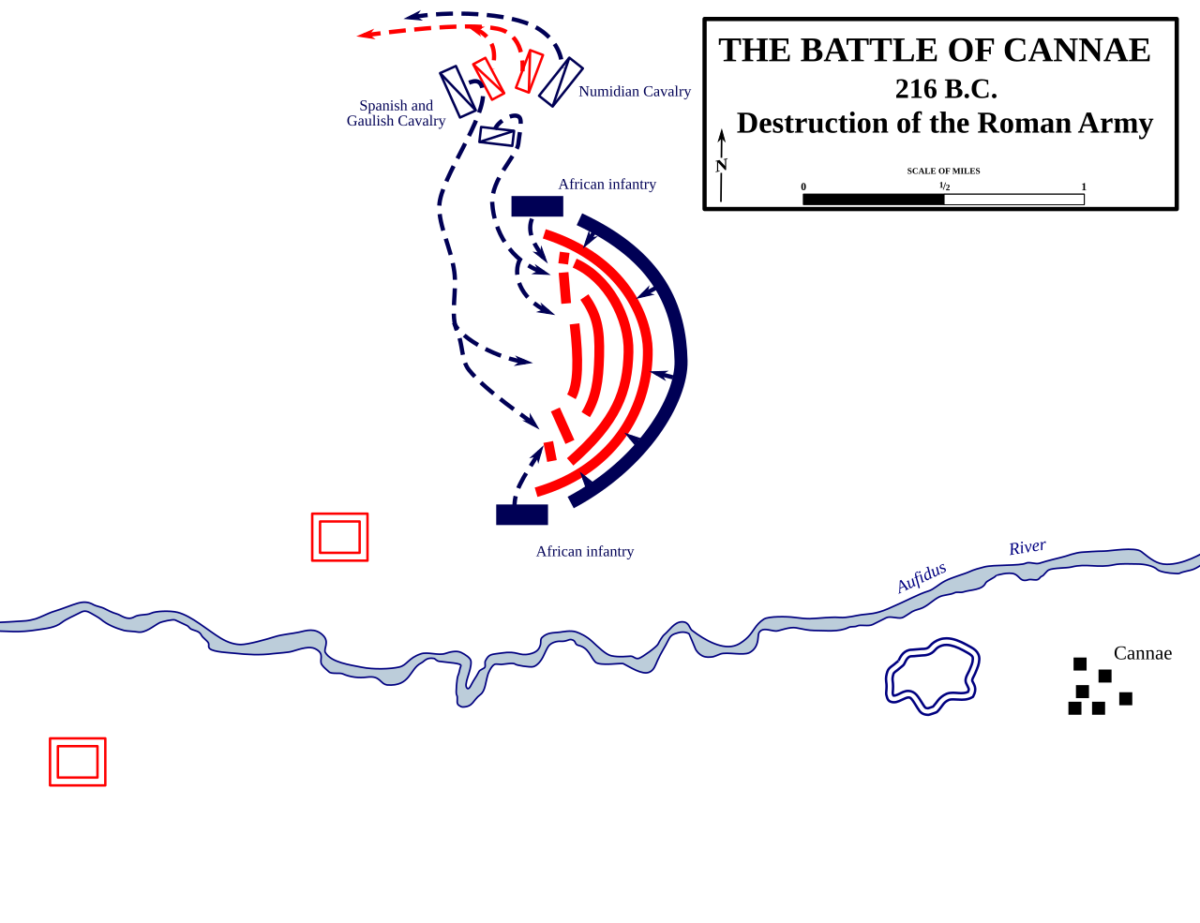
At first, it seemed as though the Roman infantry would win the day as the Carthaginians were pushed steadily back, though without breaking. In reality, the Romans were entering a trap. Hannibal’s convex line became concave and kept falling back, luring the Romans into a deadly embrace. The Romans were now parallel with the two columns of Libyan soldiers Hannibal had stationed in reserve on either side of his main line, and now they attacked the Roman flanks. To make matters worse, these new assailants were using Roman equipment they’d taken from dead Romans in a prior battle, which confused the Romans further. One moment, they were steadily pounding against the quavering Carthaginian line; the next, they were being attacked on both flanks by men who looked like their fellow soldiers.
The death blow came from Hannibal’s cavalry. Having shattered and pursued the Roman horse units, Hannibal’s horsemen returned to the field and smashed into the rear of the Roman infantry mass. The Romans were now surrounded, their glorious charge transformed into a deathtrap. The Romans were slowly squeezed in Hannibal’s chokehold: they were so tightly packed that they couldn’t use their weapons properly, and the battle quickly became a massacre. According to “Great Battles: Decisive Conflicts that Have Shaped History,” 48,000 Romans, including the consul Paullus, were killed, and another 20,000 captured. The grand Roman army was no more. By this point in the war, and largely due to Cannae, the Romans had lost 20 percent of their total body of fighting men aged 18-50.
After the battle, Hannibal sought to negotiate Rome’s surrender. But Rome refused to negotiate. In a shining example of Roman toughness and determination, they decided to fight on.
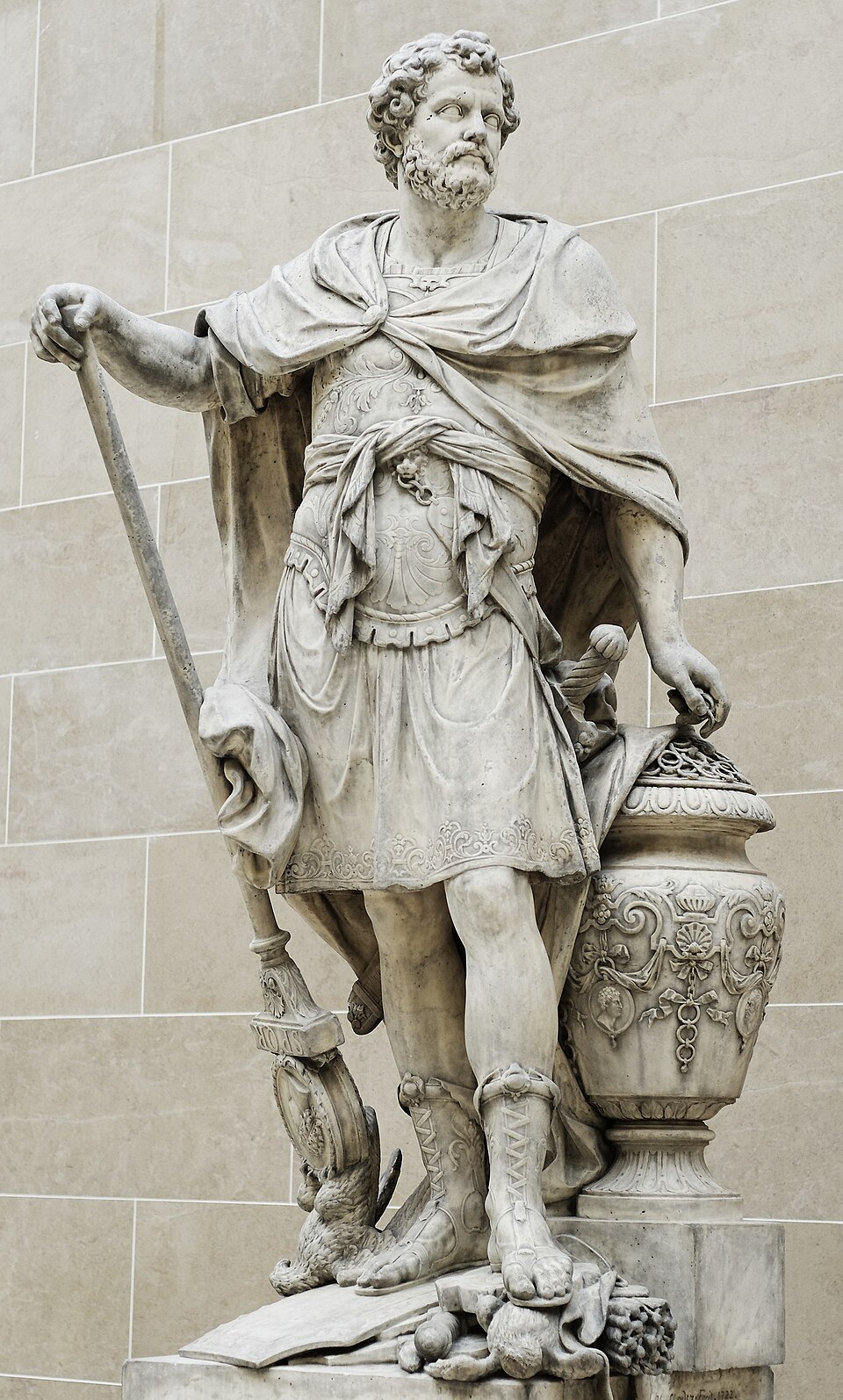
Hannibal probably should have hounded the Romans at this point, pressing on to attack Rome itself, but he hesitated, partly because he lacked the necessary siege equipment. He had also hoped that many of Rome’s Italian allies would defect to his side after such a victory, but most did not, which meant an all-out assault on Rome was still a formidable task.
But on their side, the Romans were initially stunned by horror and grief. When news of the defeat reached Rome, the city nearly panicked, and a great lamentation rose and echoed through the streets and temples. Virtually every family had lost a father, brother, or son. The demoralization was almost total.
But it was not total, and, despite everything, Rome did not give up. In fact, this devastating defeat ultimately hardened their resolve to resist Hannibal and win the war. They learned important lessons, and it initiated important changes in Roman military theory.
First, Rome returned to the Fabian strategy of a war of attrition against Hannibal. By hampering and harassing him rather than engaging him directly, they slowly whittled away at his troops without risking a huge portion of their own. As the invading force, Hannibal’s army couldn’t keep this up forever, whereas the Romans, on their home turf, with plenty of men and supplies at their disposal, could.
Second, in order to make up for the loss of manpower, Rome opened up her legions to new classes of men. Lower ranks of Roman society (including slaves and landless peasants) could now become soldiers. The new legions were also trained to fight in smaller, more flexible groups, rather than in the densely packed, unwieldy mass that proved so fatal at Cannae.
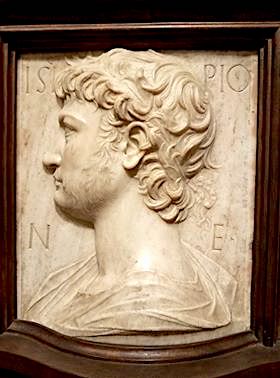
In tandem with this, they learned the importance of more advanced battlefield tactics and maneuvers, some of which the Roman general Scipio Africanus would ultimately use against the Carthaginians themselves. As Joshua Mark wrote for “World History Encyclopedia,” “Roman skill on the battlefield, through which they became masters of the world of their day, can be traced directly back to Scipio Africanus and his adaptations of Hannibal’s strategies at Cannae.” Thus, Cannae was in some way a direct preparation for the ultimate defeat of Hannibal and Carthage.
Finally, the Romans must have instinctively known that persistence and determination were the key virtues in war-waging, and that they could even compensate for a lack of tactical superiority. Rome lost an enormous number of men at Cannae, and this on the heels of other massive defeats, yet they fought on. As the Roman historian Livy wrote, “Certainly there is no other nation that would not have succumbed beneath such a weight of calamity.”
Instead of succumbing, Rome rebuilt everything from scratch. And that is what set her apart and made her heir to the whole world.
What arts and culture topics would you like us to cover? Please email ideas or feedback to features@epochtimes.nyc.