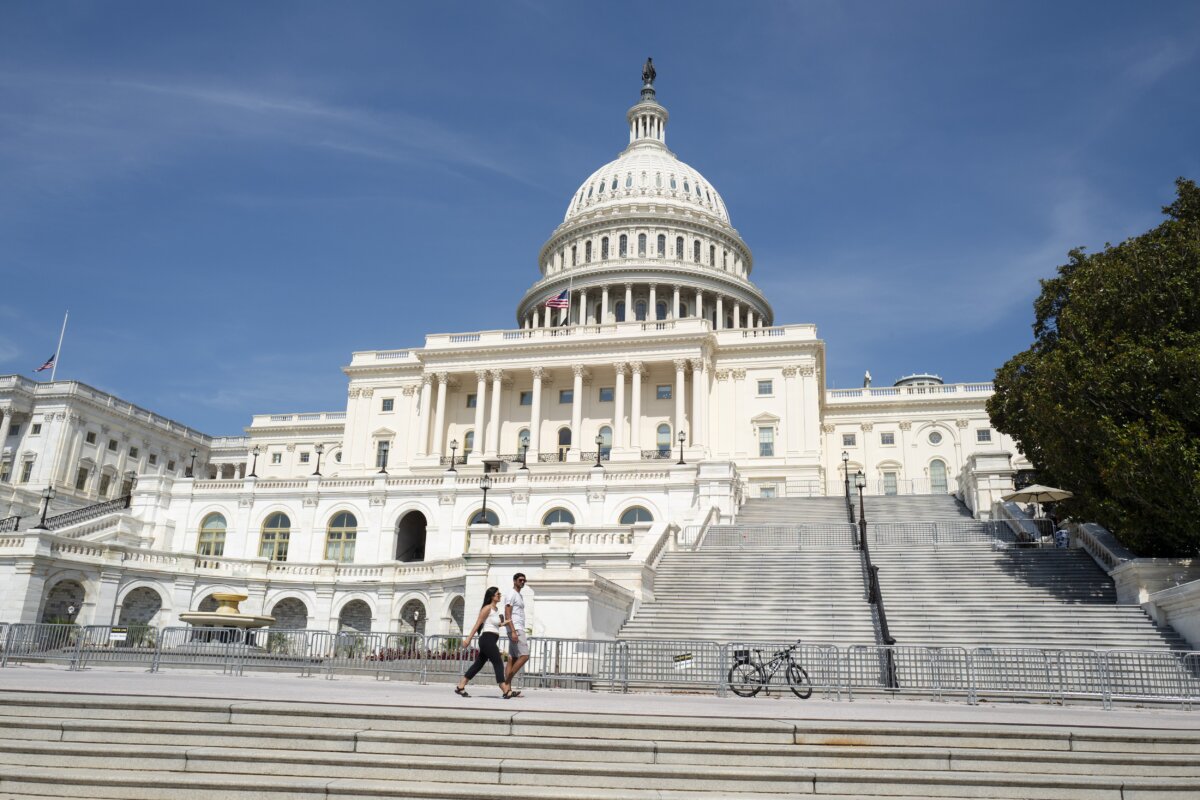

A bill tackling systematic forced organ harvesting in China is now headed to the House after getting the Senate green light on Sept. 28.
S.4009, with support from 12 bipartisan sponsors, passed the Senate with unanimous consent.
Dubbed the Falun Gong and Victims of Forced Organ Harvesting Protection Act, the bill addresses an issue that is gaining growing attention in the United States.
Here are the key things to know about the legislation and why Americans should care, in the words of those behind the bill.
‘On Demand System’
Forced organ harvesting refers to the involuntary extraction of organs, often resulting in the victim’s death.
As early as 2006, whistleblowers raised the alarm about the abuses taking place in China under Beijing’s auspices.
In 2019, the London-based China Tribunal concluded a year-long investigation into the issue. Forced organ harvesting, it found, had taken place in the country for years “on a significant scale.” A major victim group is practitioners of Falun Gong, according to the tribunal ruling. It also said Uyghur Muslims were at risk while being detained in “re-education camps” in China’s Xinjiang region.
“We call it an ‘on-demand system,’” Dr. Torsten Trey, executive director for Doctors Against Forced Organ Harvesting, told The Epoch Times.
A request for organs would trigger the search for a matching donor, who could be a political prisoner with the right blood type and tissue factors, he said.
He likened it to “a living pool of non-consenting donors who will be slaughtered like cattle.”
What the Bill Does
The bill would sanction foreign individuals for carrying out or facilitating the abuse, barring them from entering the United States and blocking them from making U.S. transactions. Those violating the sanctions risk facing up to $250,000 for a civil offense, or $1 million and 20 years in prison in criminal penalties.
It also directs the U.S. State Department to conduct an investigation with input from the health secretary, the director of the National Institutes of Health, and the relevant heads of the intelligence community.
Within a year of the bill’s passage, the secretary of state would report to Congress about China’s organ transplantation practices and policies.
The report would assess whether the Chinese communist regime conducts systematic forced organ harvesting and look into where the organs are from, how fast they are obtained, and whether that timetable is practical in the country.
Should it find the abuse to be taking place at scale, U.S. officials would evaluate whether forced organ harvesting in China constitutes an atrocity.
A version of the bill passed the House in May 2025.
Sen. Todd Young (R-Ind.) said the bill’s passage is “an important step in defending religious freedom and human dignity in the face of the CCP’s ongoing abuses.”
Sen. James Lankford (R-Okla.) described the taking of organs from prisoners of conscience as evil.
“America should plainly say this is wrong and back it up with consequences,” he said in a statement.
He added that he wants to “stand up for the victims the CCP wants the world to ignore.”
—Eva Fu
BOOKMARKS
New York Gov. Kathy Hochul has appointed the state’s attorney general, Letitia James, as special prosecutor in an investigation into gang rape allegations at Cornell University. Tompkins County District Attorney Matthew Van Houten has reopened the investigation after declining to prosecute anyone for the alleged incident in 2024.
Convicted murderer Christa Pike is in a critical condition after surviving a failed execution in Tennessee, her lawyers said on Oct. 1. Find out more by reading Zachary Stieber’s latest.
A U.S. District Court judge in Connecticut has blocked the state’s ban on pistols that can be easily converted from semiautomatic to fully automatic machine guns using illegal devices. District Court Judge Kari A. Dooley ruled the ban did not meet the legal standard set in the June 2022 U.S. Supreme Court decision in New York State Rifle and Pistol Association v. Bruen.
As a Florida county works to remove all Flock Safety automated license-plate readers from local roads, officials discovered several cameras that were installed without their knowledge or approval. Jacob Burg covers the story in his latest report.
The Democratic National Committee has sued the Department of War and the Office of Management and Budget after they removed a checkbox that said, “I am a U.S. citizen living outside the country, I have never lived in the United States” from overseas mail-in ballot applications. The DNC says the change could make it impossible for U.S. citizens born and living abroad to use the form to register in states where they are eligible to vote.
—Stacy Robinson
 Friends Read Free
Copy
Facebook
Tweet