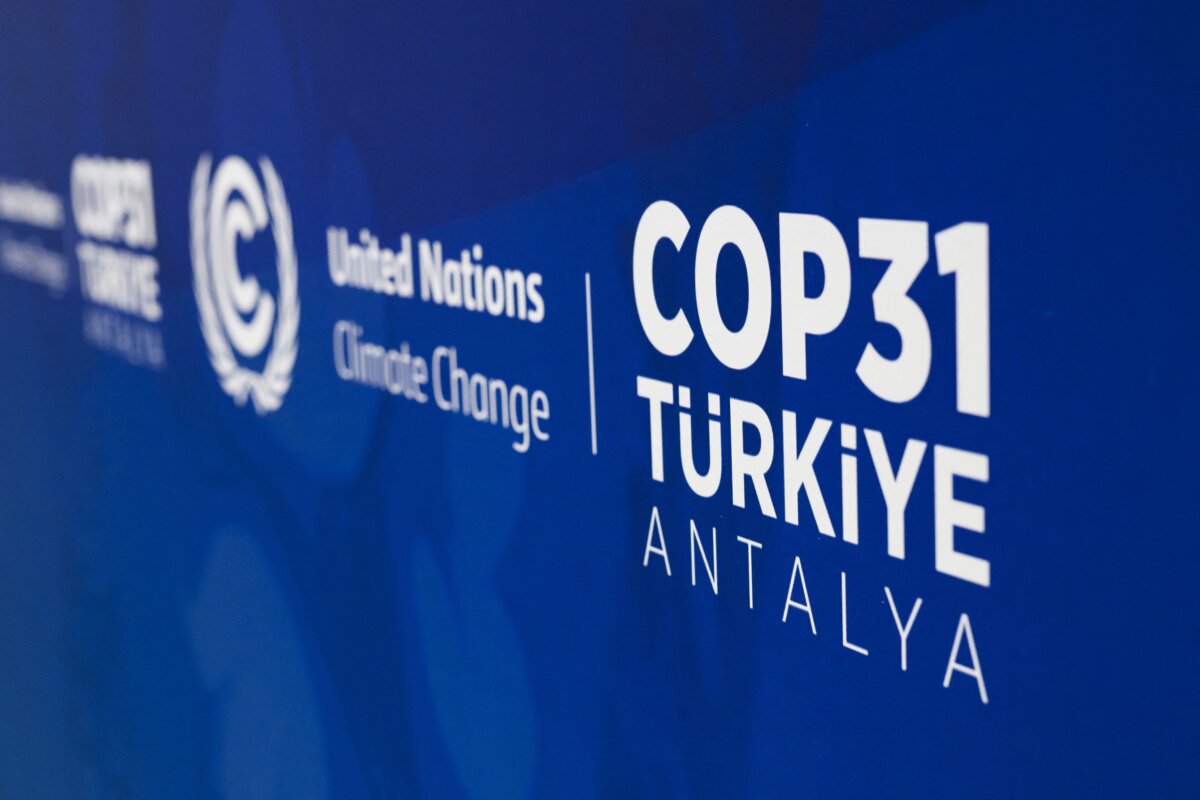

Democrats’ resounding midterm victories are encouraging for activists promoting climate-related actions at this year’s international conference in Antalya, Turkey.
Speaking as part of an unofficial U.S. delegation to COP31, former U.S. climate envoy John Kerry called the midterms “a transition that the world wants” and said that “in the United States, people made climate change and its exigencies a voting issue.”
According to the United Nations, the Conference of the Parties (COP) is “the supreme decision-making body” of the United Nations Framework Convention on Climate Change (UNFCCC), in which nations have met each year since 1995, the exception being 2020, to negotiate agreements on limiting greenhouse gas emissions, making payments from rich countries to poor countries, and other environmental issues. This year’s conference runs from Nov. 9 to Nov. 20.
For the past two years, the Trump administration has declined to send a delegation to COP and has cut subsidies for wind and solar power and electric vehicles, while pushing for deregulation of the oil, gas, and coal industries.
After the recent U.S. election in which Democrats retook Congress, Democrats substantially increased their delegation to the event.
“As a result of the midterm elections, the Democrats in particular have decided to make a strong presence here,” Committee for a Constructive Tomorrow (CFACT) President Craig Rucker, who is attending COP31, told The Epoch Times.
“They initially were just sending 19 Congressmen, but now they have over 120 different mayors, the governor of New Mexico, and others who are showing up here to say the U.S. is back in on the climate negotiations.”
CFACT advocates for free-market solutions to environmental problems.
Also among the state and local attendees are California Gov. Gavin Newsom, Minnesota Gov. Tim Walz, Palo Alto Mayor Vicki Veenker, Raleigh Mayor Janet Cowell, and many other municipal members of organizations like the U.S. Climate Alliance, Climate Mayors, and America Is All In.
COP Calls for ‘Implementation’
The theme of this year’s COP gathering is “implementation,” or a shift from making pledges to fulfilling them.
According to the Paris Climate Accord, member nations commit to voluntary “nationally determined contributions” (NDCs), which are climate action plans to reduce greenhouse gas emissions and help the developing world deal with extreme weather.
In September, Turkish Environmental Minister and COP31 President-Designate Murat Kurum called on member nations to prioritize climate funding and put it on par with defense spending.
“Our climate finance needs stand at between $7.5 trillion and $9 trillion, yet the world currently invests only around $1.9 trillion,” Kurum stated. “I call that difference a chasm—and it is a chasm we must close.”
At COP29, summit leaders called for rich countries to pay developing countries $300 billion a year by 2035.
Some critics are skeptical of this plan.
“The biggest thing they want to get out of this is money,” Rucker said, calling the financial NDCs “a redistribution scheme from rich nations to poor nations to help them cope with a so-called climate crisis, which since they’ve been holding these [conferences], has failed to materialize.”
COP leaders said that greenhouse gas emissions have caused an increase in droughts, flooding, and extreme heat, which they say impairs food production, supply chains, national economies, and human health.
However, critics say these events are within the normal range of the Earth’s weather fluctuations, and a 2025 study by the U.S. Department of Energy stated that “most extreme weather events in the United States do not show long-term trends.”
‘Electrification’ the New Buzzword
Beyond financing, another goal being touted by COP leaders this year is “electrification,” or transitioning more of the world’s economic production and transportation onto the electricity grid.
The proposal, under the moniker “35×35,” calls for an increase in electricity’s share of global energy consumption from about 23 percent today to 35 percent by 2035.
Accordingly, an organization called the We Mean Business Coalition (WMBC) called on COP members to “close the electrification implementation gap.”
According to a WMBC statement, China is “furthest ahead on actual electrification, while the United States risks losing momentum and major European economies including Germany, the UK, Italy and Poland are struggling to turn strong policy frameworks into comparable progress on the ground.”
Electrification also plays to China’s strategic advantage, given that it has relatively few reserves of oil and gas, but dominates supply chains for batteries and solar panels, leads the world in construction of new coal-fired electric power plants and is currently the world’s largest manufacturer of EVs.
The United States, by contrast, is the world’s largest producer of oil and natural gas.
COP leadership touted recent progress in achieving its goals.
Chris Bowen, the minister for Climate Change and Energy for Australia, which is co-chairing the event, stated that “global renewable electricity generation has almost doubled” since 2015.
“Around $2.2 trillion was invested in clean energy last year, nearly twice the amount flowing to fossil fuels,” Bowen said, noting that more than 160 countries have submitted updated NDCs to date. “There is enormous momentum on electrification.”
Trump Skeptical of Global Agreements
The United States signed on to the UNFCCC treaty in 1992 under President George H.W. Bush with unanimous approval from the Senate.
President Donald Trump, however, has been decidedly skeptical of the climate agenda, telling the U.N. in 2025 that it was “the greatest con job ever perpetrated on the world.”
Trump announced in January 2026 that the United States would withdraw from the UNFCCC, becoming effective in February 2027, although U.S. funding for the organization was cut immediately.
According to American Energy Alliance Vice President Kenny Stein, whatever is agreed at COP31 is largely “irrelevant.”
“Even with Democrats taking control of Congress, you still have a Republican president, and Donald Trump is very dismissive of all these global agreements,” Stein told The Epoch Times.
“There’s not going to be any change as far as international agreements and international cooperation, at least for the next two years, regardless of Congress.”
 Friends Read Free
Copy
Facebook
Tweet