
Rep. John Moolenaar (R-Mich.) and Rep. Ro Khanna (D-Calif.) of the House Select Committee on the Chinese Communist Party released a bipartisan report on Nov. 13 detailing how the Chinese Communist Party (CCP) used state money and state-owned buyers to dominate industries vital to U.S. security.
In most areas of manufacturing, the report says, China “is no longer merely competing with the United States but has decisively surpassed it.”
The report, “Rigging the Game: How China Undermined Western Manufacturing and Helped Hollow Out American Industry,” draws on case studies of biomanufacturing, aerospace, semiconductors, and machine tools.
It reaches three conclusions: Beijing steers capital, technology, and market share into industries it deems strategic. It also uses subsidies, regulations, state-owned buyers, and government-backed investment funds to grow those industries and weaken foreign rivals. And it seeks to make the world depend on Chinese factories while cutting its own reliance on foreign suppliers.
Moolenaar said China’s “predatory trade practices and massive subsidies” have hollowed out the U.S. manufacturing base.
“We must reindustrialize America, so we are never reliant on China to make the vital products our country needs,” he said in a statement.
“Over decades, the CCP has identified strategic industries and technologies, and sought to dominate them,” Khanna said. “Unfortunately, America’s workers, communities, and security have paid the price.”
Xi’s Playbook
The committee traces Beijing’s approach to an April 2020 speech by Chinese leader Xi Jinping. Xi told the party’s top economic policy body to “tighten the dependence of international production chains” on China. That dependence, he said, would give Beijing a powerful way to counter and deter foreign supply cutoffs.
“Abroad, China wants leverage. At home, it wants autarky,” the committee wrote, using a term for national self-sufficiency.
The report argues that Beijing built its industry around military-civil fusion, the CCP’s policy of merging civilian industry with the military. The committee found that China has 230 times the civilian shipbuilding capacity of the United States, and that its commercial and naval yards share the same welders, steel, and dry docks.
“Modern great-power conflict will be a production competition as much as a technology competition, and the side that can replace losses the fastest will more often prevail,” the report states.
Legacy Chip Push
In semiconductors, the report focuses on mature-node chips, the older, simpler chips made at 28 nanometers and larger that run car controls, power systems, and displays. China held 34 percent of the world’s capacity to make these chips in 2024, behind only Taiwan’s 43 percent, according to TrendForce figures cited in the report.
TrendForce projects that China will reach about 47 percent by 2027 and pass Taiwan. China is also home to 57 of the 97 new chip plants slated to open worldwide from 2023 to 2025, the report says, citing the industry group SEMI.
Beijing has also sharply limited imports of foreign chips. After Washington cleared Nvidia’s H200 chips for sale to China early this year, the report says, Beijing refused them and pushed its own industry instead.
“China’s aggressive push into this node of the semiconductor supply chain is unfair to international firms, but it is working,” the report states.
‘Industrial Mother Machines’
Beijing calls machine tools “industrial mother machines” because they make all other manufacturing equipment. Chinese firms held about 2 percent of their home market for high-end machine tools in 2013, the report says. A 2024 Chinese government report cited by the committee puts that share above 30 percent.
State-owned buyers prop up the industry. Shenyang Machine Tool, for one, drew more than 70 percent of its 2023 revenue from its state-owned parent and from units of the state aircraft maker Aviation Industry Corporation of China, the report found.
Jetliner Falls Short
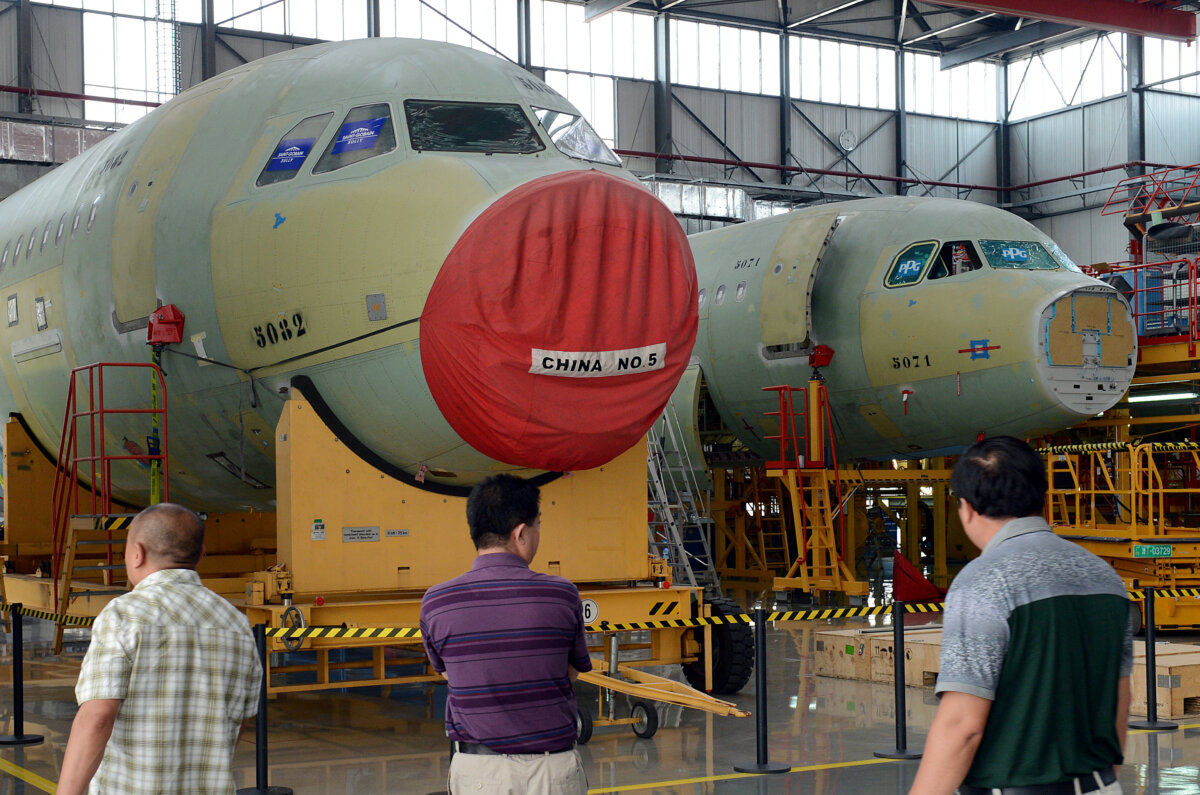
Not every push has paid off. The state-owned Commercial Aircraft Corporation of China, or COMAC, planned to deliver 75 of its C919 narrowbody jets in 2025. It cut the target to 25 and delivered 15.
The C919 still depends on Western engines and avionics, and it lacks certification from U.S. and European regulators. Without that approval, the export markets the program needs remain closed, the report says.
China’s three big state-run airlines have each ordered 100 of the jets. But as the committee put it, purchases by state-owned enterprises “guarantee demand, but they cannot manufacture airworthy supply.”
Europe’s Airbus, meanwhile, has fared far better in China than Boeing. Chinese state carriers have ordered more than $58 billion in Airbus jets since 2017, while Boeing has not won a major Chinese order in that time, the report found.
“While Boeing made certain limited investments in China, Airbus bent over backwards for the CCP,” the committee wrote. Even so, the report says, Beijing held up final approvals of Airbus jets this year to pressure European regulators into certifying the C919.
A Call to Rebuild
The report urges a decades-long, whole-of-government push with U.S. allies to rebuild key industries, pursued with the urgency of the Manhattan Project or the interstate highway system.
It lands as the committee’s own future is in question. As a select panel, the committee lasts only for the current Congress and must be renewed when the next one convenes in January. In a Nov. 9 statement, Moolenaar urged lawmakers to keep it, calling the coming two years “a critical period.”
“As China intensifies its efforts to win the innovation competition and monopolize key supply chains, we must learn from the past and invest in the future,” Khanna said.
 Friends Read Free
Copy
Facebook
Tweet