
Commentary
What’s behind the latest BRICS meeting?
Impatience and frustration for Chinese leader Xi Jinping with BRICS and Russia. For years, Beijing appeared willing to tolerate enormous costs to preserve its partnership with Moscow.
Yet Russia provided China with discounted energy, military cooperation, and a powerful strategic counterweight to the United States and Europe.
But in return, China gave Russian President Vladimir Putin something arguably even more valuable: a major economic lifeline after Russia’s invasion of Ukraine isolated Moscow from much of the West.
The Beijing–Moscow Alliance Has Limits
Beijing continues to describe the two countries as strategic partners and has pledged to deepen cooperation. But China is increasingly unwilling to subordinate its own economic interests to Russia’s geopolitical ambitions.
The relationship has limits, and those limits are becoming clearer. The costs of the relationship are rising, not diminishing.
China’s relationship with Russia exposes a broader weakness in Beijing’s strategy, in that it conflicts with its trading partners in the West as well as with the ambitions of the Chinese Communist Party (CCP).
BRICS Cooperation Has Limits, Too
The same problem is appearing with regard to BRICS. Fractures and competing interests are present that aren’t easily healed or mediated.
There are plenty of examples.
India remains deeply suspicious of Chinese intentions. Brazil wants BRICS to remain an economic and diplomatic forum rather than become an anti-American alliance. Russia wants the organization to challenge Western power.
But Beijing increasingly wants BRICS to become an instrument for building a more CCP-centered international order as a counterweight to the United States.
Those objectives overlap in some areas, but are increasingly at odds with each other.
Russia Is Becoming More of a Liability
At this point, Russia remains strategically useful to China. It supplies enormous quantities of energy, provides a land bridge across Eurasia, and forces Washington and its allies to divide attention between Europe and the Indo-Pacific.
But Russia is also becoming more expensive to support.
Chinese trade with Russia fell for the first time in five years in 2025, declining by 6.5 percent to roughly $234 billion. Chinese exports to Russia fell by nearly 10 percent, while Chinese imports declined by more than 3 percent.
What’s more, Chinese automobile exports to Russia plunged by 46 percent, as Moscow raised import levies on Chinese vehicles. Meanwhile, the value of China’s Russian crude imports fell substantially.
That reveals something important.
China will cooperate with Russia when cooperation serves the CCP’s interests. But Beijing has little reason to sacrifice those interests to rescue the Russian economy.
Unlike Russia, China is more dependent on markets, energy, and technology. It does not need Russia’s war to become its war.
China Has Its Own Economic Problems
China’s willingness to absorb geopolitical costs is also being constrained by its domestic economy.
The International Monetary Fund, or IMF, expects Chinese growth to slow from 5 percent in 2025 to roughly 4.5 percent in 2026, while warning about weak domestic demand, property-sector problems, deflationary pressure, and longer-term constraints from an aging population and slower productivity growth.
That changes Beijing’s calculation fundamentally.
China needs access to global markets and energy at favorable prices. It also needs foreign investment and advanced technology. And it needs to prevent the United States and its allies from consolidating a broad economic coalition against it.
Russia’s confrontation with the West complicates all of those objectives, as does turning BRICS into an overt anti-Western bloc.
India Is the Bigger Problem
India may be Beijing’s most difficult BRICS problem. The two countries share membership in BRICS, the Shanghai Cooperation Organization, and other multilateral forums.
But they are also strategic competitors.
The 2020 border clash between India and China killed at least 20 Indian soldiers and severely damaged bilateral trust. Although relations have improved and military disengagement has reduced tensions, the underlying territorial dispute remains unresolved.
India also does not want BRICS transformed into a Chinese-led anti-Western alliance.
New Delhi seeks strategic autonomy rather than alignment with either Washington or Beijing. India supports greater use of national currencies in bilateral trade, but has resisted proposals that would effectively replace the dollar-based financial system with a Chinese-centered alternative.
That creates a fundamental contradiction.
China wants BRICS to increase its collective power against the West. India wants BRICS to increase the bargaining power of developing countries without becoming Beijing’s geopolitical instrument.
Brazil Has Its Own Agenda, Too
Brazil presents another obstacle to China’s BRICS dominance.
Beijing and Brasília have developed deep economic and diplomatic ties, and both governments publicly support greater BRICS cooperation.
But Brazil has resisted turning BRICS into an explicitly anti-American organization.
When U.S. President Donald Trump threatened additional tariffs against BRICS countries in 2025, Brazilian President Luiz Inácio Lula da Silva argued that BRICS was not created to confront the United States.
The problem became even clearer when Lula attempted to organize a coordinated BRICS response to U.S. tariffs. His own description was revealing: There was no coordination yet.
BRICS Is Getting Bigger—and Harder to Control
The irony is that China helped drive BRICS expansion. The bloc now includes 10 full members, including Egypt, Ethiopia, Indonesia, Iran, and the United Arab Emirates.
That gives BRICS enormous demographic and economic weight, but also makes consensus harder to achieve. The new members have different political systems, security interests, economic priorities, and relationships with Washington and Beijing.
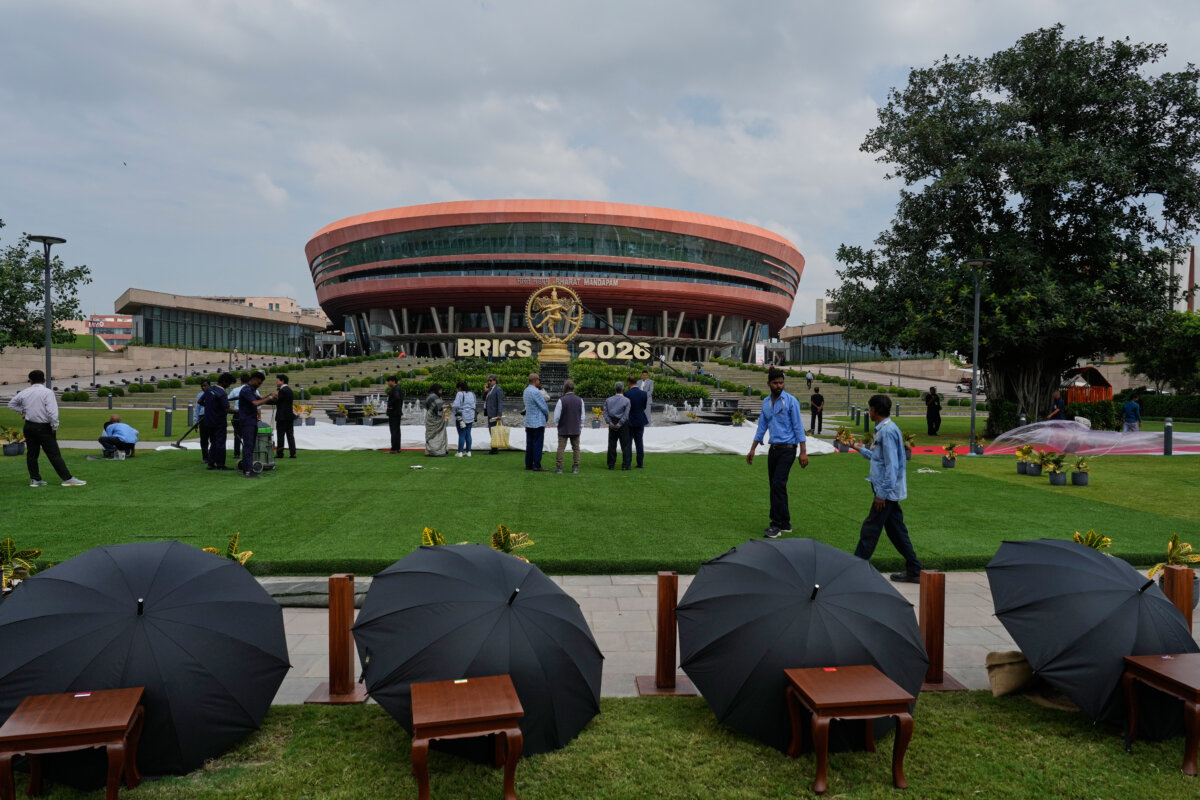
The 2026 summit shows that even when BRICS reaches agreement, the language often has to be broad enough to accommodate fundamentally different national positions.
The larger BRICS becomes, the less it behaves like a Chinese strategic instrument. India, China, Russia, Iran, and the UAE do not share the same interests in the Middle East. India and China remain strategic competitors. Brazil continues to emphasize economic cooperation rather than confrontation with the West.
This is the paradox confronting Xi. China remains by far the largest economy in BRICS and possesses enormous economic leverage over many members, but it’s less reliable as an instrument of Chinese policy.
The Real Problem for Beijing
China’s challenge is, therefore, not simply that BRICS is weak, but that the obstacles are built into the membership itself.
BRICS has made real progress in areas such as the New Development Bank and payment-system cooperation. But transforming that cooperation into a coherent anti-Western bloc is another matter.
Beijing still wants a multipolar world. But increasingly, it wants one in which China remains free to pursue the CCP’s interests first.
That leaves BRICS as something considerably less threatening—and considerably less useful to Beijing—than the grand alternative to the Western order that the CCP once envisioned.
Views expressed in this article are the opinions of the author and do not necessarily reflect the views of The Epoch Times.
 Friends Read Free
Copy
Facebook
Tweet