
Commentary
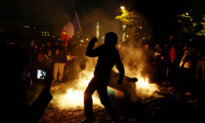
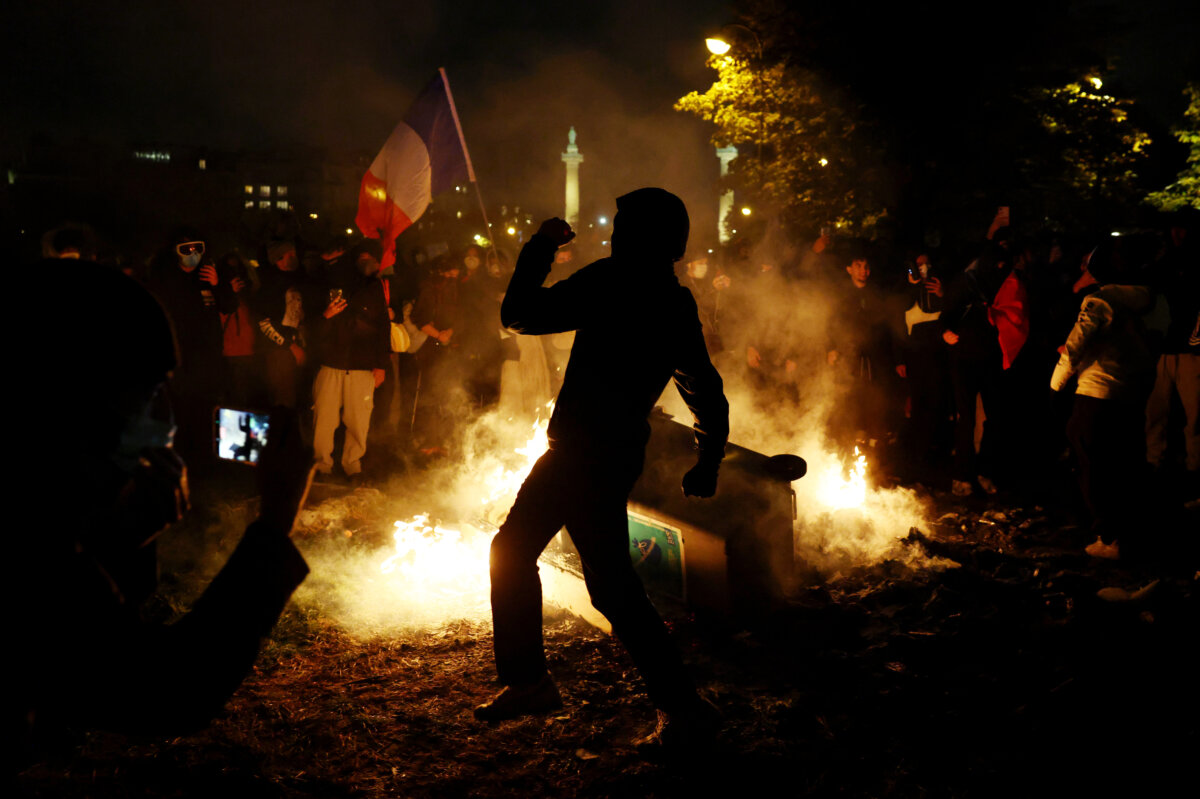
Nov. 7. Riots are still erupting in France’s major cities, for the fourth weekend in a row, and are perhaps only slightly less destructive than before. On Oct. 19, the government imposed a curfew in many cities, then sent in police and water cannons. More than 3,000 shops—including several supermarkets—have been looted or destroyed. Stores that survived had boarded up their doors and windows, transforming the centers of Paris, Lyon, Marseille, and other cities into bleak, barren ghost towns.
The police, now mobilized to the limit, cannot indefinitely sustain this level of deployment. Their numbers are not unlimited, and individual officers cannot remain on duty without sleep. Police officers also cannot be expected to endure increasingly extreme violence. Since Oct. 17, more than 2,000 officers have been wounded—some severely—and the numbers continue to rise. On Oct. 31, firebombs were hurled at police officers, engulfing them in flames. The police were forced to retreat—in fact, flee. Even the firefighters trying to extinguish the flames were attacked.
French police officers have been given orders that no rioter should be harmed, even those who directly threaten the life of an officer. Should a rioter be killed, authorities would view it as a major catastrophe—perhaps triggering a wider uprising across the country—and to defuse the situation, the officers responsible would almost certainly be imprisoned. Every police officer is aware of what happened to Florian M., the officer who, while attempting to arrest Nahel Merzouk, a young criminal of Arab descent, on June 27, 2023, accidentally killed him: The officer was arrested and charged with intentional homicide.
The French police also see that arresting rioters is futile. All rioters—even the most violent—enjoy virtually total impunity. Of the nearly 5,000 rioters who have been arrested since Oct. 17, almost all were released within a few hours, free to resume rioting. To date, about 200 have been brought before a judge and fewer than half have been convicted.
Police officers can see that the French justice system is now largely in the hands of a far-left organization, the Magistrates’ Union, whose positions align with those of La France Insoumise (France Unbowed), currently the leading left-wing party in France. The party’s founding documents clearly state that its goal is to combat police repression and fight for “social justice”—hardly to uphold law and order.
Far-left militias identifying with the Antifa movement, which train for street combat, are active in France. While the French intelligence services are aware of them, most of their members—even those classified as capable of threatening the security of the state—are not under surveillance. Hodei Ciarra Docampo, accused of burning down the magnificent Limoges town hall, is a repeat offender, previously convicted of assaulting and wounding a police officer, yet he was set free to reoffend. He was deemed dangerous, and has proven that he is.
A militia, the “Young Guard,” is responsible for many serious assaults, as well as the murder in February of a 23-year-old Catholic man, Quentin Deranque, in Lyon. Two of the men accused of that murder are in prison awaiting trial. They had been parliamentary assistants to the militia’s leader, Raphaël Arnault, a member of parliament (MP) for France Unbowed. Arnault was questioned by the police only a few days ago—eight months after the incident.
Several MPs and mayors from France Unbowed have called for insurrections and openly support the rioters.
For the past two decades, the number of Muslim immigrants in France has increased significantly. Even though many have acquired French nationality, the majority of Muslims living in France have not integrated. An increasing proportion—57 percent of Muslims aged 18 to 24 who were polled—state that Sharia law is superior to the laws of the French Republic. Many live in no-go zones controlled by Muslim criminal gangs that sustain themselves through drug trafficking (France is in the process of becoming a “narco-state”), accompanied by radical imams who incite jihad as well as hatred of the native French people, France, its history, its architecture, its laws, everything about it. Members of these gangs carry out raids in the city centers of major French urban areas several times a year, attacking everything in their path.
Although the collection of ethnic and religious statistics is prohibited in France, studies indicate that a minimum of 10 million Muslims live in France and that 25 percent of children born in 2024 and 2025 were given Muslim first names—a proportion that continues to grow each year. The “great replacement” described by Renaud Camus is a reality that Jean-Luc Mélenchon, the leader of France Unbowed, acknowledges—indeed welcomes—by suggesting that a “new” Muslim France is taking shape.
While some rioters may belong to the far left, the majority appear to be Muslims and part of this “new” France—as can be seen in video footage filmed by the rioters themselves, complete with exclamations in the videos of “wallah” (“by Allah”) and “bismillah” (“in the name of Allah”).
American and Israeli flags are burned and trampled. Palestinian flags are seen everywhere. They have become a symbol not only of a destructive and murderous intent toward Israel and Jews—with Jewish-owned businesses specifically targeted—but also of support for violence against French authorities and a rejection of Western civilization.
In response to the images of the riots and looting that have gone viral, U.S. President Donald Trump noted that France is being “besieged, looted, and set on fire by migrants.” Israeli Prime Minister Benjamin Netanyahu spoke of an “invasion of extremist Islam” in France. French President Emmanuel Macron denounced the remarks of “foreign leaders” as “unacceptable” and “stupid” and claimed that the images of riots in circulation were generated by artificial intelligence and that the incidents depicted had never taken place.
The shopkeepers whose stores were destroyed could see what was taking place. It happened to them. Many who were not insured against riots lost everything. Some have said their shops will remain closed. Others have sought bank loans to rebuild what was destroyed and restock their inventory. Most banks are afraid to offer loans, because further destruction is expected. Insurance companies that compensate those who were insured have warned that they will need to revise their terms and significantly increase premiums for coverage against riots and looting.
The police have told shopkeepers that their safety can no longer be guaranteed and advised them instead to hire expensive private security. It is an admission by the government that it is no longer willing or able to fully protect French individuals or property. On Oct. 24 and Oct. 31, there were also home invasions involving violence and theft. Consequently, many shopkeepers, homeowners, and renters have begun arming themselves. Since Oct. 17, sales of defensive and hunting weapons at gun shops across the country have increased tenfold.
France is still in a truly dire economic situation. The cost of the Oct. 17 to Oct. 18 riots alone has been estimated by the French government at 1.2 billion euros ($1.34 billion). Although the riots on Oct. 31, Nov. 5, and Nov. 7 were less significant, their damage adds additional costs.
The economic fallout from the riots will amount to an even higher figure. Financial experts have estimated the cost at a minimum of 22 billion euros ($24.65 billion).
Meanwhile, commercial activity has collapsed. French agriculture and industry are struggling to survive. Tourism, which accounts for roughly 8 percent of France’s gross domestic product (GDP), has been set back. Cancellations of flights to France and hotel bookings are mounting. No one, understandably, is stampeding to visit a country that looks like a war zone.
Public spending has reached more than 57 percent of GDP—the highest rate in the developed world, alongside Finland—and there is little room for further increases. Redistributive spending accounts for 60 percent of budgetary outlays. Successive governments have run budget deficits every year since 1974, and France’s public debt now exceeds 3.6 trillion euros (approximately 119 percent of GDP). In a few months, that figure will be even higher. Interest payments on the national debt have become the single largest item in the state budget.
Economic growth is virtually non-existent. France’s GDP fell by 0.1 percent in the third quarter of 2026. The French pension system is effectively bankrupt. It relies on a pay-as-you-go model in which contributions from the current workforce fund the pensions of retirees. When the system was established in 1945, there were five workers for every retiree; today, that ratio has fallen to 1.7 workers per retiree.
The French education system is also failing profoundly. France’s standing in international educational rankings is in free fall—an alarming development in an era when intellectual capital is a critical asset.
With less than six months to go before France’s next presidential election, the country appears to be on the brink of collapse.
Not since the end of World War II has it been in such a condition. However, in 1945, the French population held out hope for a recovery. Today, a pervasive sense of pessimism reigns over France. Polls state that 83 percent of those surveyed describe the future of their nation as hopeless, and 65 percent believe that Western civilization itself may be coming to an end.
The French public’s rejection of Macron is massive and deepening. His already-low approval rate has fallen even lower. He now enjoys a “favorable” rating from only 13 percent of the public. Eight out of 10 French people consider him “a bad president.” Since the legislative elections of 2024, the National Assembly has lacked a stable majority, leaving successive governments virtually unable to make any decisions.
Polls indicate that no candidate from the parties that have governed France for the past 30 years would be able to secure enough votes in the first round to advance to the runoff. The second round will likely pit Mélenchon against Marine Le Pen of the National Rally Party—with Le Pen currently projected to win in every poll.
Mélenchon can see he has no chance of winning, but he is a revolutionary: He seems to be counting on chaos to overturn existing institutions and then attempt to seize power.
During the National Rally’s 19th Congress on Oct. 24 in Orléans, Le Pen, apparently seeking to encourage a sense of optimism, spoke of hope, national unity, and the rebirth of France. Her task, if she is elected, will not be easy. Riots might even intensify.
A few months ago, France was still able to borrow money at a 3.2 percent interest rate. Now, the financial markets’ lack of confidence is such that it can only borrow at a rate exceeding 5 percent. If interest rates rise much further, France will no longer be able to fulfill its payment obligations and will be placed under the supervision of the European Central Bank (ECB). The ECB would impose drastic conditions, leaving any French government—regardless of its political stripe—with no other choice than to accept the ECB’s decisions.
Violence can occur anywhere, at any time. It can always be exploited—by leftists, Islamists, and even Macron himself—to further inflame any situation. On Oct. 23, Kévin Tessier, a drug addict undergoing psychiatric treatment, opened fire with a submachine gun on blacks and Arabs in the town of Trappes, a Muslim-majority suburb west of Paris. Tessier murdered a black Christian man and seriously wounded a 12-year-old girl. Without waiting for the results of the investigation, Macron immediately paid a visit to the town’s Islamist mayor, Ali Rabeh, at the time enjoying the company of Elias d’Imzalène—who, in 2024, had called for an “intifada in Paris and the French suburbs.”
Macron said that the attack that had just taken place was “a turning point.”
“It is the first time we have had a terrorist act that was planned to kill our compatriots, our children, based on the color of their skin or their religion,” he said.
Macron apparently forgot that 16-year-old Thomas Perotto was murdered on Nov. 19, 2023, by members of a Muslim gang—and that, in light of abundant evidence, the justice system ultimately acknowledged it as an act of anti-white racism. He also apparently forgot the Jews murdered in France since 2003 only because they were Jews: Sebastien Selam; Ilan Halimi; Jonathan Sandler and his two sons, Gabriel and Arieh, and Myriam Monsonego—all killed in Toulouse; Yohan Cohen, Philippe Braham, François-Michel Saada, and Yoav Hattab, murdered at a kosher supermarket in Saint-Mandé; as well as Sarah Halimi and Mireille Knoll.
Tessier is not a member of a right-wing party. He even attended meetings in support of the “Palestinian cause.” All the same, a few days later, Macron denounced “ambient racism,” and pointed the finger at the National Rally Party. Sofia Tizaoui, an activist for France Unbowed who had been invited on television, told Julien Odoul, a National Rally MP: “I want you to be a dead party.”
“France,” stated American historian Victor Davis Hanson, “is headed for inevitable decline.”
If Le Pen becomes president and actually succeeds in restoring order and leading an economic and financial recovery, France may regain its strength. If she fails, France could continue to become a “third-world nation.”
The situation across the rest of Europe has also not been improving. Leftist and Islamist riots have recently broken out in Germany, Italy, Albania, Spain, Belgium, and Greece. All of Western Europe is grappling with mounting economic difficulties as well as uncontrolled migration. Unless a broad recovery takes place, Europe’s greatly sneered-at “great replacement” might well soon be complete.
Originally published by Gatestone Institute
Views expressed in this article are the opinions of the author and do not necessarily reflect the views of The Epoch Times.
 Friends Read Free
Copy
Facebook
Tweet