

Commentary
The new report on the gross domestic product (GDP) looks encouraging. The real GDP increased at an annual rate of 3.4 percent in the third quarter of 2026 (July, August, and September). In the second quarter, real GDP increased by 2.2 percent. Seems like a good trend. But then you look at the details.
Services increased. However, “the increase was led by health care (mainly hospitals and outpatient care).” More specifically, this category contributed 0.56 percentage points to growth in the quarter and 0.79 percentage points in the previous quarter. Stated differently, this accounts for roughly one-sixth of third-quarter growth, and more than a third in the second quarter.
It’s certainly the single biggest growth item in services. Half of that spending traces to government sources for various programs. All of it is about treating sickness of one sort or another or the effects of aging.
Let’s get philosophical here. Should we call this output, productivity, or growth? The data say it is, but I wonder. I’m haunted by the parable Frédéric Bastiat told in the 19th century in which a boy throws a rock through a shopkeeper’s window and everyone is sad. But then an economist shows up and says this is actually good because it gives revenue to the glazier, who will spend it on his family and food, and so on it goes.
Bastiat explains that actually the first intuition is correct. The revenue streams here are fixing destruction, not creating wealth. The expenditure of the shopkeeper is a pure transfer of wealth from one person to another. It’s not output, growth, or prosperity. After all, the shopkeeper would rather save his money and spend it on his kids or on having a better life.
Bastiat uses the parable to teach a lesson about other forms of fixing and repair, whether from rocks or war. They don’t grow the economy; they subtract from it. Claims otherwise seize on what’s seen and ignore what is unseen.
Here’s my concern. This entire sector of medical services and healthcare provision is the No. 1 source of jobs in this country. It is 19 percent of GDP. It is growing very fast and could ultimately outpace manufacturing and technology. The expenditures are also growing. They exceed $15,000 per year per person.
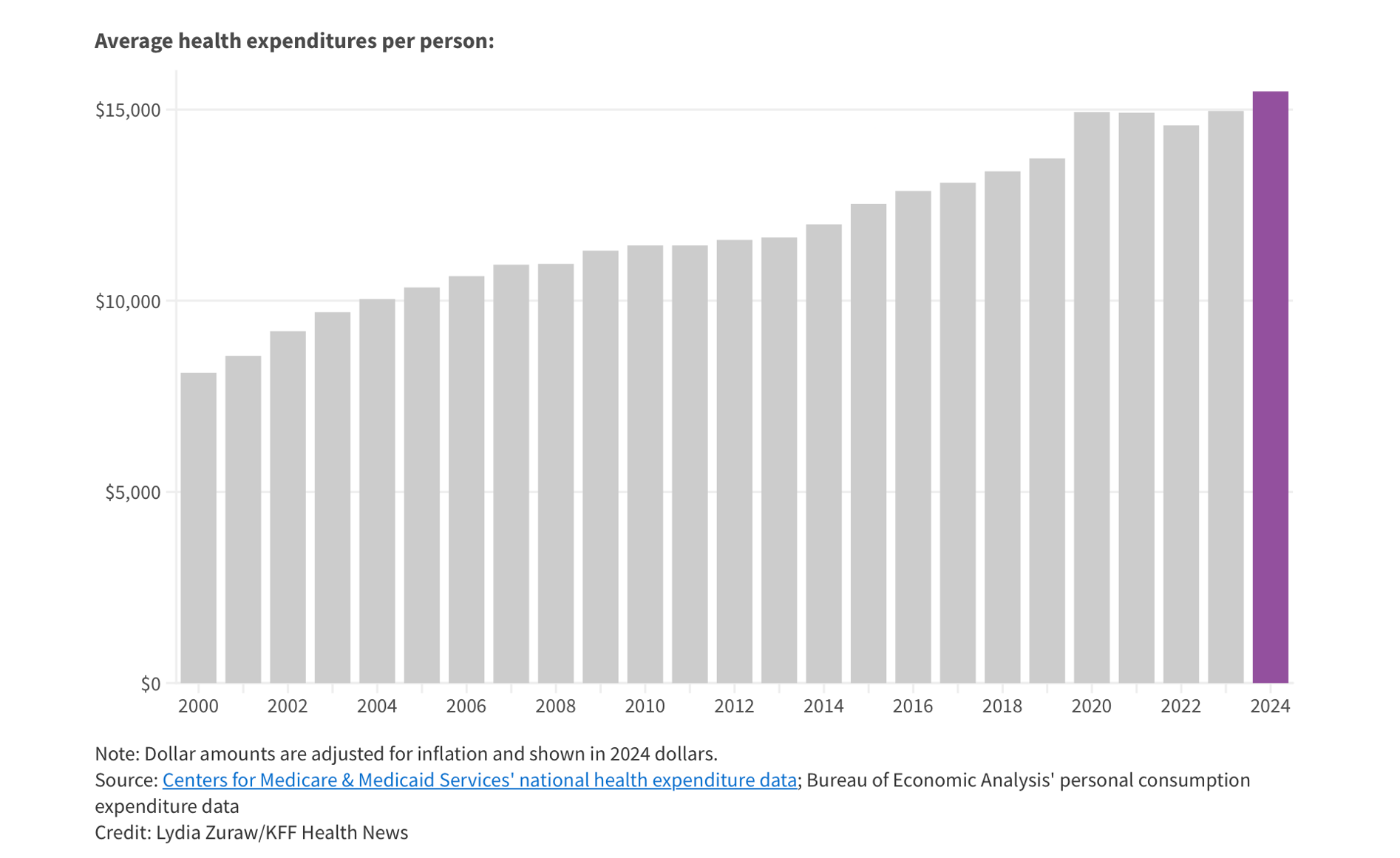
Economists have long noted the problem of “defensive expenditures.” Converting household medical bankruptcies and rising premiums into an aggregate “services growth” figure does not change the micro reality for many households.
It doesn’t seem like a good thing that people are sicker than ever. Believing that this is a form of economic growth could be called the broken person fallacy (instead of the broken window fallacy). It is not wealth creation merely to take money from people to fix their suffering and only manage their death until their money runs out.
The injury added to the insult is that a large share of spending is on chronic conditions linked to diet, inactivity, obesity, and other lifestyle factors that are at least partly preventable. But we have no real incentive to prevent them because living a healthy lifestyle pays zero returns on the cost of health insurance.
We pay and pay, and it’s not always clear what we get in return. After all, American health insurance buys nothing but the right to spend even more.
That’s not free enterprise. That’s parasitism!
About two years ago, a healthcare economist of enormous wisdom, usually quite moderate in his opinions, said something interesting to me. He said that the main problem we have today is figuring out how to make it profitable for industry to help people get healthy rather than merely managing sickness or, worse, harming them in the knowledge that they will have no choice but to spend more on the industry.
There is not a future of a flourishing and prosperous society within this model of doing business.
We really need a complete rethinking of this whole paradigm. It serves no one to characterize a massive industry treating a sick population as a form of economic growth. Economic growth is new businesses, new technologies, growing division of labor, savings and investment, and rising living standards.
Economic growth is not 60-year-olds being treated for heart disease, diabetes, failing limbs, high blood pressure, and vaccine injury. This is something different. It’s repairing broken windows or just treating broken people with drugs and taking their money for overpriced hospital stays, clinical office visits, expensive diagnostics, and unaffordable healthcare bills.
This is the path to household bankruptcy, as many people are experiencing now. Converting this microeconomic experience to aggregated macroeconomic data doesn’t magically convert tragedy to rosy economic reports and forecasts. Something has gone very wrong with our methodology if we believe otherwise.
So how do we convert a system that profits from sickness to one that profits from wellness? This is the great challenge of our time. It is going to require dramatic reform. Among other changes, we need vastly more institutional competition and competition among providers. This means scrapping certificate-of-need regulations that limit the building of new clinics and hospitals, plus scope-of-practice restrictions.
These restrictions are the legal, regulatory, and professional limits that define what a licensed or certified professional is authorized to do and what he is prohibited from doing. In healthcare, this is the most common context for the term. Scope of practice sets the boundaries of activities, procedures, and services a professional may perform based on their education, training, experience, licensure, and applicable laws.
This is why nurse practitioners cannot prescribe without physician oversight, and why you cannot charge your insurer or Medicare for chiropractic after a certain age, nor naturopathic or homeopathic care at all. The restrictions on residency slots and strict licensing are what limit the number of doctors. This absurdly restrains midwives or forces them into the underground economy.
Other reforms are necessary to lower healthcare costs and stop the hemorrhaging of our wallets and the decay of our bodies to benefit industrial cartels. But at the very least, we need a bit more incredulity when it comes to believing these GDP reports. They may not be delivering unto us glorious news but might actually be hiding a terrible decay beneath the surface.
Views expressed in this article are the opinions of the author and do not necessarily reflect the views of The Epoch Times.
 Friends Read Free
Copy
Facebook
Tweet