
Commentary
In the fall of 1863, Abraham Lincoln twice addressed the American people with words that still reverberate today.
On Oct. 3, in a document written by his Secretary of State William Seward, Lincoln issued a “Proclamation” marking the last Thursday in November as a day of national thanksgiving. “In the midst of a civil war of unequalled magnitude and severity,” Lincoln called on Americans to set aside that day so as to acknowledge “the gracious gifts of the Most High God” and to “implore the interposition of the Almighty Hand to heal the wounds of the nation.”
Since that time, though we have seen a change of dates to the fourth Thursday of the month, every president since Lincoln has issued such a proclamation. When we’re savoring our Thanksgiving turkey and trimmings, we might raise a glass to Abe Lincoln.
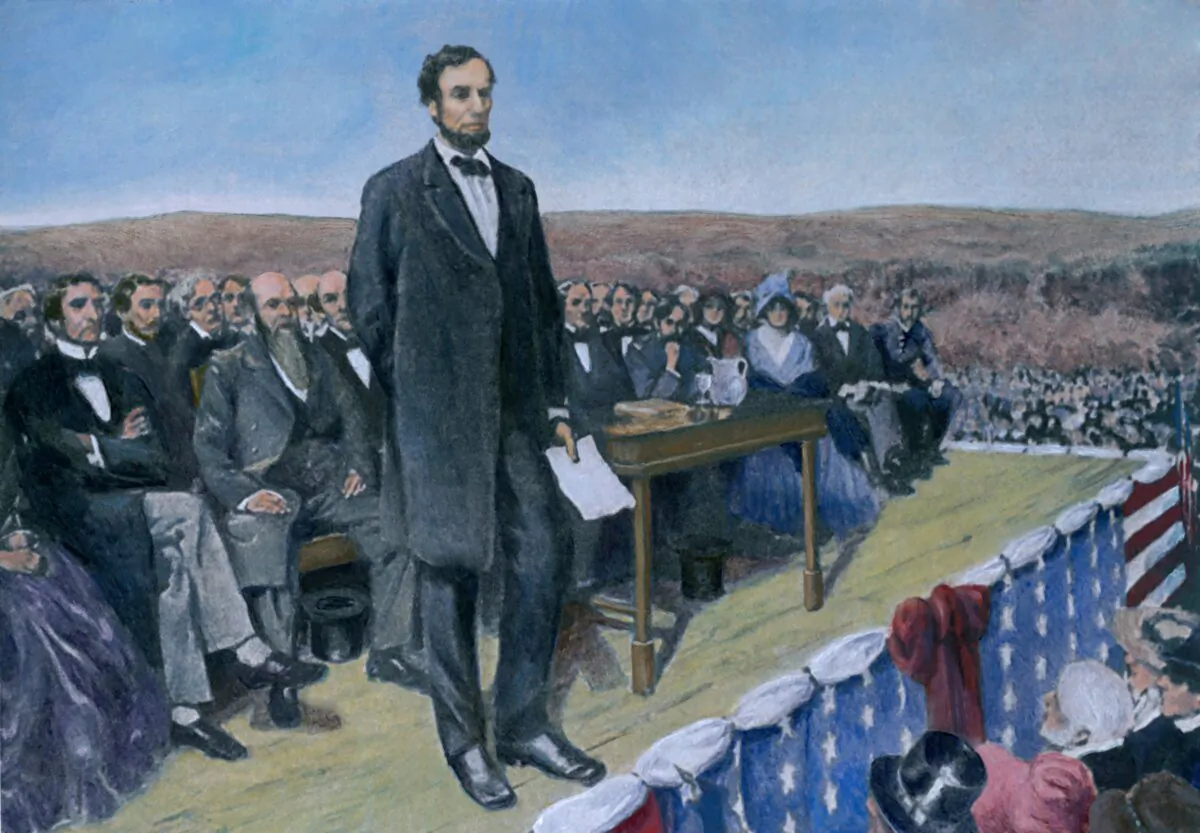
This year, it so happens that Thanksgiving falls on Nov. 26, just as it did in 1863. Just a week before that newly created day of gratitude, on Thursday, Nov. 19, 1863, Lincoln delivered his Gettysburg Address on the battlefield in Pennsylvania.
The dedication of a new national cemetery for the Union dead of this battle had brought together the crowd and the president that day. Edward Everett, a scholar, minister, and statesman, was the main speaker and gave a speech lasting approximately two hours, not an uncommon length for the time.
Lincoln followed up with a speech of 272 words that lasted about two minutes.
And while the newspapers and the public didn’t immediately recognize it, his Gettysburg Address became and remains the best-known speech in American history. Schoolchildren once memorized it—some still do—teachers of rhetoric routinely employ it in their instruction, and journalists and commentators even today frequently quote from it.
There are excellent reasons for the fame that time has bestowed on Lincoln’s Gettysburg oration.
The cadence of each of the 10 sentences, Lincoln’s word choice, the compression of thought, and the poetry of the piece as a whole mark this address as extraordinary. Contrary to popular opinion, Lincoln did not write these words on the train to Gettysburg, though he doubtless contemplated them while making that trip. He was known for his close attention to his speeches, and of the five surviving copies made of the speech in his own hand, none show the effects of the bumps and jolts a train of that day would have produced.
In combination with this masterpiece of eloquence are the sentiments that spoke to the occasion, to the audience, and to us today. Referring first to “a new nation, conceived in Liberty, and dedicated to the proposition that all men are created equal,” Lincoln notes that they have gathered to dedicate a part of the battlefield as “a final resting place for those who here gave their lives that that nation might live.”
After declaring that the dead have themselves consecrated this ground, Lincoln delivered the core of his message in the last sentence of the address, one which generations since have treasured and repeated so frequently that it has become a part of the American credo. Here, once again, is that singular sentence: “It is rather for us to be here dedicated to the great task remaining before us—that from these honored dead we take increased devotion to that cause for which they gave the last full measure of devotion—that we here highly resolve that these dead shall not have died in vain—that this nation, under God, shall have a new birth of freedom—and that government of the people, by the people, for the people, shall not perish from the earth.”
These words and those from the opening of the speech regarding liberty and equality have inspired Americans ever since they were spoken. They remind us that we were a liberty-loving people right from the birth of our republic, that each American has equal rights, and, perhaps most importantly, that we are a nation under God that repeatedly undergoes “a new birth of freedom.”
This new birth of freedom requires constant care and vigilance, as noted throughout our history. In his 1967 inaugural speech as governor of California, Ronald Reagan reminded his audience: “Freedom is a fragile thing and is never more than one generation away from extinction. It is not ours by way of inheritance; it must be fought for and defended constantly by each generation, for it comes only once to a people. And those in world history who have known freedom and then lost it have never known it again.”
Lincoln would have immediately understood and agreed with Reagan’s words.
These days, some Americans have forgotten, as Lincoln, Reagan, and so many of our leaders past and present have reminded us, that liberty is America’s cornerstone and that it comes with a cost, which is preserving and passing it along to the next generation as our ancestors passed it to us.
Do this, and, as Lincoln put it, “these dead shall not have died in vain.”
Views expressed in this article are the opinions of the author and do not necessarily reflect the views of The Epoch Times.
 Friends Read Free
Copy
Facebook
Tweet