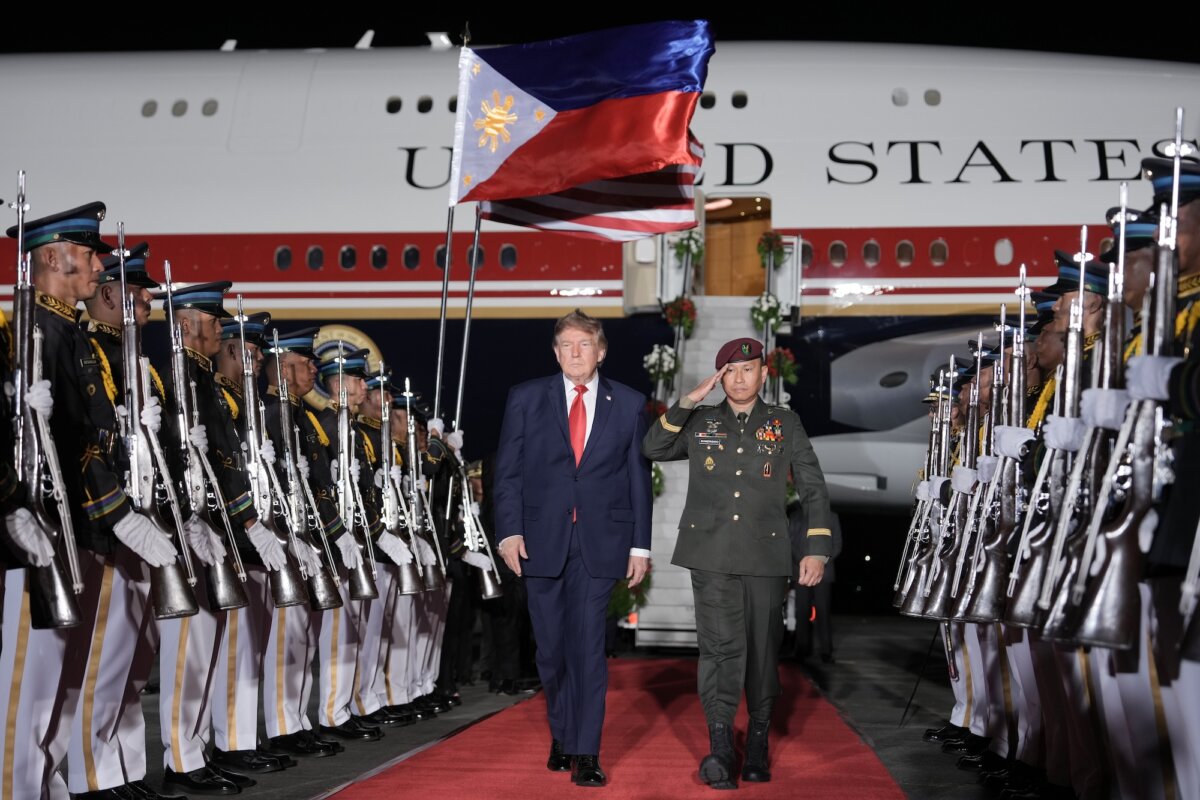


MANILA, Philippines—U.S. President Donald Trump arrived in the Philippines on Tuesday, beginning a high-stakes, three-day visit to Asia with a red-carpet arrival ceremony.
Air Force One touched down at around 5:30 p.m. local time on Nov. 17 in Manila, where delegations from across the world are gathered for the Association of Southeast Asian Nations (ASEAN) conference, with Trump expected to attend a special summit reception and dinner.
As Trump disembarked the plane, he was handed two flags—U.S. and Philippine—which he waved for the cameras before being greeted by officials and walking down the red carpet. A marching band played “YMCA” as he walked toward a waiting helicopter. The trip, which also includes a stop in China, is Trump’s first international visit since the midterm elections.
Trump’s three-day itinerary includes talks with world leaders, including a planned trilateral meeting with Russian President Vladimir Putin and Chinese Communist Party (CCP) leader Xi Jinping.
On the agenda are also discussions with the Quad—a group of countries comprising Japan, Australia, India, and the United States—along with an expected announcement of a trade deal with Thailand.
At around 6:45 p.m. local time, Trump and several members of his cabinet met with the Quad leaders and their respective entourages.
“The Quad leaders summit is something that’s become very important, very special, and it’s an honor to be involved,” Trump said.
Trump announced that the Quad on Tuesday would be conducting a joint military exercise involving maritime patrol aircraft “as we continue to protect peace through strength.”
Other priorities of Trump’s visit include advancing Pax Silica, the U.S. State Department initiative established in December 2025 to secure supply chains and critical minerals needed for artificial intelligence, dubbed “super intelligence” by the Trump administration. The president is expected to encourage Asian nations to choose U.S. suppliers over Chinese manufacturers for advanced computing technology.
Philippine National Police spokesperson Brig. Gen. Allen Rae Co said earlier on Tuesday that security preparations were in place for Trump’s arrival, coming amid a number of protests and street rallies by various groups despite police appeals to defer demonstrations, according to the state-run Philippine News Agency. A separate security contingent had been assigned to Trump, according to Co, who declined to disclose operational details.
Edgard Kagan, a senior adviser at the Center for Strategic and International Studies (CSIS) and former U.S. ambassador to Malaysia, told reporters at a Nov. 9 press briefing that attending the ASEAN conference “signals that the U.S. is engaging on something that’s very, very important to Southeast Asia, and recognizes that Southeast Asia continues to be an area of significant competition between the U.S. and China.”
Regional Partnerships
The timing of the meetings signals to the CCP that U.S. interests are in developing political and economic partnerships throughout the region, according to Kagan.
“It’s fair to say the Chinese are not fans of the Quad,” Kagan said, noting that the meeting sends a message to Xi “that the U.S. has some very significant relationships, and … doing this immediately before going to China is a reminder that the president’s working on the U.S.-India relationship.”
Philippine President Ferdinand “Bongbong” Marcos Jr. will host Trump at Malacanang Palace on Nov. 18 for a bilateral lunch.
Discussions are expected to include the U.S.–Philippine Mutual Defense Treaty, as well as tariffs and trade.
The U.S. delegation will then head to Shenzhen, China, on Nov. 18 for the Asia-Pacific Economic Cooperation summit.
The Trilateral Meeting
All eyes are on the possible Nov. 19 sideline meeting among Trump, Xi, and Putin in Shenzhen.
Denuclearization and military arms controls are topics of discussion proposed by Putin and agreed to by Trump, though details of the agenda are limited.
“An ambitious arms control agreement does not look like a likely outcome from this,” Heather Williams, director of the Project on Nuclear Issues and senior fellow in the Defense and Security Department at CSIS, said during a Nov. 9 briefing.
“If Trump, Putin, and Xi do meet to discuss denuclearization, I would say expect modest risk reduction steps at best and, in particular, watch for friction with U.S. allies.”
Williams highlighted steps taken by the Chinese regime in recent years to expand its arsenal, while noting that the CCP took part in a bilateral dialogue with the Biden administration that produced little in terms of formal outcomes. During a bilateral meeting in Lima, Peru on Nov. 16, 2024, U.S. President Joe Biden and Xi agreed that humans must not cede control over decisions to use nuclear weapons to artificial intelligence.
Potential outcomes of the trilateral meeting during Trump’s Asia visit, Williams said, could include a joint statement declaring nuclear war cannot be won and must never be fought, an agreement to keep nuclear weapons under human control, and an agreement on missile launch notifications.
 Friends Read Free
Copy
Facebook
Tweet