
Commentary
The city of Savannah has taught me that beauty still matters.
A city with a population of a mere 150,000, Savannah attracts nearly 15 million tourists a year. Pound for pound, there are few cities in America that host so many weddings, honeymoons, and bachelorette parties. Tourist spending in 2024 was estimated at about $4 billion.
What is all the fuss about?
Savannah has no major sports teams, neither college nor pro. The restaurant scene is bustling, to be sure, but for a real foodie, any major city leaves it in the dust.
It does not boast the gambling or entertainment of Las Vegas. There are no theme parks of note in striking distance. It is near the beach, but Hilton Head is the destination of choice in this neck of the woods, not nearby Tybee Island.
Pleasant beach weather is rare, in any case. During the tourist season, oppressive humidity is usually the rule rather than the exception. What’s more, Savannah is not on the way to any other place. If you visit Savannah, you really have to mean it. No one who ends up there is just “passing through.”
And still, the people come—and come in droves.
I don’t think it is rocket science: If you build something beautiful, they will come.
Savannah is a uniquely beautiful town. She styles herself as the most haunted city in America. Ghost tours are all the rage. But it is her beauty that haunts, not the ghosts.
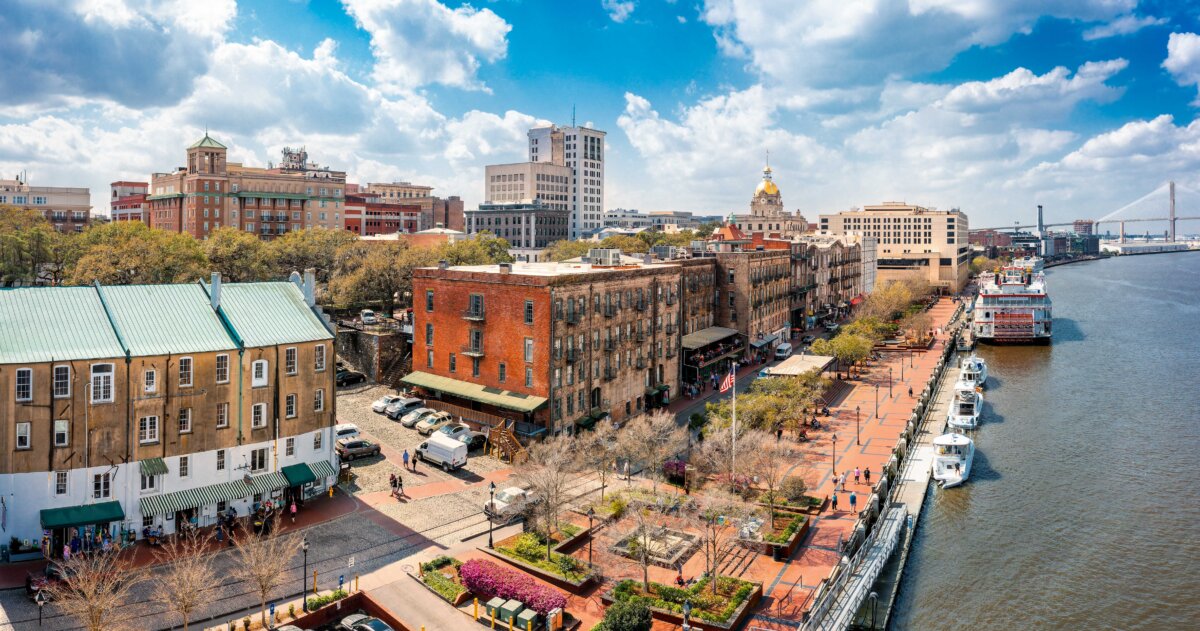
What jumps out at the visitor before anything else is the mixture of natural beauty and the built environment. The live oaks rise up like pillars of the earth, rooted in every city square; they line the boulevards and streets like watchful guardians, making you feel as if you have joined a procession.
These majestic trees often grow wider than they are tall, offering relief from the heat; Spanish Moss seems to drape itself across the branches, lending an air of antiquity and mystique. The live oaks would be enough on their own, but throw in the elegance of the Greek Revival, some Gothic flamboyance, and Italianate grandiosity for good measure, and you have yourself one of the most beautiful places in America.
Savannah is on a short list with New Orleans; her sister and rival, Charleston, South Carolina; and Québec City, Canada, as the best-preserved and most beautiful colonial towns on this side of the pond.
She is no Disney world either. Savannah is not made up of a few well-kept blocks designed to spring a trap on tourists. She seems to go on and on. And so she does.
Savannah can boast a legion of neighborhoods with beautifully preserved historic public buildings and homes that hail from the horse-and-carriage era, through the streetcar, to the automobile. Hardly a modern blemish to be found anywhere. How did this happen?
The so-called Oglethorpe plan may be the part of her DNA that sets Savannah apart the most. The Oglethorpe plan refers to the city’s design by its founder, General James Oglethorpe, who settled on a bluff overlooking the Savannah River in 1733. A colony established to provide a buffer between Charleston and Spanish Florida, Oglethorpe planned the first city squares in Savannah to be easy to defend and to encourage natural community.
The square was mixed-use: The idea was that the surrounding lots should include both public and private property, referred to as “trust” and “tithing” lots, respectively. Because this plan worked so well and was easy to replicate, Savannah continued the Oglethorpe plan long after her establishment; there are now 22 squares that follow it. The results are difficult to argue with.
The beauty of Savannah today takes the form of a kind of romance; it is not only the pretty trees, stately buildings, and town planning. When you walk through these squares and see a school, a church, a post office, and a family home all within spitting distance, some part of your soul swoons.
Few modern people know what it is to live like this—in a place so human—but there is no question they long for it.
People come to Savannah, I think, to imagine what it would be like to live in a world so deeply rooted. Many decide to stay and find out. In a town full of families who can trace their roots to the founding, there are also transplants who could live anywhere.
Part of the romance of beauty is that our encounters with it make us feel at home. This brings me to a final word about the magic at work in Savannah’s singular beauty.
When I first moved to Savannah and had the privilege of living in the historic district, I was struck by how I never grew tired of my walks, even though you could walk through it all in less than half a day. Here, again, we have James Oglethorpe to thank.
The squares were designed for pedestrians, not cars or commuters. When we walk, people like to have choices. You can walk through Savannah a hundred times and always take a different route. Something about Savannah’s beauty is always fresh, even as you feel surrounded by antiquity—a vanished world somehow remains present here.
The theologian St. Augustine said something like this about beauty: Its presence feels at once something ancient and something new. I think he would have felt very much at home in Savannah.
Views expressed in this article are the opinions of the author and do not necessarily reflect the views of The Epoch Times.
 Friends Read Free
Copy
Facebook
Tweet