Commentary
U.S. President Donald Trump made it clear in recent remarks: “We’re leading China in AI [artificial intelligence] … and, frankly, I want to keep it that way, because whoever wins AI, wins.”
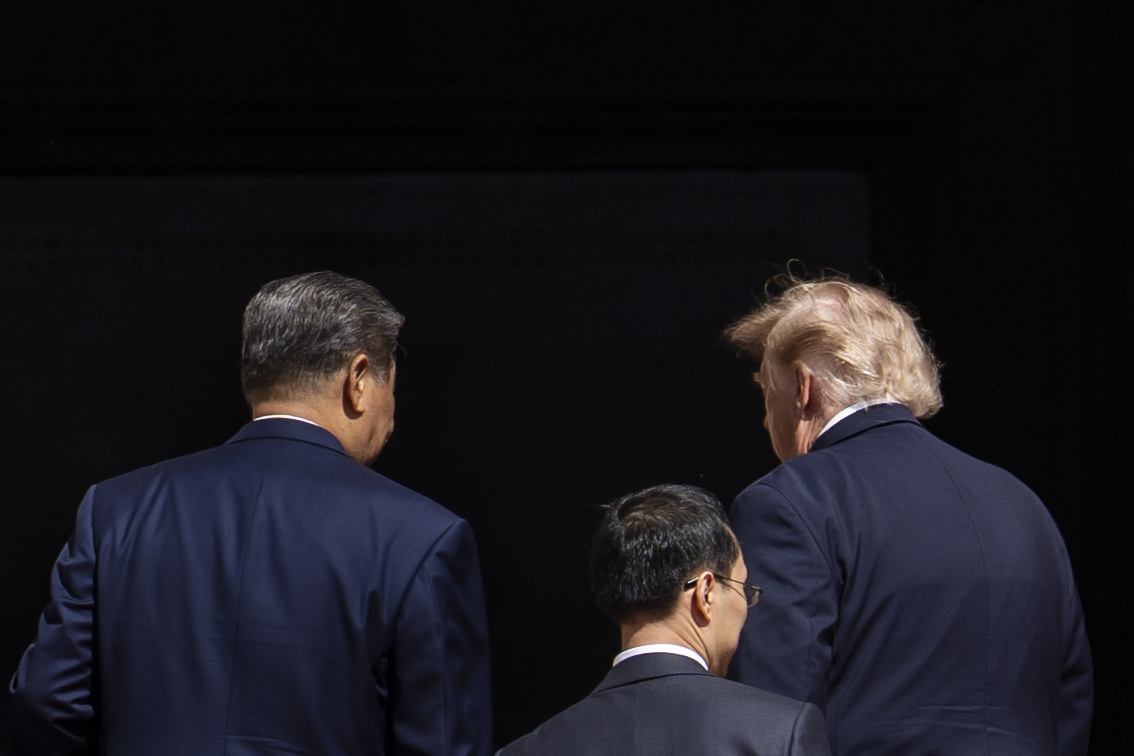
Whether the United States or China wins AI, or “Super Intelligence,” as Trump calls it, and thus global strategic primacy, was one of the highest-stakes issues at the recent Sept. 23 to Sept. 25 summit in Washington between Trump and Chinese Communist Party (CCP) leader Xi Jinping.
At a Sept. 25 White House state dinner, Trump displayed the United States’ artificial intelligence leaders, including OpenAI’s Sam Altman, Nvidia’s Jensen Huang, Google and Alphabet’s Sundar Pichai, Microsoft’s Satya Nadella, Meta’s Mark Zuckerberg, Apple’s Tim Cook, and SpaceX’s Elon Musk, whereas China did not bring any of its corporate AI leaders.
The United States leads the global annual $2.7 trillion AI industry, primarily because it has constructed more than 5,400 data centers, U.S. private-sector AI investment exceeds $760 billion, and U.S. companies build the superior microchips that power its AI models.
China may have verified more than 500 data centers, with some estimates putting the number at about 1,000, while state spending on AI infrastructure could amount to $295 billion over the next five years. China is becoming competitive in AI models, although its most capable Huawei AI microchips may be three years behind the most capable chips from U.S. company Nvidia.
As such, since 2022, China has been trying to rope the United States into “dialogue” over AI, with former U.S. President Joe Biden agreeing to AI talks in November 2023, and the first U.S.–China government talks on AI governance and risks taking place in May 2024.
Then, on Sept. 20 this year, U.S. Treasury Secretary Scott Bessent announced that formal AI talks will precede the next Trump–Xi meetings, at the November 2026 Asia-Pacific Economic Cooperation summit in Shenzhen, China, and then the December 2026 G20 summit in Doral, Florida.
During the latest summit, Xi pressed for more “dialogue,” according to Chinese state media Xinhua.
One certainly hopes that Washington and Beijing make good use of a formal, structured “U.S.–China AI Dialogue” and the “AI safety notification mechanism” recently announced by Bessent.
However, confidence in China’s willingness to cooperate in taming AI is not borne out by its decades of refusal to consider limitations on its now-burgeoning nuclear arsenal, including its lack of public comment on Trump’s summit suggestion that China and Russia join the United States in three-way arms-control talks—and its unwillingness to control telecommunications and AI giant Huawei.
Founded in 1987 by People’s Liberation Army engineer Ren Zhengfei, Huawei is now a Shenzhen-based megacorporation and major global producer of consumer electronics, telecom infrastructure (30 percent of the global market), cloud computing and, more recently, the leading Chinese producer of AI chips.
These investments have also turned Huawei into a very competitive AI powerhouse, as it can offer cheaper, Chinese state-subsidized, comprehensive “single-stack” AI packages made up of 5G telecommunications, cloud servers, AI silicon, and enterprise switches.
However, the Washington summit also coincided with the latest chapter in the long-running U.S. war with Huawei. On Sept. 9, Huawei went on trial in the U.S. District Court for the Eastern District of New York in Brooklyn, facing 14 criminal counts, including bank fraud, wire fraud, racketeering, and trade secret theft.
In his opening statement, U.S. Department of Justice trial attorney Taylor Stout stated that Huawei engaged in a “far-reaching criminal scheme extending over twenty years … victimized American companies and abused the American financial system, all in an effort to dominate the telecommunications industry around the world.”
The record shows that Huawei rewards its employees for espionage and has been a key architect of the Chinese Communist Party’s digital dictatorship—the melding of digital information and surveillance technology to contain the citizens of China and to strengthen the dictatorships of Chinese Communist Party (CCP) allies.
Huawei’s war against democracy has at times been kinetic.
On Feb. 16, 2001, the United States bombed cable nodes being built by Huawei in violation of United Nations sanctions, to connect Saddam Hussein’s anti-aircraft weapons, radar, and command-and-control systems in order to more effectively target U.S. aircraft enforcing no-fly zones.
On this occasion, by striking on a weekend, the United States sought to avoid killing Huawei technicians, but the early protest by then-Secretary of State Colin Powell and sanctions imposed by Washington have not prevented the CCP from turning Huawei into a major tool to subvert freedom and advance terrorism.
The current Brooklyn trial highlighted how Iran strengthened its terror regime. Before he left Iran for the United States in 2011, prosecution witness and telecom engineer Parham Baheshti said he had worked with Huawei to expand the internet in Iran, but realized that they were “analyzing the [Iranian] people and their online behavior … They help a dictatorship to rule and suppress people.”
Already in 2026, the Iranian regime is estimated to have killed more than 30,000 opponents, largely around anti-regime protests in January.
Should this regime and its Huawei-assisted surveillance networks survive, there is concern that Iran’s adoption of Huawei’s advanced AI capabilities could enable surveillance networks to automatically monitor vast amounts of internet and video data, even predicting opposition behavior to achieve faster suppression.
Thankfully, Trump is well aware of the threat posed by Huawei and has taken several defensive initiatives.
In an Aug. 17, 2020, interview on Fox News, Trump called Huawei “spy way.” About a year earlier, in May 2019, Trump’s Department of Commerce placed Huawei on the “Entity List,” administered by the Bureau of Industry and Security (BIS), barring U.S. companies from selling components, software, or services to Huawei without a license.
In 2020, the Trump administration updated the BIS-managed Foreign-Direct Product Rule to forbid foreign chipmakers, such as TSMC in Taiwan, from selling chips to Huawei and to China that used U.S.-sourced software or chip-fabrication tools.
From 2019 to 2020, the administration went from banning to purging Huawei and other Chinese equipment from the U.S. telecom sector, to be replaced with “safe” U.S. products, a process expanded under the Biden administration and costing nearly $5 billion.
In addition, the Trump administration has enhanced U.S. competitiveness against Huawei by easing regulations, opening federal lands, providing financial support for the growth of U.S. data centers, and facilitating mergers that increase U.S. competitiveness.
In particular, the administration reversed initial opposition, following a U.S. Intelligence Community assessment that it was important for national security, to approve the $14 billion merger—finalized in August—between Hewlett Packard Enterprise (HPE) and Juniper Networks, a pioneer in routing and cloud networks.
This complements HPE’s strengths in enterprise servers and data storage, enabling it to become a U.S. “single-stack” competitor to Huawei.
But the U.S. battle with Huawei will continue, including a May 2025 BIS rule banning U.S. use of Huawei’s advanced Ascend AI computer chips if they use U.S. technology, as well as the growing effort to prevent Chinese AI models, such as Huawei models, from using cloud services to access and exploit U.S. AI models.
To “win” AI, the United States must also contain and defeat Huawei, a key weapon in the CCP’s arsenal for achieving global digital dominance.
Views expressed in this article are the opinions of the author and do not necessarily reflect the views of The Epoch Times.
 Friends Read Free
Copy
Facebook
Tweet