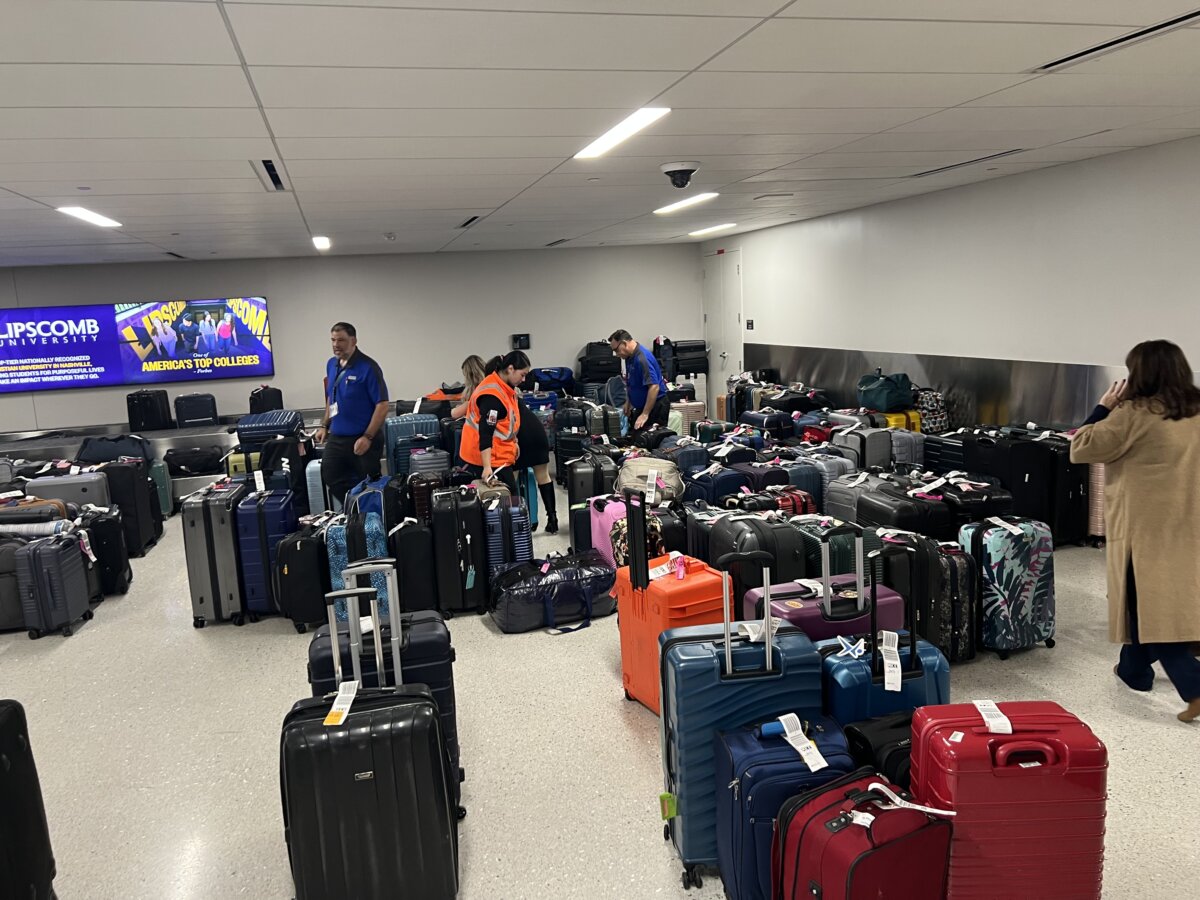

Thousands of domestic American flights were not allowed to take off by the Federal Aviation Administration (FAA) and were canceled Friday, due to a communications problem in the network of en route centers that handle air traffic when planes are traveling between airports.
Transportation Secretary Sean Duffy announced a little after 4 p.m. ET that the agency had issued a “nationwide ground stop” at airports because of an unspecified communications problem that was affecting all of the 22 Air Route Traffic Control Centers that cover the continental United States, Alaska, and Hawaii.
The stoppage lasted for more than four hours and resulted in “tens of thousands of people in airports, separated from their families, without any knowledge of where they’re going to sleep tonight,” Duffy said in a press conference in the 8 o’clock hour.
All planes still in the air when the stoppage was announced, domestic and international flights, were either landed at their destinations or diverted. Hotels, trains, and many related websites were overwhelmed with heavy demand. Many Americans expressed anger and frustration, and speculated about what might have caused such a huge travel disruption.
Here’s what we know about what happened, so far.
Was This a Hack?
Homeland Secretary Markwayne Mullin held a press conference soon after the stoppage was announced to calm fears. He said the government doesn’t have evidence that it was a “nefarious attack” and instead was treating it as a “telecommunication outage as of right now.”
Asked if the outage was caused by a human or artificial intelligence hack, Mullin refocused the question on batting down the physical terror threat.
“Everybody’s safe. There is no reason to be concerned about your loved ones if they’re flying,” Mullin said, though he eventually add, “We’re not ruling out anything at this point.”
Mullin was asked about the coincidence of Microsoft’s Outlook program going down on Thursday, followed by a flight communications outage the next day. “I don’t see any reason to connect those two at all,” he said, and reiterated that idea in the later joint press conference with Duffy.
Microsoft chimed in to say that it didn’t think the two were connected, either.
Democrats Press for Answer
More than 7,000 flights within, into, or coming out of the United States were canceled Friday, according to the FlightAware tracker. Some prominent Democrats criticized the responses coming from the administration.
“The safety of our skies is built on redundancies. Whatever led to the nationwide ground stop will warrant a thorough and complete investigation. As Aviation Subcommittee Ranking Member, I’ll be demanding answers from the FAA,” Sen. Tammy Duckworth (D-Ill.) wrote on X.
Rep. Jerry Nadler (D-N.Y.) echoed and amplified those concerns. He said that instead of giving straight answers, Duffy and Mullin were “delivering more chaos and confusion.”
Nadler called the outage and plane stoppage a “wake-up call” that proves America “must modernize our aviation system AND invest in reliable alternatives like true high-speed passenger rail.”
Duffy Asks Congress to Fund System Updates
In the joint press conference announcing that the stop had been ended, Duffy agreed that America has “an incredibly old air traffic control system” that needs to be overhauled.
Yet the transportation secretary blamed Congress for a lack of funds to do the job. He said that the House and Senate had voted for more than $12 billion to update things but explained that Congress has yet to “fully fund” the system’s modernization.
“This is an emergency. I want Congress to give us emergency funding,” he said.
President Donald Trump has previously asked for $30 billion in additional funding. Duffy upped the ask at the press conference to $50 billion.
The secretary laid out some of the things wrong with the current infrastructure, including old radio parts and switches, leaky air traffic control towers with broken elevators, and using radar manufactured in the 1970s for which replacement parts are no longer manufactured.
Last week, the FAA announced a new initiative to try to update the air traffic control system so that it no longer has to use floppy disks.
Cause Still Uncertain
Mullin said his agency is still investigating the incident, though it has received none of the usual indications that foreign agents or terrorists were involved.
“We’re still working on the details of what went wrong today,” Duffy said. In broad terms, the system was overwhelmed, and the en route centers were not able to effectively track or communicate with all the airplanes in the sky.
The failure wasn’t total, but the system could not effectively handle more planes, so all flights that hadn’t taken off yet were grounded to let the airports land the planes in the sky safely and so that diagnostic workers could test equipment and replace bits of it that weren’t working.
The system was overwhelmed at the same time as some updates were occurring. Further replacement of some older components with newer parts seemed to do the trick, Duffy said, which he said would indicate that the problem was the old system, not the new additions.
Yet it remains possible that something that someone did in trying to update the old system at least worsened the current problem.
The last brief nationwide ground stop occurred in 2023 because the Notice to Airmen system went down, Reason Foundation transportation policy analyst Marc Scribner noted.
“That was a mistake by a contractor who accidentally deleted some files, and that cascaded because that system was so ancient and macgyvered together. So it wouldn’t shock me if some kind of human error is the proximate cause here. But it’s possible that there was some sort of equipment failure,” Scribner told The Epoch Times.
Scribner said it’s a problem that U.S. air traffic control continues to rely upon “ancient systems” when there are “twenty-first century digital solutions with redundancies that probably could have prevented this sort of thing.”
 Friends Read Free
Copy
Facebook
Tweet