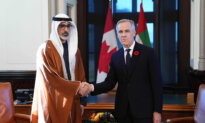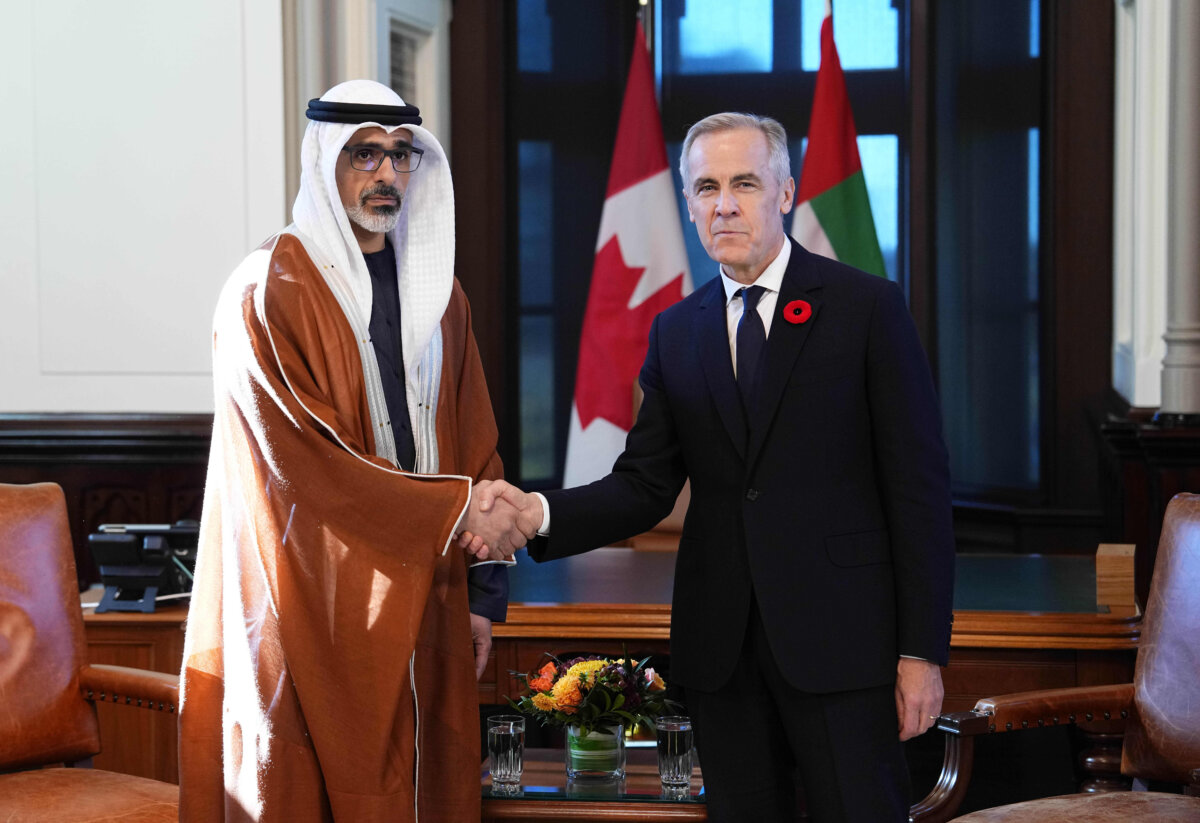

Prime Minister Mark Carney formalized a free-trade agreement and defence co-operation pact with the United Arab Emirates this week as part of talks that will also see Ottawa start extradition treaty negotiations with the Gulf nation.
The agreements were among several trade and infrastructure deals signed during a visit to Ottawa by Abu Dhabi’s crown prince. They follow a pledge made by the UAE last fall to invest $70 billion in Canada.
The federal government has not provided a timeline for when the promised investments will begin. International Trade Minister Maninder Sidhu said the funding could support new projects in mining, logistics, energy and digital technology.
“They are actively looking at deploying that as soon as possible,” he told reporters on Oct. 27. “They’ll have more to say publicly soon.”
Neither Carney nor Crown Prince Sheikh Khaled bin Mohamed bin Zayed Al Nahyan took questions from the media about the trade deals or the UAE’s $70 billion commitment.
The leaders also didn’t elaborate on the potential extradition treaty.
The Prime Minister’s Office said in a statement that Canada and the UAE planned to “launch negotiations toward various justice and public safety instruments, such as an Extradition Treaty and a Mutual Legal Assistance Treaty.”
An extradition treaty would establish the UAE as an official extradition partner, granting it the power to request that Canada surrender individuals sought by UAE authorities for actions deemed criminal under both nations’ legal systems.
Sidhu was questioned by reporters about pursuing an extradition agreement amid concerns over the UAE’s human rights record. Human Rights Watch and Amnesty International have reported the imprisonment of government critics, concerns over the fairness of criminal trials, arbitrary detention, and restrictions on freedom of expression in the Gulf nation.
“Human rights never takes a back seat with Canada,” Sidhu told reporters. “It’s important that we continue to engage, being at those tables to make sure that we raise whatever we need to raise in terms of human rights.”
The UAE has also faced allegations of supporting Sudan’s Rapid Support Forces (RSF), a paramilitary group accused of widespread atrocities during Sudan’s civil war. The U.S. government has determined that genocide has occurred in Sudan’s Darfur region, where the RSF has been accused of mass killings and other abuses. The UAE denies allegations that it has provided military support to the warring parties.
A coalition of 17 civil society organizations wrote an open letter earlier this year, urging Canada to reconsider deepening its connection with the UAE, arguing the country is fuelling the conflict in Sudan.
The letter, signed by the Trade Justice Network, Amnistie internationale Canada francophone and Equality Fund, said championing human rights must remain central to Canada’s national identity even as it pursues trade diversification.
“Even as Canada looks to diversify its trading partners, we insist that it needs to assert its support for human rights as a core Canadian value,” said the letter. “Our prosperity cannot be built at the expense of the lives and futures of the Sudanese people.”
Deals and Details
Sheikh Khaled, the son of the UAE president, and other senior Emirati officials arrived in Ottawa on Oct. 26 for a two-day visit, including a state dinner hosted by Carney.
Carney, who spoke at the dinner, said the countries are bound by a shared determination to “build for the future.”
Part of that is the agreements Canada and the UAE signed committing to expanding clean power and energy infrastructure and collaboration on diplomatic training, according to the PMO.
The two nations have also formalized a defence partnership agreement that encompasses military education and professional development, coordinated training operations, cybersecurity, and information sharing, as well as the creation of a joint military committee.
Conservative MP Stephanie Kusie, who serves as her party’s critic for international trade, commented on Ottawa’s deal with the UAE in Oct. 27 social media post, saying it’s “tiresome to see the Prime Minister holding yet another flashy meeting with no tangible outcomes for Canadians, as he did today with the UAE.”
“Canadians are struggling to make ends meet and are looking for hope. Instead of another fancy ceremony, Canadians deserve clear information about the number of jobs and the names of projects involved, not another vague ‘strategic partnership’ that lacks any real details on how it would improve their lives,” she said.
The Prime Minister’s Office said the trade deal is poised to cut or abolish tariffs on more than 99 percent of existing Canadian exports heading to the UAE upon full implementation.
The PMO said the agreement also aims to address non-tariff barriers and establish a more reliable framework for conducting trade, making investments, and broadening market opportunities for Canadian goods and services. These include offerings from the industrial, agricultural, forestry, fishing, seafood, environmental, and engineering industries.
The Prime Minister’s Office said the trade agreement is expected to take effect next year.
Carney first visited the UAE for trade talks last November. He was the first Canadian prime minister to do so in more than four decades.
The Canadian Press contributed to this report.
 Friends Read Free
Copy
Facebook
Tweet