

Prime Minister Mark Carney said Canada and China are deepening their financial ties as part of their strategic partnership, pointing to steps the two countries have already taken in that direction.
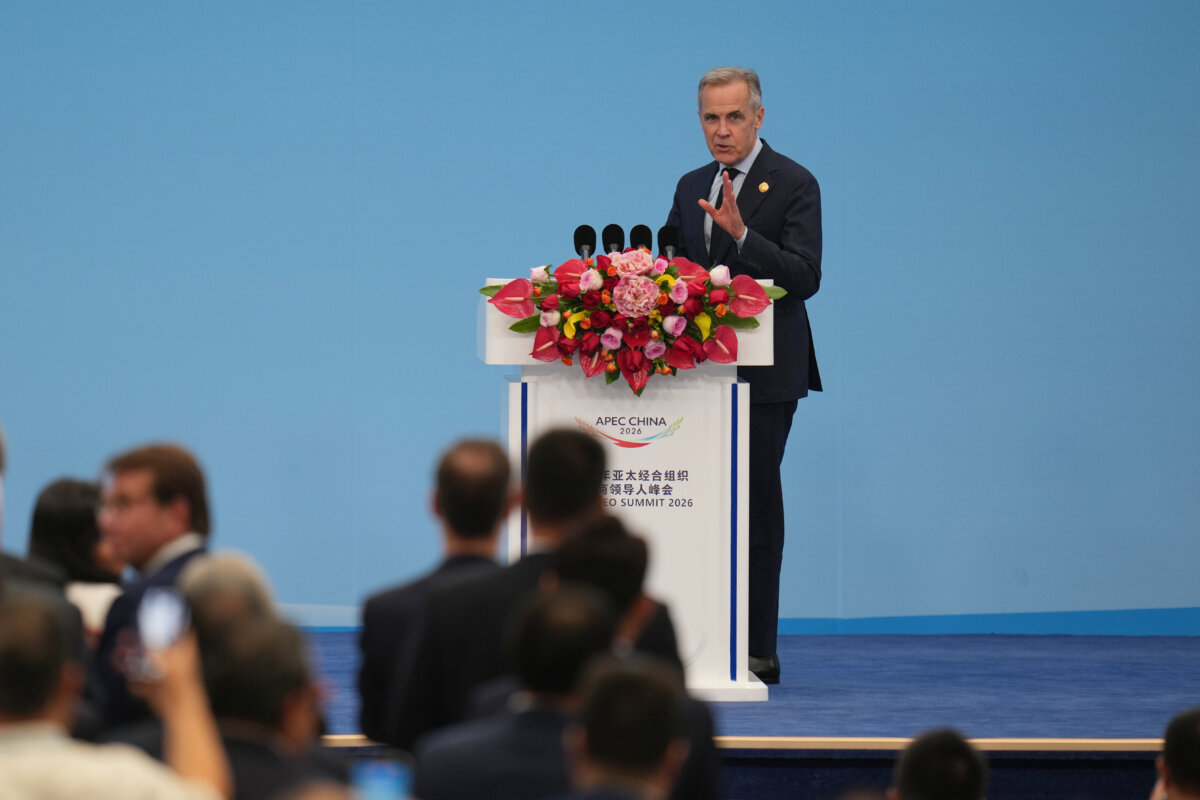
Speaking at the Asia-Pacific Economic Cooperation (APEC) CEO Summit on Nov. 18, Carney said the two countries are connecting their “economies more closely,” adding that it “includes the digital and financial plumbing that makes trade possible.”
He said that disruptions can spread quickly when Canadian businesses “depend on too few currencies or single payment channels.” He said this can be remedied through “more options, deeper local capital markets, currencies that can responsibly play a larger role and wider access for financial firms in each other’s markets.”
The prime minister said the Bank of Canada and the People’s Bank of China have renewed their currency swap arrangement, giving them the “tools to act decisively in times of financial stress.” The five-year arrangement allows the central banks in the two countries to directly swap currencies, providing access to liquidity without having to buy the currencies on the open market during periods of financial stress.
Prior to Carney’s trip to Asia, China’s Ministry of Finance announced that it would begin issuing up to 4 billion yuan (CA$846 million) in sovereign green bonds in Canada in early November. The proceeds are meant for projects beneficial to the environment.
The announcement came during the second Canada–China Economic and Financial Strategic Dialogue in Vancouver on Nov. 8 and 9. Finance Minister François-Philippe Champagne told reporters that this would be “one of the largest” issuances of Chinese sovereign bonds, and that the announcement was a “sign of confidence in Canadian financial markets.”
China’s state-run Global Times said that the initiative marks “another step in expanding the Chinese currency’s international reach” and creating an alternative to the U.S. dollar in trade. Beijing has been pushing to reduce dependence on the U.S. dollar and expand the use of the Chinese yuan in international trade, including through BRICS, a grouping it co-founded with Brazil, Russia, and India.
In an interview with The New York Times in September, Carney said he favours a “diversification of reserve currencies” away from U.S. dollar dominance, adding that it would provide more flexibility. He noted that a shift away from the U.S. dollar is already underway, as reflected in currency reserves and payment flows, but said the shift “can’t fully happen until there’s proper liberalization in China.”
“That’s the tough thing to do for them, for anybody to go from their system to have capital liberalization. So that will limit the extent to which it happens,” he said.
Carney made similar comments when he was governor of the Bank of England. He has said in the past that he favours a “multipolar system” because it would be better for the global economy, and in a 2019 speech while at the Bank of England, he argued for an international monetary system that relies on multiple currencies rather than being dominated by any one currency, such as the U.S. dollar.
In his Nov. 18 speech, Carney also said that Ottawa and Beijing have created a new financial working group and established a new regulatory and supervisory dialogue.
Chinese media outlets, citing Chinese officials, also said the agreements include the establishment of more branches of Chinese banks in Canada.
China has also opened the door to greater investment by Canadian pension funds in its financial markets and to Canadian institutions raising funds in China through yuan-denominated bonds.
Dennis Molinaro, an author and former Canadian government national security analyst, warned that Canada’s financial integration with China through currency swaps and bank branches would be “much harder to reverse than a trade deal.”
While trade agreements can be undone, Molinaro said, financial links “tie institutions together,” leaving banks and pension funds with “money at stake in the relationship staying good.”
“In a hypothetical US-China crisis, Canadian pension money in Chinese markets is something Beijing can hold as leverage against Canada. Chinese bank branches in Canada could be a route around US sanctions. Both are being built now,” he said on X.
He added that people tied to such institutions that depend on good relations between the two countries would now have a reason to “argue against anything that would disrupt the relationship.”
Molinaro also said the United States could interpret the agreement as “Canada building ways around the dollar with China” while Ottawa is attempting to make a trade deal with the United States, “and they wouldn’t be wrong.”
“The reality is that Canada is building greater financial ties with a state known to repeatedly use economic coercion against it,” he said. He added that while the United States also uses tariffs, Beijing operates at a different level, including arbitrarily arresting Canadian citizens, and blanket trade measures such as bans on Canadian canola and meat imports.
Following Carney’s meeting with Chinese leader Xi Jinping on the sidelines of the summit on Nov. 17, the two countries agreed to extend and expand a trade arrangement under which Beijing would lift tariffs on around $400 million worth of Canadian exports, including frozen pork cuts and seafood products. In exchange, Ottawa would extend tariff exemptions to an additional 32 types of Chinese steel and aluminum products for which Canadian supply is unavailable.
Carney’s office says the two leaders also discussed areas of collaboration in trade, security, artificial intelligence, and energy, among other topics.
 Friends Read Free
Copy
Facebook
Tweet