
A House of Commons committee will not study vandalism, arson, and other criminal attacks against places of worship in Canada after its chair ruled that a proposed study fell outside the committee’s mandate.
Conservative MP Andrew Lawton challenged the ruling, but committee members voted 7-4 to uphold it.
Lawton introduced a motion on Oct. 29 calling on the Standing Committee on Canadian Heritage to examine vandalism, arson, shootings, and other criminal attacks against churches, synagogues, mosques and other places of worship across the country.
Committee chair Lisa Hepfner ruled the motion inadmissible, saying it dealt primarily with matters related to the Criminal Code rather than heritage or identity. She suggested Lawton bring the proposal to the justice or public safety committees instead.
Motion’s Substance
In support of his motion, Lawton cited police-reported hate-crime statistics showing incidents targeting religious groups increased from 469 in 2015, to 1,115 in 2025. He also said incidents targeting Jewish Canadians, quadrupled over the same period, rising from 178 incidents to 788.
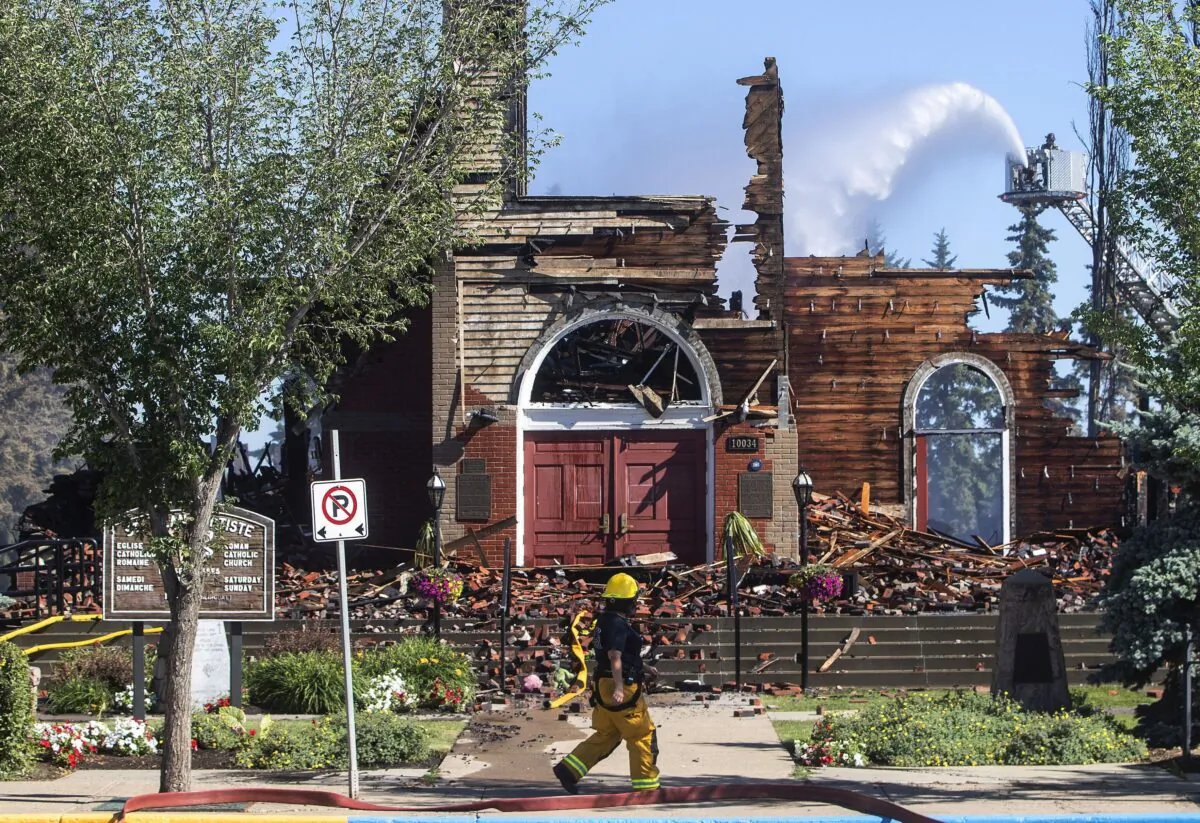
Lawton said the federal government had confirmed 423 police-reported arsons at places of worship since 2015, including 90 in 2021. He also cited figures tracked in a Juno News analysis indicating that 133 Christian churches had been vandalized, burned, or desecrated since 2021. At least 33 were destroyed by fire, with arrests made in only nine of those cases, he said.
Lawson additionally cited the 2017 killing of six worshippers at an Islamic cultural centre in Quebec City and attacks against synagogues, temples, mosques and other places of worship. He highlighted a Sept. 20 shooting outside the Sons of Jacob Synagogue in Belleville, Ont., in which a police officer guarding the building was severely wounded.
“The prime minister himself has acknowledged that Canada’s ‘civic compact is failing Jewish Canadians,’” Lawton said.
The Conservative MP proposed holding at least eight committee meetings and inviting the ministers responsible for Canadian identity and culture, public safety, and justice, along with Statistics Canada officials, police hate-crime units, and representatives of faith communities.
“What I will say in support of this motion is that hate against faith communities is very real,” Lawton said.
Hepfner said the motion related to the Criminal Code, declared it “out of order,” and said her decision was “not debatable.”
She said the proposed study fell outside the committee’s mandate because it did not focus on heritage or identity, preventing the committee from making related recommendations.
Legal Group Expresses Concern
Mark Joseph, executive director of The Democracy Fund (TDF), told The Epoch Times that his organization has long been concerned about what he described as a “lack of curiosity” among federal politicians regarding church burnings.
Joseph said politicians had expressed concern about attacks on other places of worship but had shown comparatively little interest in the burning of more than 100 churches.
TDF launched an independent forensic investigation in May, led by Glenn Baxter, a certified fire and explosion investigator. Baxter is working to obtain and review about 100 fire investigation reports, with findings expected to be released next year.
Joseph described the process as “laborious,” saying Baxter must contact municipalities and police services to obtain the documents. The agencies then have to locate the reports, redact private information and release them, a process that can take months.
Joseph said he could only speculate about why political leaders appeared uninterested in investigating church burnings. He also described the process of obtaining information about the fires as “opaque.”
He noted that the church fires began amid controversy surrounding reports of the discovery of potential unmarked graves at former Indian residential schools in 2021.
In a recent case, a historic church on New Brunswick’s Acadian Peninsula was destroyed by fire in August. Police charged a 68-year-old man with arson in connection with the blaze.
The 108-year-old Saint-Simon Catholic Church was believed to be the largest wooden church remaining in New Brunswick.
 Friends Read Free
Copy
Facebook
Tweet