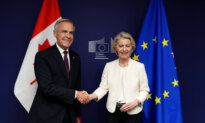

Germany supports deeper ties with Canada, but has reservations about the associate membership proposed by the European Commission’s president, the country’s ambassador to Canada says.
German Ambassador to Canada Mathias Luttenberg told CTV’s “Power Play” that the “associate member” title proposed for Canada last month by European Commission President Ursula von der Leyen “raises some concerns.”
Luttenberg said the concerns have nothing to do with Canada itself, but rather the terminology being used, and what an associate membership would actually mean.
“If you come up with a new concept in the European Union… then of course it takes some time to reflect for all 27 member states,” Luttenberg said during the Oct. 27 interview. “What we have in front of us is something which is not clearly understood by all member states. I think we have been a little surprised by the announcement.”
He noted that the term “associated membership” is already used in reference to the bloc’s relationship with other European countries that have yet to become members.
“Germany has been using the term of associated membership for something completely different, which is the relationship of the European Union to Ukraine and potentially Moldova—so countries which are actually striving for full EU membership,” he said. “We want these countries to become members of the European Union and therefore, as a precursor to full membership, we call it associate membership.”
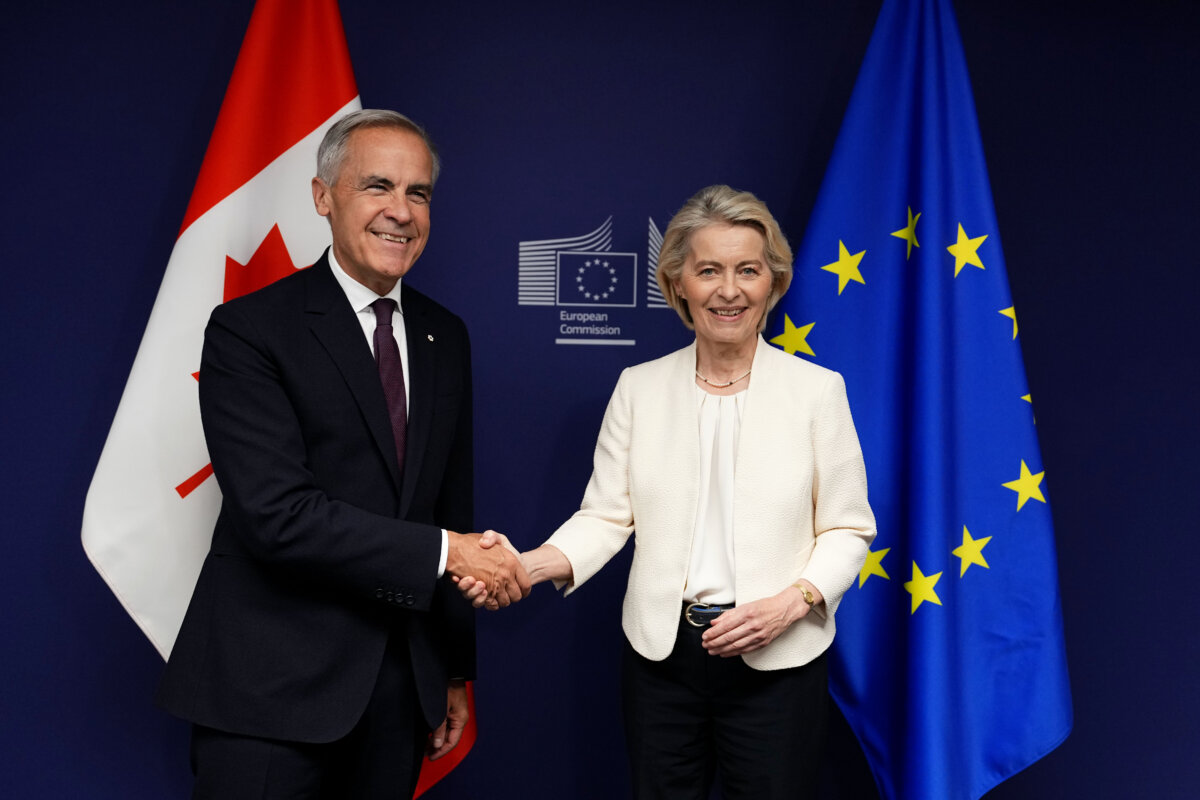
Von der Leyen floated the idea of Canada becoming the first associate member of the European Union during her state of the union address to the European Parliament in Strasbourg, France, on Sept. 16.
Prime Minister Mark Carney, who was in the front row during her address, welcomed the idea in his own speech before the European Parliament the following day. He said Ottawa was prepared to deepen cooperation in areas such as critical minerals, defence industrial capacity, artificial intelligence, and energy security.
Countries Express Concern
Germany is not the only country to raise concerns about von der Leyen’s “associate member” proposal for Canada.
France, Italy, and Greece have also questioned the terminology and the diplomatic process behind the initiative, according to several European news outlets.
Carney told reporters this week that the substance of the relationship matters more than the name itself.
“The good news is it doesn’t matter about specific names or nomenclature,” he said prior to an Oct. 27 cabinet meeting on Parliament Hill. “What matters is the difference that it will make to lives of Canadians, young Canadians in terms of opportunities to study, work and travel, our Canadian businesses in terms of new opportunities, Canadian researchers in terms of depths of opportunity, and Canada as a whole becoming a more independent, more sovereign nation.”
He said the two-day Canada-EU summit, beginning Oct. 29, was intended to launch a formal, year-long process to negotiate and define what the proposed status would entail.
The summit, hosted by Carney, is taking place in Montreal on Oct. 29 and 30. A number of dignitaries will be in attendance, including von der Leyen and European Council President António Costa.
A leaked draft of the joint Canada-EU summit declaration included a commitment to define the parameters of an “associate membership” for Canada by 2027.
Germany, Italy, France, and Greece objected to including the term in the draft declaration, citing concerns about legal uncertainty, a lack of prior consultation, and the precedent it could set for other countries seeking closer ties with the bloc, according to Euronews.
Italy asked for the draft to be revised to clarify that the concept had been put forward by the European Commission, rather than collectively approved or endorsed by all 27 EU member states, Euronews reported.
Several media outlets have reported that EU ambassadors were holding last-minute meetings ahead of the Montreal summit to discuss replacing the “associate membership” label with different wording.
Luttenberg called the summit “a step on a long ladder” in EU-Canada relationships, and noted that the associate member status could be a long drawn out issue because “you’re not talking to one person only, you’re talking to 27 member states and they all have to be on board.”
Canada-EU Summit
The Prime Minister’s Office is framing the summit as a way to advance “an ambitious new partnership” with the European Union.
“Canada and the European Union are building on each other’s strengths – deliberately, systematically, and rapidly – to form a new, ambitious alliance,” Carney said in a statement issued by his office. “An alliance that builds resilience for what it allows us to do for our citizens, and our citizens to do for themselves. An alliance strong enough so that no one can dictate our choices, and an alliance open enough that others can join.”
The PMO said the EU brings market power, research depth, and manufacturing strength to the partnership, while Canada offers energy resources, critical minerals, expertise in space technology, AI, and quantum computing, as well as “one of the world’s strongest banking systems.”
The goal, the PMO said, is to leverage these “complementary strengths” for the benefit of both parties.
The summit is also intended to build on last year’s launch of the New EU-Canada Strategic Partnership of the Future and the Security and Defence Partnership, the PMO said.
The New EU-Canada Strategic Partnership of the Future is a bilateral framework designed to deepen cooperation in areas including digital technology, economic security, and clean energy competitiveness. It operates alongside a parallel Security and Defence Partnership which positions Canada as Europe’s premier non-European defence ally.
Canada became the first non-European country to join the Security Action for Europe (SAFE) initiative earlier this year.
 Friends Read Free
Copy
Facebook
Tweet