
The Saskatchewan government has introduced legislation that would establish new restrictions on where supervised drug consumption sites can operate in the province.
Mental Health and Addictions Minister Lori Carr introduced The Community Support and Recovery Act in the Saskatchewan legislature on Nov. 16.
The proposed legislation would prohibit future supervised consumption sites from operating within 400 metres of schools and daycares. It would also require organizations to obtain approval from the provincial minister before applying for a federal exemption to operate such a facility.
The Saskatchewan government said in a news release that the federal exemption process considers several factors but does not establish minimum distances from schools and child-care centres or require provincial approval.
The government expects the legislation to pass in spring 2027.
Wâhkôhtowin Harm Reduction in Regina is the only supervised consumption site currently operating in Saskatchewan. Health Canada’s website says the facility received a federal exemption on Dec. 19, 2025, authorizing supervised injection, drug checking, and peer assistance. The exemption expires on Dec. 31, 2026.
Health Canada says it received the centre’s application to renew its exemption on July 31, and the request remains pending.
In a news release, Carr said the province does not fund or support supervised consumption site operations because they require federal approval. However, she said the province must have the authority to determine where such facilities are located to protect families, children, businesses and communities.
NDP MLA Leroy Laliberte spoke to reporters after the legislative session on Nov. 16. He did not comment on the specifics of the proposed legislation but criticized the government’s priorities.
“It’s distracting to what really is happening in the province … the housing crisis, the addictions crisis. We’re seeing homelessness, we’re seeing all of these different things,” he noted. “It’s awful to see how many people we are losing on a daily [basis].”
Other Provinces’ Approaches
Other provinces have taken different approaches to supervised drug consumption services, with some moving away from the model.
Alberta closed supervised consumption sites in Calgary and Lethbridge in summer 2026 as part of a shift toward a recovery-focused approach. The province said funding for the services would be redirected to expand addiction treatment, medical detox, recovery support, and 24-hour outreach teams.
The province had previously closed a site at the Royal Alexandra Hospital in Edmonton and another in Red Deer. Those closures, along with the more recent shutdowns, leave three supervised consumption sites operating in Alberta: two in Edmonton and one in Grande Prairie.
The Alberta government has said its eventual goal is to transition entirely away from the supervised consumption model and prioritize treatment and recovery services.
Ontario announced plans in August 2024 to restrict supervised consumption sites near schools and child-care centres. The province subsequently ended funding for its supervised consumption sites, with the last provincially funded location, in Kingston, closing on Sept. 30, 2026, and transitioning into a Homelessness and Addiction Recovery Treatment (HART) Hub.
Nine former supervised consumption sites in Ontario have transitioned into (HART) Hubs since April 2025.
Three supervised consumption service locations remain in Toronto: Casey House, Kensington Market, and Street Health. They operate outside the province’s publicly funded consumption-site program.
British Columbia had 58 overdose prevention or supervised consumption sites as of September 2025, according to the provincial government. However, the province has scaled back some of its so-called harm-reduction policies, including ending its three-year drug decriminalization pilot project early following public backlash.
Meanwhile, Manitoba opened its first supervised consumption site in Winnipeg on Aug. 11. The province described the facility as a way to help people who use drugs “get connected with supports and services so they can get on to a path of recovery.”
The site is run by the province in collaboration with the Aboriginal Health and Wellness Centre and can accommodate 12 people at a time. It offers supervised injection and inhalation, drug checking, nursing support, and connections to health and social services.
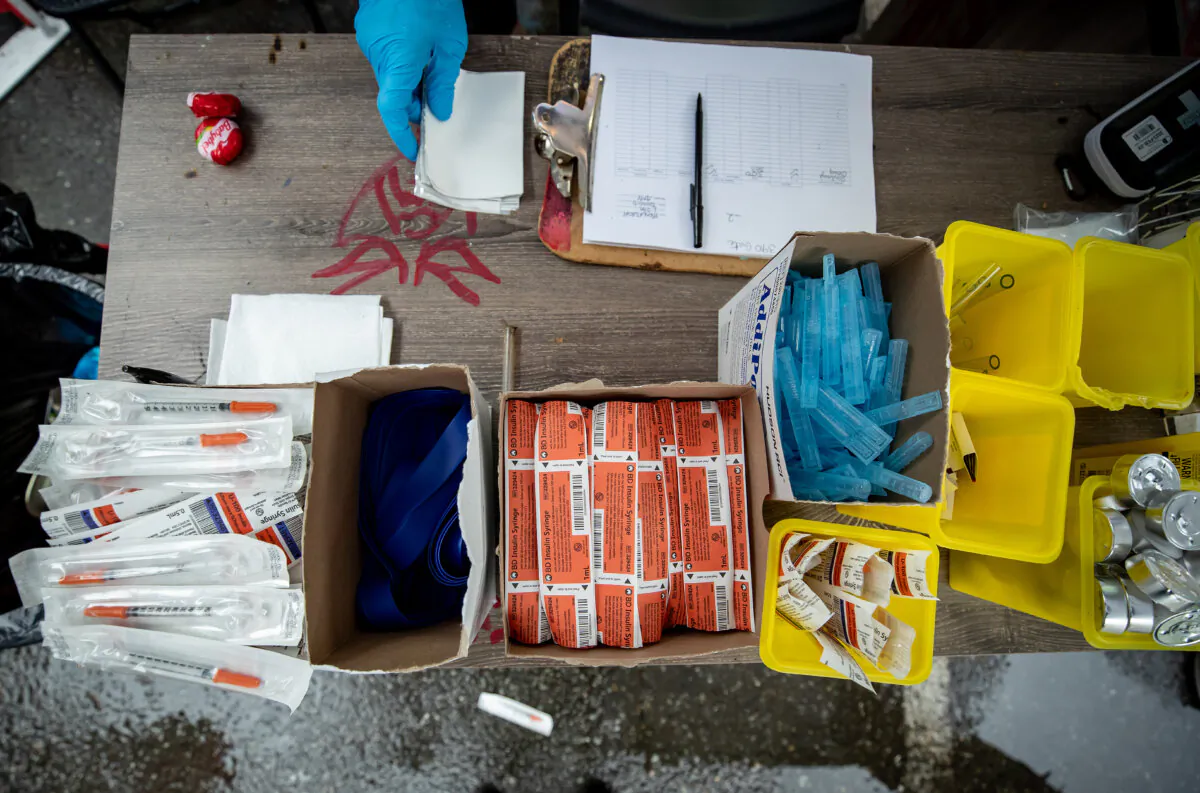
Clients bring their own drugs when visiting the site, where staff confirm that the drugs are not contaminated with fentanyl or other dangerous substances. The venue will provide consumption supplies like needles and inhalation kits and will also have Naloxone kits on site to reverse opioid overdoses.
 Friends Read Free
Copy
Facebook
Tweet