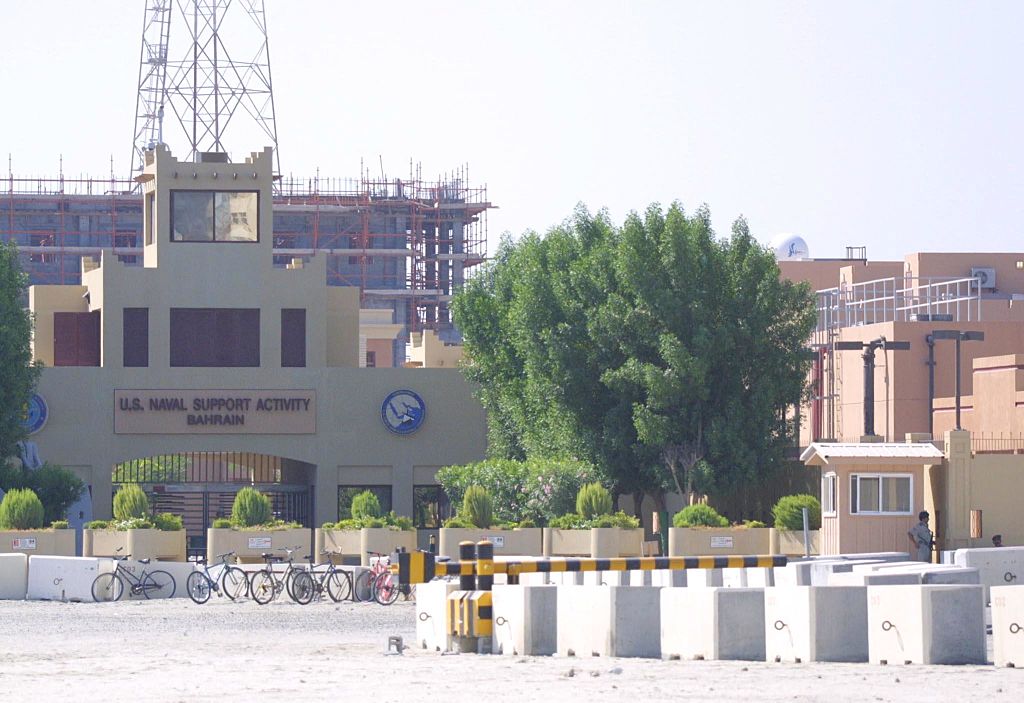

The United States military denied Iran’s claim that it destroyed a U.S. early-warning radar in Bahrain on Friday.
U.S. Central Command said in a post on X that Iran’s Islamic Revolutionary Guard Corps (IRGC) launched two one-way attack drones toward Bahrain, and both were shot down by U.S. forces. There were no injuries or damage.
The IRGC said earlier on Friday that its Aerospace Force fighters targeted and destroyed the radar in response to what it described as an air attack on a telecommunications tower in Sirik in southern Iran, Iranian state news agency IRNA reported.
The IRGC said that in case of further attacks on Iran, it will “respond without geographical limits.”
The Epoch Times reached out to the Bahraini Foreign Ministry for comment but didn’t receive a response by the time of publication.
Iran targeted U.S. military assets in the Gulf in September.
Bahrain said in September that it intercepted Iranian missiles or drones targeting the country and accused Tehran of targeting civilians. Kuwait also reported drone attacks, while authorities in Iraq’s Kurdistan region reported the interception of 10 explosive drones that Iranian media said were aimed at U.S. bases.
Those attacks followed U.S. strikes on Iranian rocket launchers on Larak Island on Aug. 30. Washington said Tehran planned to use the launchers to fire missiles into the Strait of Hormuz after shipping lanes had been cleared.
Regional Impact
Since the outbreak of the conflict in February, Iranian attacks have affected Gulf Cooperation Council (GCC) states through strikes on military and civilian targets, as well as repeated threats to maritime security in the Strait of Hormuz.
GCC Secretary-General Jasem Mohamed Albudaiwi said on Oct. 31 that Iranian attacks had tested the region’s security despite Gulf states not being parties to the conflict.
Iran has said it harbors no hostility towards the GCC bloc, which comprises Bahrain, Kuwait, Oman, Qatar, Saudi Arabia and the UAE.
According to U.S. Central Command, Iran deliberately targeted civilian infrastructure, neighborhoods, and commercial shipping in its neighboring countries, saying more than 20 civilian mariners had been killed in recent months.
The United States said last week that it launched a new task force to stop Iran from moving weapons, dual-use technology, sanctioned materials, and illicit funds across its land borders and the Caspian Sea. It is operating alongside its naval blockade of Iranian ports.
 Ships are anchored off the coast of Khasab in Oman’s Musandam Governorate, near the Strait of Hormuz, on Oct. 2, 2026. (AFP via Getty Images)
Earlier this week, Iran said it was updating its military doctrine to focus on rapid response and operations without geographical limits, replacing its previous doctrine centered on defensive operations and retaliatory deterrence.
Stalled Talks
The announcement came amid stalled negotiations between Washington and Tehran. Iran says it is waiting for a U.S. response to seven conditions for ending the conflict, including a ceasefire, lifting the U.S. naval blockade and removing sanctions before talks can resume.
U.S. President Donald Trump said on Thursday that the United States no longer needed a deal with Iran.
“Those days have long since passed. We’ve got their money, Hundreds of Billions of Dollars, and we’ve got their Strait!” he wrote in a post on Truth Social, without providing further details.
The Trump administration has repeatedly said it aims to prevent Iran from rebuilding its nuclear program, while Iran rejects U.S. allegations surrounding its nuclear activities.
Earlier this week, Mohsen Rezaei, secretary of Iran’s Supreme National Security Council, told Lebanon’s Al Mayadeen television network that all enriched nuclear material would remain inside Iran for domestic use.
The International Atomic Energy Agency, which monitors Iran’s nuclear program, said last month that communications with Tehran continued at a technical level, but normal inspections had not resumed.
 Friends Read Free
Copy
Facebook
Tweet