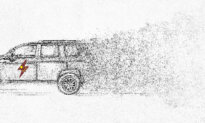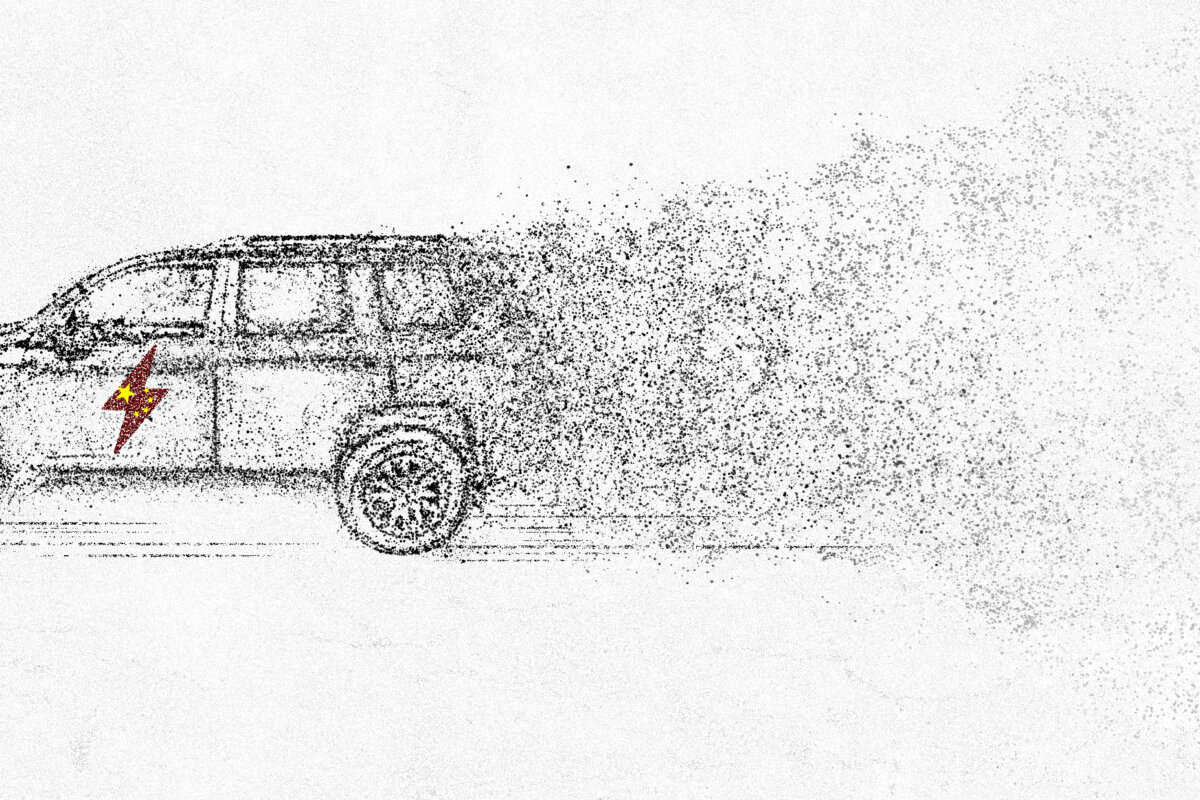

For a generation of Americans, “Made in China” meant cheap. For the past two decades, Beijing has worked to make it mean fast.
It has largely succeeded, with the concept now dubbed “China speed.” Chinese companies develop new cars in roughly half the time of Western rivals, are rapidly expanding electric-vehicle exports, and release artificial intelligence (AI) models that trail America’s best by only a matter of months.
Recently, however, the world got a glimpse of what all that speed was hiding.
In October, brake pedal brackets broke on three Huawei-JAC Maextro luxury minivans in a Chinese media test, prompting a government probe and a promised redesign. In Malaysia, a Chery Omoda 5’s rear axle detached—the second such failure there, after one in April 2024.
Even the communist regime admits the problem. On Oct. 10, China’s industry ministry and three other agencies issued draft rules aimed at carmakers that put insufficiently tested designs on the road. Beijing’s mouthpiece People’s Daily endorsed the move, using the label “crash-course cars” for models with compressed development and trimmed real-world testing.
Investigators haven’t published findings on the brake failures, and Chery has blamed weak welds for the axle, but the crackdown suggests that for some automakers, China’s speed came partly at the expense of quality control.
In September, U.S. security agencies accused six top Chinese AI companies of siphoning capabilities from American models through distillation.
Analysts who spoke with The Epoch Times trace China’s speed to two shortcuts: copying what others built and testing only as much as the rules demand, or less. And when something breaks, the regime’s first instinct is to hide the evidence.
Copying other companies’ products is a business model under the Chinese Communist Party (CCP), said Nicholas Eftimiades, a retired senior intelligence officer who spent 34 years at the Central Intelligence Agency, the State Department, and the Defense Intelligence Agency.
“That’s how China has risen so fast and so far,” he told The Epoch Times.
Eftimiades wrote “Chinese Espionage: Operations and Tactics” and has tracked at least 900 Chinese espionage cases.
For years, those shortcuts mostly stayed in China. Now, they are shipping out vehicles by the millions, triggering regulatory alarms worldwide—even as countries such as Canada welcome them in.
“Developing new vehicles as quickly as is being done in China relies on virtual testing and industry-wide shared components,” Sam Fiorani, vice president of global vehicle forecasting at AutoForecast Solutions, told The Epoch Times.
“When these parts fail, it will affect a large number of vehicles on the road, and those issues are showing up in weak mounts for axles, pedals, and other key components.”
Overtaking on the Curve
Beijing has a phrase for its business model: “overtaking on the curve.” In racing, it means passing rivals as they brake into a corner; any driver knows the risk.
The push came from the top. In 2014, Chinese leader Xi Jinping said during a visit to a Shanghai automaker that new energy vehicles were the “path that must be taken” for China to become a strong car country.
Beijing spent at least $230 billion propping up the industry from 2009 to 2023, the Center for Strategic and International Studies estimated, though the think tank’s data show that support per sale has fallen sharply since the early years.
Speed became a point of pride. Huawei’s then car chief, Yu Chengdong, boasted on state broadcaster CCTV in 2022 that rivals normally take three years to build one car, while Huawei and its partner Seres made three in a year. Seres handled the hardware development and manufacturing, while Huawei supplied the software, electronics, and sales network.
Some of the sharpest warnings have come from inside China’s auto industry.
In June, Geely chairman Li Shufu warned that building cars has no shortcuts and that every new model must complete full reliability testing.
In 2016, Wang Binggang, a longtime government adviser on electric vehicles (EVs), said the slogan reflected “petty cleverness,” an opportunistic way of dodging the hardest engineering, though he also called EVs a real chance to narrow the gap with global automakers.
Speed isn’t all shortcuts, said John Helveston, an engineering professor at George Washington University who studies China’s auto industry.
“Today, the advantage is more rooted in the improved production efficiencies and sheer depth and breadth of the battery and motor supply chain in China, by far the largest in the world,” he told The Epoch Times.
Chinese automakers can now develop a new vehicle in about 18 months, roughly half the time established automakers need, he said.
Copy First
Still, the quickest shortcut has always been someone else’s work.
Chery, the state-backed automaker whose SUV lost its axle in Malaysia, made its name with the QQ, a cheap minicar launched in 2003 that resembled the Daewoo Matiz, which General Motors later sold in China as the Chevrolet Spark.
In 2004, GM’s South Korean unit, GM Daewoo, sued, alleging the QQ copied the Matiz. It also claimed Chery used a disguised Matiz to pass the government tests needed to sell the QQ, according to state media China Daily. Chery denied copying, saying it developed the car itself, and the companies settled in 2005.

Huawei faced a stranger charge. In 2019, the Justice Department indicted two Huawei units on charges of stealing secrets from T-Mobile’s phone-testing robot, Tappy, alleging that an engineer slipped a piece of the robot’s arm into his laptop bag and walked out of the lab.
Prosecutors also said Huawei offered bonuses to employees who stole competitors’ confidential information. Huawei has denied wrongdoing, and the Tappy allegations are part of a broader racketeering case now on trial in a federal courtroom in New York.
Asked about the bonus program, Eftimiades said, “It’s not unusual, and the fact that they have emails showing this, illustrating this, shows just how blatant they are in doing it.”
He said copying is rewarded because it works: “So it’s encouraged as a business model, and it’s proven quite effective, because it gets you up to where the competitor is without having expended any money.”
The AI Shortcut
Similar allegations run through China’s AI boom, and shortcuts apply equally to digital software assets.
On Sept. 8, the National Security Agency, the Federal Bureau of Investigation, and the Cybersecurity and Infrastructure Security Agency accused six Chinese AI companies, including DeepSeek and Moonshot AI, of “industrial-scale” campaigns to extract the capabilities of American models by training on their answers—a technique called distillation.
The agencies said the copying forms “the core—not merely a supplement” of how the companies build their AI, and that it was likely happening with the Chinese regime’s awareness. A House committee found last year that DeepSeek likely used unlawful distillation and that its app sent Americans’ data to China.
Anthropic, the U.S. company behind the Claude chatbot, went further, alleging that in one 10-day period, Moonshot quietly passed nearly 300,000 of its users’ questions to Claude and served the answers as its own. China’s commerce ministry called the U.S. agencies’ charges groundless.
Built to the Minimum
Speed also means testing less. The Maextro V800, a Huawei-backed luxury van, shows what that looks like.
In 2024, Yu, then chairman of Huawei’s smart car solutions business, claimed that Maextro, a luxury brand Huawei was building with state-owned JAC Motors, would be positioned far above the Mercedes-Maybach and the Rolls-Royce Phantom.
Maextro launched in 2025 with a sedan, the S800. Its first minivan, the V800, went on sale in August 2026 starting at about $114,000.
On Oct. 8, the Chinese car review site Dongchedi released a video of three new V800s being put through emergency stops from 62 mph on a closed course. On every one, the plastic bracket holding the brake pedal snapped. The last van, bought to verify the first two results and showing about 2 miles on its odometer, lost its foot brake on its second full-force stop.
The trouble starts, Helveston said, “when testing gets squeezed to hit a launch date.”
Chinese automakers do most of their testing on computers and leave real-world tests for the end, according to AlixPartners, a consulting firm that tracks the global auto industry. They also launch cars before every part is mature, counting on software updates to finish the job—an approach the firm called “a deliberate break from the zero-defect mindset.”
Helveston said that works for code, not parts.
“Some companies have also leaned on over-the-air updates to fix problems after launch, which works fine for software, but you can’t fix a piece of hardware like a brake bracket or a bad door handle with a software update,” he said.
Chinese auto commentators reported that the V800’s brake pedal was mounted on a glass-fiber-reinforced plastic bracket. After the video, Maextro on Oct. 8 called the review site’s test an extreme, “non-standard” condition. Five days later, it cited a lab report saying the part met China’s industry standard. A staff member at the lab said its reports cover only the samples a company submits, not mass production.
“Just saying we pass a test doesn’t prove anything,” said Michael Brooks, executive director of the Center for Auto Safety, a Washington consumer group.
“You have to actually go and look at the parts that have come out of your manufacturing facilities and evaluate the strength of those.”
Maextro called its fix a “free upgrade,” which customer service told Chinese media is “not a recall” and which owners of delivered vehicles must request. Three government agencies opened a joint investigation on Oct. 15 and, as of early November, have not published findings.
In the United States, it would be “a virtually immediate recall,” Brooks told The Epoch Times. “A brake pedal falling off is a slam dunk of a defect.”
Chinese state media have described a wider problem. People’s Daily quoted the head of Hyundai’s Chinese joint venture, saying some brands skip tests and turn customers into “test drivers,” and reported that one unnamed EV maker ran only a fifth of its door-handle tests on real hardware, with the rest simulated.
Fast rollouts of driver-assistance systems have drawn scrutiny, too. In March 2025, three college students on their way to an exam died when their Xiaomi SU7, the phone maker’s first car, hit a concrete barrier in a highway construction zone at about 60 mph and caught fire. Xiaomi said the car was in driver-assist mode, the system warned of obstacles, and the driver took over and braked but could not avoid the barrier.
In September 2025, Xiaomi recalled nearly 117,000 SU7s—about 34 percent of those it had sold—to fix flaws in the driver-assistance system through an over-the-air software update.
Censorship
The brake video soon ran into trouble online.
By the morning after its release, it could no longer be watched on several Chinese platforms. On WeChat, a notice said the video had been pulled for breaking the rules after a complaint.
The Xinjiang regional government’s official WeChat account, which criticized Maextro for answering safety questions with a list of industry standards, hid its post within hours, after it got more than 100,000 reads. Xinhua’s repost of Maextro’s statement was removed as well.
Chinese citizens have seen officials try to bury a story before.
In 2011, after two high-speed trains collided near Wenzhou and killed 40 people, workers used excavators to smash the front carriage of one train and bury it at the scene the next morning. Officials had called off the search, saying there were no signs of life. But that evening, rescuers found a little girl alive at the crash site.
The railway ministry said the burial was meant to aid the rescue. “Whether you believe it or not, I believe it,” its spokesman said. He was later fired.
Residents suspected officials of destroying evidence and hiding the real death toll. Two days later, workers dug up the wreckage and hauled it away.
Now, the same instinct protects China’s carmakers. In September 2025, China’s internet censor and five other agencies launched a campaign against online “chaos” in the auto industry, saying they were going after paid smears and fake reviews.
Among the accounts the censor later penalized were ones it accused of “hyping” car accidents and of posting car tests that reached “misleading conclusions.”
That same censor is now part of the V800 probe. On Oct. 15, it joined the industry and market regulators in investigating the van.
Brooks said U.S. regulators would treat the V800 video very differently.
“If a video like that came out of brake pedals breaking off a specific model three times in the United States, you would see the National Highway Traffic Safety Administration respond within days, requesting information and probably asking the manufacturer to issue a recall,” he said.
Some Countries Push Back
The cars are leaving China faster than ever. Exports hit 8.2 million vehicles in the first nine months of this year, up 66 percent and already more than all of last year, as domestic sales fell more than 20 percent. Chery now ships about 70 percent of its cars overseas, according to company data.
Abroad, problems are harder to hide. On Oct. 6, the rear axle of an Omoda 5 detached on a road in Johor Bahru, Malaysia. After video of the incident spread, Malaysian authorities suspended the model’s type approval and new registrations until regulators confirm the risk has been addressed.
Five days after the incident, Chery blamed weak welds on the axle’s trailing arms, its Malaysian unit apologized for the inconvenience, and the company recalled 8,878 vehicles. In 2024, it had blamed the same model’s axle failure on a supplier’s improperly calibrated welding machine.
On Nov. 6, China’s market regulator announced Chery’s recall of 53,882 Omoda and Tiggo 5x vehicles in China over a similar rear-axle weld problem.
Fiorani said quality doubts give governments more power to reduce imports of the vehicles.
“Tariffs and other trade barriers are the first line of defense, but if the quality of vehicles from China is suspect, governments can use this to limit the expansion of these brands,” he said.
Others are building walls. Mexico raised its tariff on cars from China and other non-treaty countries from 20 percent to 50 percent in January. In October, the European Union said China agreed to curb hybrid exports, and Brussels later set an annual cap of 350,000 cars—less than half what was projected for this year.
Washington has gone furthest. In 2024, the United States raised its tariff on Chinese EVs from 25 percent to 100 percent. A Commerce Department rule bars Chinese software from connected cars starting with the 2027 model year and prohibits sales by manufacturers with Chinese ties, even if their cars are built in America. The rule lets companies seek specific authorizations for otherwise prohibited transactions.
Sen. Bernie Moreno (R-Ohio)
In June, the department denied Polestar, a brand majority-owned by China’s Geely, the authorization it needed to keep selling new cars in the United States from the 2027 model year, even though its Polestar 3 SUV is built in South Carolina. Volvo, also owned by Geely, received an authorization in May. The department has not said why it treated the two differently.
A bipartisan bill sponsored by Sens. Bernie Moreno (R-Ohio) and Elissa Slotkin (D-Mich.) would go further, writing the ban on Chinese connected car technology into law and barring the import, sale, and operation of vehicles made in China. Though the measure cleared the Senate Commerce Committee unanimously in July, Sen. Rand Paul (R-Ky.) blocked a fast-track vote in September.
“In every possible dimension, bringing Chinese cars here to the United States would be an abject disaster,” Moreno told The Epoch Times.
Canada’s Open Door
Canada, by contrast, is taking the opposite approach, agreeing in January to let in up to 49,000 China-made EVs a year at a 6.1 percent tariff, a cap set to rise to about 70,000 within five years. Chery, which has set up a Canadian subsidiary, plans to launch its Omoda and Jaecoo brands in Canada in early 2027.
Like the United States, Canada relies on automakers to vouch for their own cars. Manufacturers certify that their vehicles meet Canadian safety standards, Transport Canada told The Epoch Times, and recalls “are issued by the companies and not Transport Canada.” The department can order a company to notify owners and fix a defect, and it can fine violators up to $200,000 per violation.
The department said it is not reviewing China’s new testing rules or the V800 brake reports because it is not aware of any related incidents in Canada.
In response to Ottawa’s move, Moreno said, “Can you imagine if you’re a Canadian citizen and your own government is telling you that they care so little about you that first of all they’re going to allow the Chinese to destroy their auto industry, but then on top of that, not be concerned even remotely about their safety?”
Sam Fiorani, vice president of global vehicle forecasting, AutoForecast Solutions
Nevertheless, Fiorani said Chinese brands face a tough customer base in North America.
“Buyers in the U.S. and Canada are not very forgiving if their vehicle has major flaws,” he said.
A brand that leaves large numbers of drivers stranded will have its reputation tarnished “quickly and deeply,” he added, and any newcomer “had better confirm that the major bugs are fixed before going on sale.”
‘Pay the Price’
The House Select Committee on the CCP agrees the Moreno and Slotkin’s proposed rule should become law.
A committee spokesperson told The Epoch Times in July that “unlike department rules, the law guarantees the policy won’t change from one president to the next,” a position the committee says still holds.
“The tariffs and the threat of sanctions and such are a step, and they’re a minor step,” Eftimiades said.
U.S. officials, he added, “can’t arrest their way out of the situation” and must instead put at risk what Beijing holds dear: the CCP’s hold on power and its economy.
Beijing is now racing to write the rules it skipped. But its toughest testing requirements, still in draft, apply only to new models filed from 2027. Approved models that use innovative designs face a paperwork deadline of July 1, 2027.
Until then, Eftimiades said, Chinese automakers squeezed by a saturated market at home are “trying to cut costs dramatically, and someone’s going to pay the price [for] it when they do.”
 Friends Read Free
Copy
Facebook
Tweet