




On March 23, Chris Lacey was back at the doctor. The 59-year-old electrician spent six years fighting colon cancer that had spread to his liver. But this visit was about something else entirely. A scan had turned up a narrowing in his urinary tract that had never caused him trouble. The urologist wanted to place a stent.
Lacey already had two tubes coming out of his body. The stent would have to be replaced every few months, and his wife, Thereza Cononi wasn’t sure he had that long to live.
“No more stents, no more tubes,” she told the doctor. “It’s absurd that we’re even having this conversation,” she said.
That night, Lacey developed a fever. By the next day, he was back in the hospital. He was sleeping more and eating less, while doctors treated one problem after another.
Cononi pulled a nurse aside. “He’s dying, and nobody’s talking to me about it,” she said. The nurse nodded.
When Cononi asked for a meeting with those caring for him, the hospital team told her to speak with his oncologist. That appointment wasn’t until May 12.
“He’s not going to be alive on May 12,” she told them.
 Chris Lacey before his cancer diagnosis in August 2020. (Courtesy of Thereza Cononi)
Lacey’s 33 days in hospice are more than most patients get. Nearly one in three Medicare hospice patients enroll during their final week, according to the Medicare Payment Advisory Commission (MedPAC). One in six enroll in the last three days, some with only hours left.
A hospice nurse can quickly relieve pain or help make breathing easier. Patients who enroll in hospice with only days left get that—and little else. Often, there’s not enough time to build trust with the people caring for them, and not enough time to have heartfelt conversations with the people they love.Some patients decline too quickly to consider hospice. For others, the weeks slip away, packed with appointments and procedures. Families wait for the doctor to say the word. Doctors, unsure how much time remains or reluctant to take away hope, hesitate to bring it up. Patients like Lacey, who’ve survived one crisis after another, hold out for the next treatment.
The question is how to stop the machinery of medicine long enough to ask: Is this next treatment buying more time, or just taking the time that’s left?
What Time in Hospice Buys
By the time Cononi stopped the nurse in the hallway, Lacey was already eligible for hospice. The threshold is a doctor’s judgment that a patient is likely to die within six months. He would live less than three. But no doctor brought it up.
What they would have offered is a model of care focused on comfort rather than a cure. Hospice is not necessarily a physical place. Most people receive it at home. It’s also provided at nursing homes, assisted living facilities, dedicated hospice residences, and occasionally, hospitals.
Medicare covers hospice once a patient’s own doctor and a hospice doctor both sign off on that prognosis. It pays hospice a flat daily rate, about $191 per person on average in 2024. That payment must cover all the care the illness requires, from nursing and social work visits to bathing and grooming, as well as medications and any procedure done for comfort. If a hospice spends more than that, it absorbs the difference.
Hospice care comes from a team of nurses, doctors, social workers, aides, chaplains, and volunteers who look after the family as well as the patient. Some of that help comes quickly. A nurse can ease pain or shortness of breath within hours. What can’t be rushed is trust, or a family’s readiness for what comes next.
Jason McAvoy, a Massachusetts nurse who has worked in hospice for more than two decades, has seen what time does when a patient arrives at a hospice residence. Accustomed to waiting for help in the hospital, some ring their call bell an hour before they need to use the bathroom, just to be sure someone will come.
“We’re coming when you need something,” he tells them. “When you’re in pain, we’re treating you.” It sometimes takes a while for them to believe it. That trust doesn’t form in a day or two.
Families need something else. “It’s really the preparation,” McAvoy said.
Hospice nurses walk patients and families through what dying looks like. When patients slow their eating or drinking, families often fear their loved one is starving or dehydrated. The nurse teaches that the body wants less as it shuts down. Forcing unwanted fluids can cause wet, labored breathing, making the patient more uncomfortable.
That’s the value of hospice. Throughout the dying process, as changes come, families have someone they know to turn to for support. Hospice also provides the gift of quality time. Instead of sitting in a waiting room, patients and families can be together to say what needs saying and settle what’s unfinished. When a patient arrives with a day or two left, the staff gets the immediate crisis under control, “and that’s pretty much it,” McAvoy said.
Families’ own ratings bear this out. In a 2017 study in the Journal of Clinical Oncology, families of cancer patients who had more than 30 days in hospice were more likely to call their end-of-life care excellent than families whose loved one had three days or fewer. Families were also more likely to report that their loved ones’ wishes had been followed.
Many families wish they had started hospice sooner. In a study of more than 100,000 bereaved family members, Dr. Joan Teno, a physician and adjunct professor at the Brown University School of Public Health, found that what predicted unmet needs and lower satisfaction was not how long hospice lasted, but whether the family felt it had come too late.Who Says It’s Time?
For hospice to begin, someone has to say it’s time. In Lacey’s case, no one said it explicitly. He didn’t seem ready to hear it, and Cononi learned what it cost her to bring it up. His doctors kept treating.
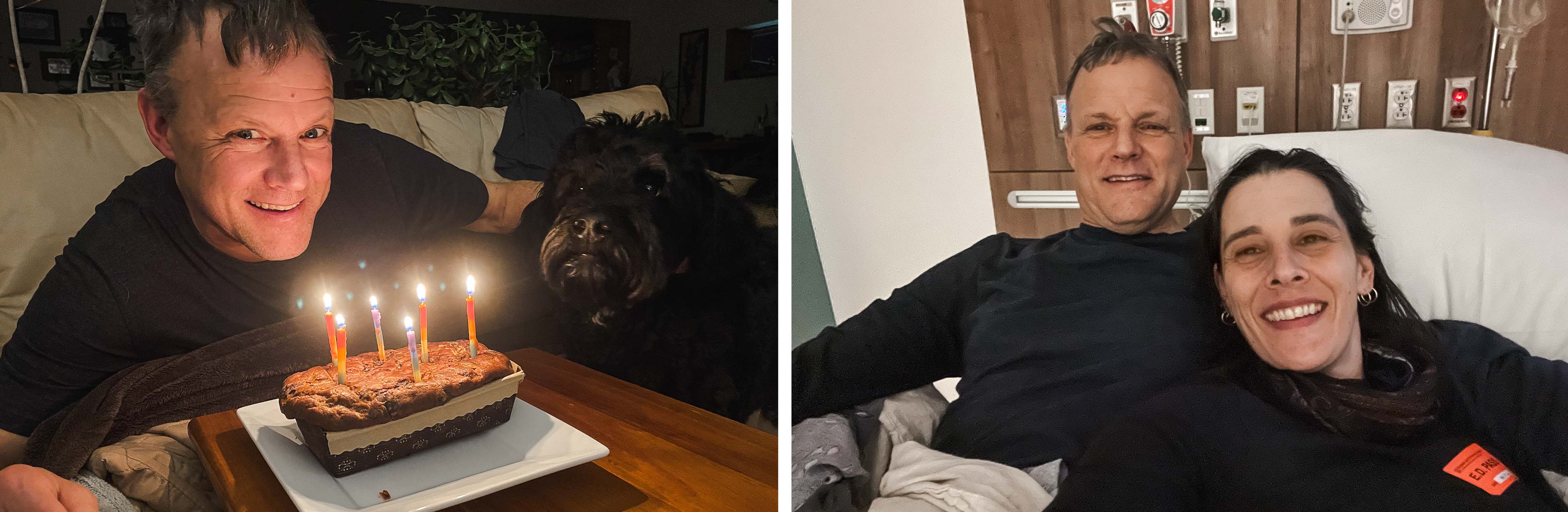 Chris celebrates his birthday following radiation treatment on March 4, 2023. (Courtesy of Thereza Cononi) Chris at Brigham and Women’s Hospital in Boston following complications involving a stent and pancreatitis on March 20, 2025. (Courtesy of Thereza Cononi)
It ran into April. On April 7, this year, two weeks after the urology appointment, he was preparing for another round of chemotherapy. He had been in and out of the hospital, and Cononi could see him growing weaker by the day.
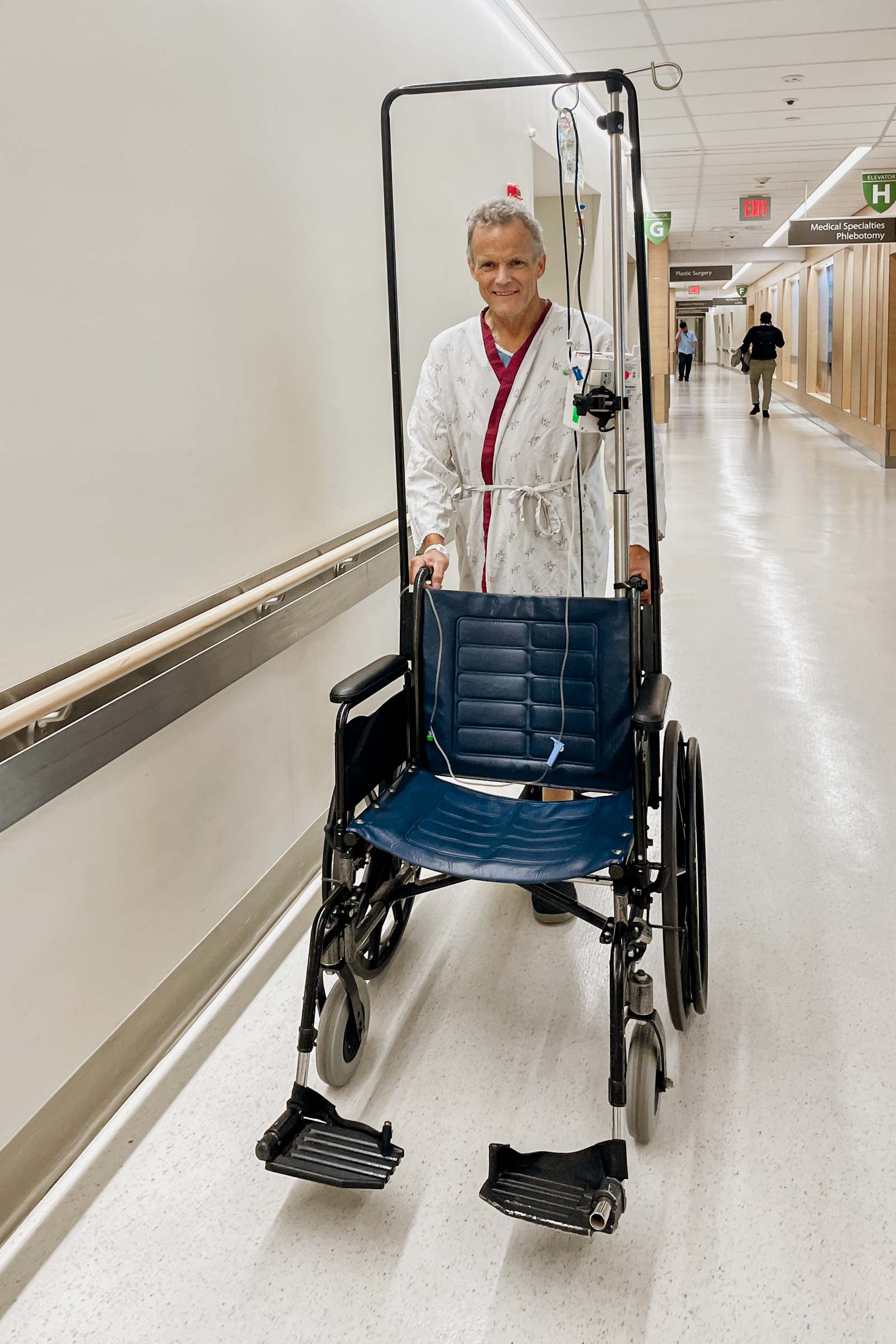 Chris at Brigham and Women’s Hospital after an arterial bleed that required emergency air transport and ICU treatment on Sept. 15, 2025. (Courtesy of Thereza Cononi)
“No, I’m not giving up,” he told her. “If I don’t get chemo, I don’t have a chance.”
To Lacey, another treatment meant another chance to live. To Cononi, it meant more suffering when she knew in her heart that time was running out.
McAvoy has watched that standoff play out in families for two decades. “The family is always trying to protect the patient, and the patient is always trying to protect the family,” he said. “But in my experience, deep down the patient always knows how bad it is.”
Still, Lacey’s hope was understandable. About six months earlier, after a bleed sent him by helicopter to a Boston hospital, doctors told him they were running out of options. The word hospice was briefly mentioned. But Lacey survived another risky procedure. Within weeks, chemo was back up for discussion.
This gave him fuel to challenge every grim forecast. “They were wrong about that. How do we know they’re not wrong about this?” Cononi recalled him saying.
She wanted his doctors to explain what another treatment could realistically accomplish. They discussed his condition with her privately, she said, but rarely brought those conversations into his room.
“Every time I brought them up, I was the bad guy,” she said. She came to believe that his doctors didn’t want to be the ones to tell a man who had repeatedly beaten the odds that his luck had run out.
McAvoy thinks it’s more than a reluctance to deliver bad news. Doctors are trained to do something, to fix things, he said. Sometimes that training shapes what they see.
“If you’ve got a hammer, everything becomes a nail,” McAvoy said. “If you’re a surgeon, you do surgery, even if it’s one in a million.”
Hospice can feel like admitting failure to physicians, rather than offering patients a different kind of care, he said.
Hospice providers interviewed by MedPAC described a similar pattern. Timely referrals were less likely to come from specialists such as oncologists, who often stayed focused on treating the disease until close to the end.
Hospice researcher Megan Mullins, who studies end-of-life care at UT Southwestern Medical Center, described another force at work: treatment momentum. Once treatment begins, it can be difficult to stop.
“One thing fails, we just move automatically on to the next one,” she told The Epoch Times. Rather than reconsidering another round of chemotherapy, doctors may offer it and then “stick the hospice on at the end.”
That’s what frustrated Cononi. She wasn’t asking doctors to give up on him. She wanted to discuss what another treatment might cost him.
“They should have been more transparent,” she said, “about what the outcome of the chemo was going to be.”
12 Days Home
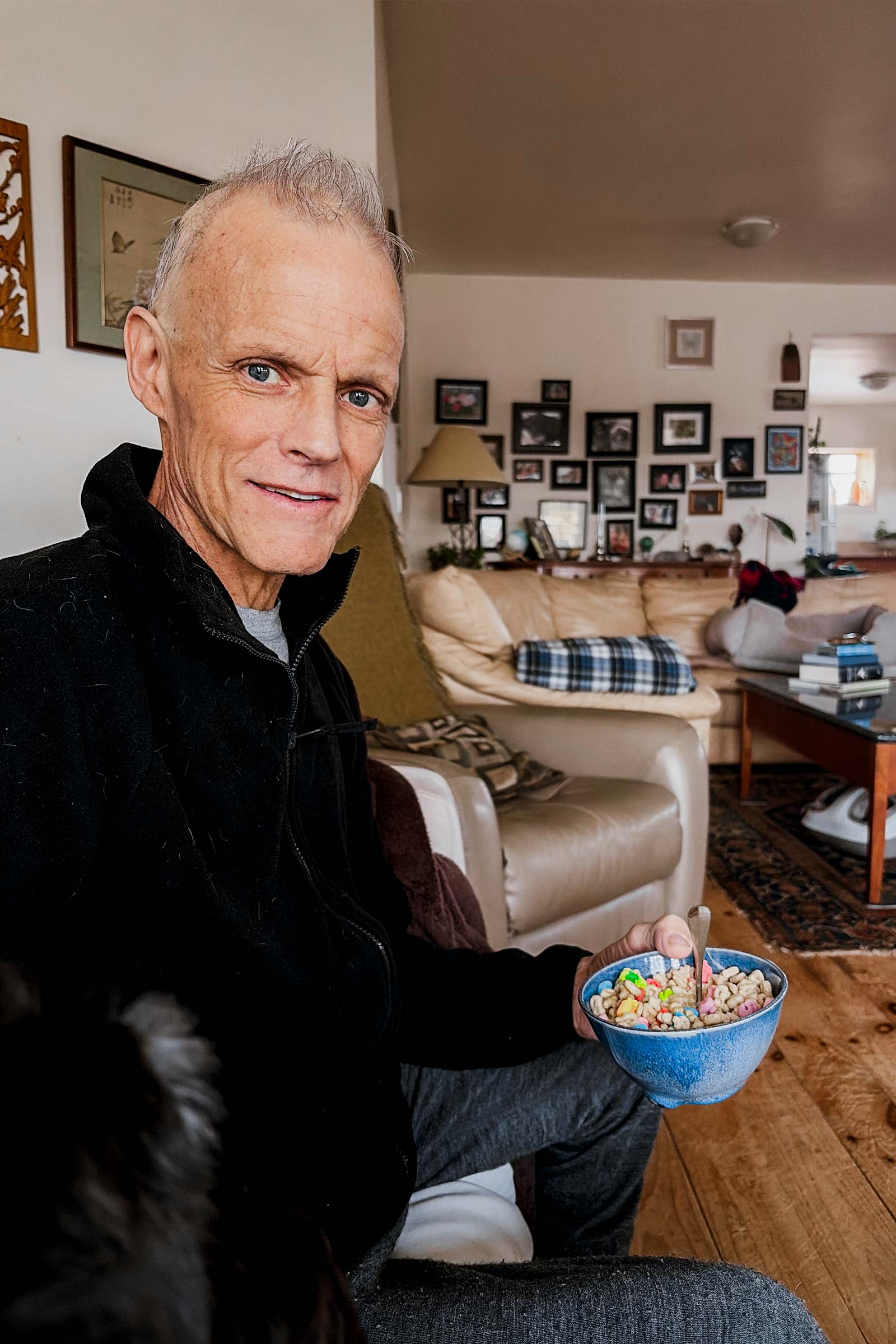 Chris Lacey on April 7, having breakfast before one of his last chemotherapy treatments. (Courtesy of Thereza Cononi)
He listened to monitors beeping as he tried to sleep under bright neon lights. He had lukewarm food delivered on little trays whether he was hungry or not. His days were filled with needles, questions, and fear.
On his last two hospital admissions, he was under isolation precautions. He couldn’t leave his room, and everyone who came in had to wear a protective gown.
Cancer patients are especially likely to spend their weeks this way, missing out on the benefits of hospice. A 2025 study looked at how more than 315,000 older Americans with cancer spent their last month of life. The ones still getting chemotherapy or other cancer drugs were far more likely to end up in the emergency room, and far less likely to be on hospice, than those who weren’t.
On April 30, two days after being discharged, Lacey woke up to blood in one of his drains. He refused another ambulance ride, so Cononi drove him to the clinic for an outpatient tube check, followed by an antibiotic infusion.
He could barely keep his eyes open. Staff were preparing to send him home when Cononi asked they check his blood pressure. It was 83/47, low enough that his organs were at risk.
Cononi pleaded for someone to admit him. She couldn’t take him home, and the unit couldn’t keep him. The staff called a code, summoning the hospital’s emergency team to take him to the emergency department.
By 10 p.m., a doctor was suggesting he go home and return for blood tests the next day. Cononi begged them to keep him. “I can see what’s going on,” she said. “This man is dying … and nobody is helping.”
Lacey never went home again.
On May 5, his oncology team finally told him chemotherapy was no longer helping. “It’s harming,” Cononi recalled the oncologist saying.
By then, he was so weak that staff worried he might not survive the 15-minute ambulance transfer to hospice.
33 Days on Hospice
Hospice didn’t change the fact that Lacey was dying. It changed how he spent his remaining days, and how much of his care Cononi had to carry alone.
When he arrived at the McClure Miller Respite House in early May, Cononi was used to fighting for his care.
As he was being admitted, she explained to his nurse why he needed a particular dose of a drug he took for complications of his liver disease. Other providers had challenged the dose. This nurse simply listened. “That’s fine,” the nurse said.
“I didn’t have to fight for him anymore,” she said.
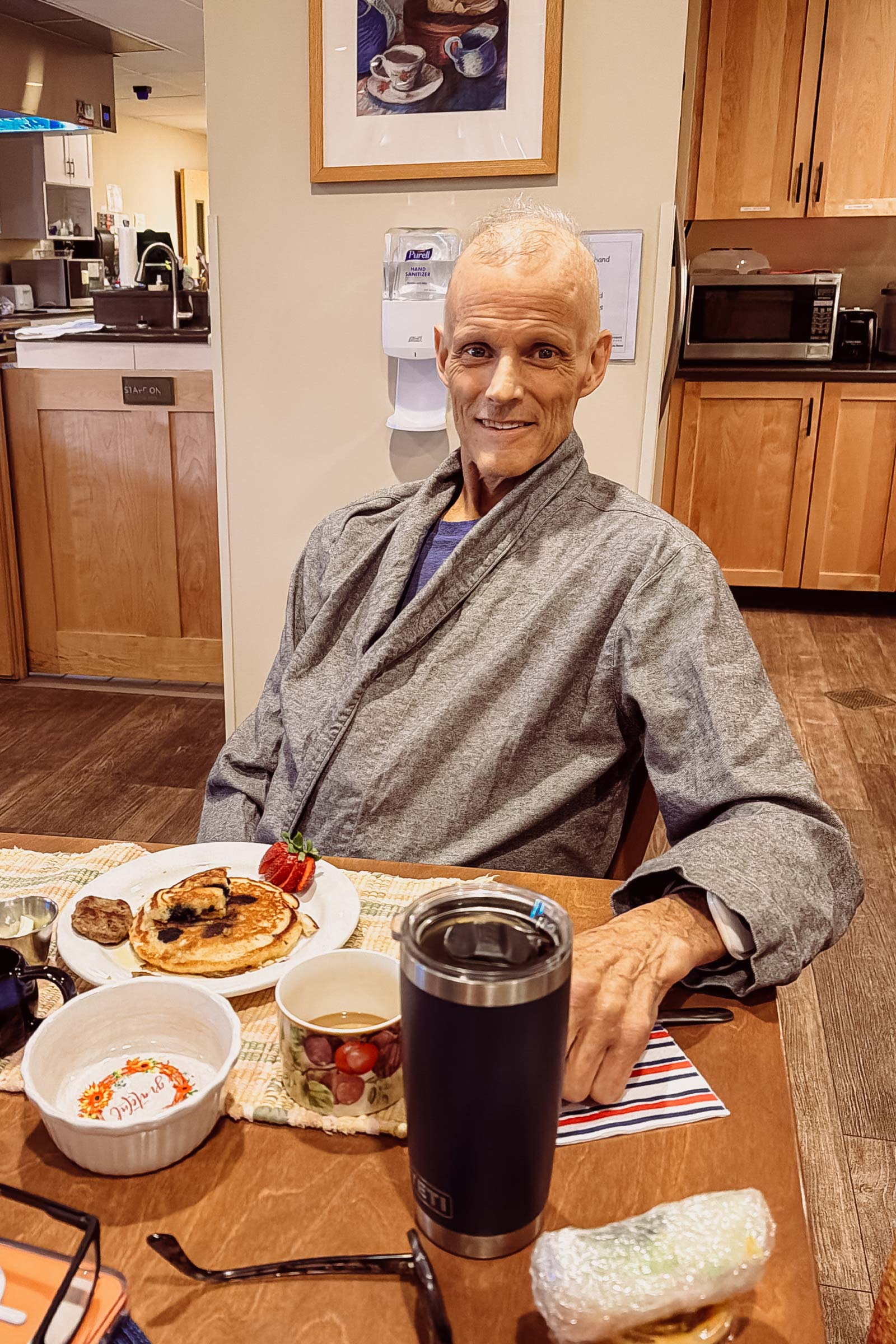 Chris Lacey enjoys breakfast and coffee with a friend at the McClure Miller Respite House during his hospice stay on May 8. Hospital staff were not sure he would make the ambulance transfer one day earlier. (Courtesy of Thereza Cononi)
On May 8, a mere three days after arriving at the Respite House, she arrived to find Lacey sitting up, eating breakfast, drinking coffee, and visiting with a friend.
“Oh my God, you’re sitting here. You’re up,” she remembered saying.
Lacey could now choose where to eat. He could go outside to breathe fresh air. He could visit with his dogs. People could visit without gowns or protective equipment.
Friends who were uneasy in a hospital came and stayed. His door went from “being a revolving medical door to a revolving door of happiness, connection, and love.” He stopped being a “pin cushion” and went back to being a husband, an electrician, a friend, a dog father.
“And he got better,” Cononi said.
Not better from his cancer. But better able to enjoy his days. Patients often regain energy when treatments stop, and their symptoms are managed, McAvoy said.
He believes they may even live longer, a common feeling among hospice providers. “If you do it the right way, you live longer on hospice, and you get more time with your family,” he said. But he said his experience may not reflect hospice care today.There isn’t much evidence. A 2007 study of 4,500 Medicare patients found that those who had hospice care lived an average of eight days longer than those who did not, a difference that rose to 29 days after accounting for differences between the groups. But the study couldn’t determine whether hospice itself was responsible.
No modern randomized trial has determined if longer life is a benefit of hospice. Such a study would require dying patients to leave a deeply personal choice to change. Living longer, after all, is not what hospice promises.
It promises comfort, and even that is not always straightforward. As fluid built up in Lacey’s abdomen as a result of his cancer, Cononi pushed for a procedure to drain it so he could be more comfortable. Staff initially resisted. McAvoy agreed that draining abdominal fluid can be a comfort measure, though he noted that the high cost can also influence hospice decisions.
Eventually, a physician came to evaluate Lacey. After reviewing his history of severe bleeding, he warned that the procedure could kill him.
“It’s too nice of a day to die,” Lacey said. “I don’t want to die on a sunny day.” He decided against the procedure and lived another two and a half weeks.
There were moments that Lacey struggled with what hospice meant. He asked what would happen if he started bleeding again, and was surprised to hear he wouldn’t return to the hospital. “So they’ll just let me bleed?” he asked.
Cononi and the team reassured him that they would keep him comfortable. The transition was not always easy. But for 33 days, Lacey had time with the people he loved, feeling like a human again, instead of a patient.
He died on June 7.
When to Ask
Not every late arrival to hospice is a missed chance, Teno said. Some patients turn hospice down when it’s first offered. Others decline faster than anyone expected.
“The patient has to be ready,” she told The Epoch Times.
But being ready for hospice and being ready to ask a question are different things. Families can ask if the next treatment will benefit the patient long before anyone says hospice. This could help to slow the medical momentum that often keeps people going in treatment.
They also don’t need to wait for a crisis to begin the conversation. Teno recommends consulting palliative medicine or geriatrics as serious illnesses progress to clarify treatment goals and recognize when it might be time for hospice.
Palliative care can begin while treatment continues. A consultation doesn’t require a patient to stop treatments or agree to hospice.
Mullins, the hospice researcher, advises families to watch for repeated hospitalizations and changes in everyday functioning. If a patient who once recovered quickly now needs help walking, eating, or managing other ordinary activities, it might be time to consider hospice.
Before agreeing to another treatment, she suggests asking what it will realistically accomplish.
“What can I expect if the illness gets worse?” she said.
McAvoy suggests asking for the estimated chance that a proposed treatment will work, along with what it will demand of the patient’s time and energy.
It’s best to have these discussions before a medical crisis hits, Mullins said. She urges families to talk about what matters most to the patient, including with anyone designated to make decisions on their behalf.
Cononi has thought a lot about the months leading up to Lacey’s death.
“In hindsight, I wish he had gone on hospice care in March,” she said. But she knows he had to come to that decision on his own.
During the 33 days at the hospice residence, something changed for Cononi, too. For six years, she had been his nurse and his advocate. At the Respite House, she got to stop.
“I finally was able to be his wife again,” she said.
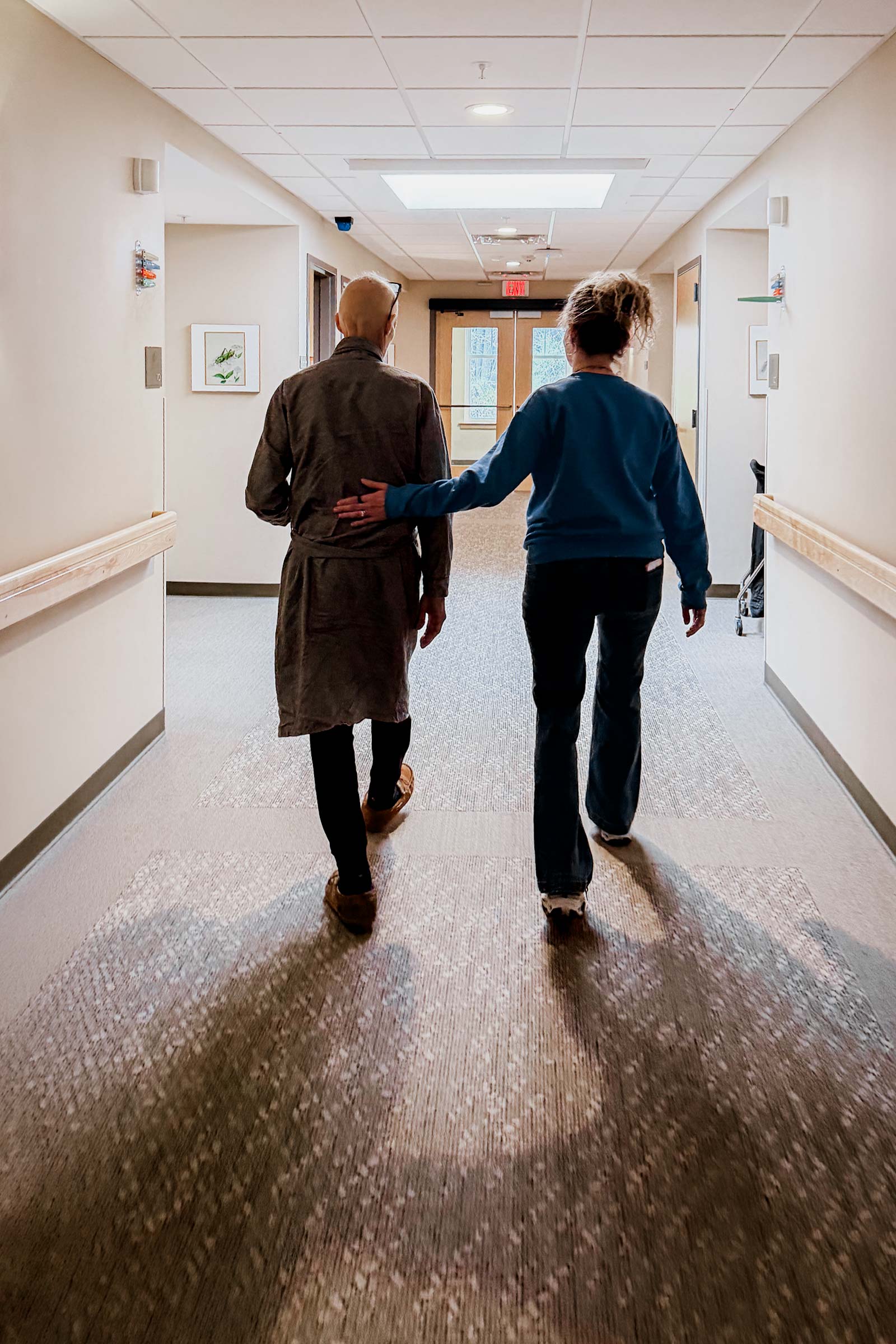 Chris Lacey walks back from the common room at the McClure Miller Respite House during his hospice stay on May 12. (Courtesy of Thereza Cononi)