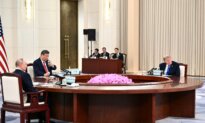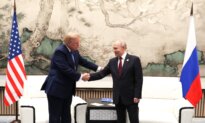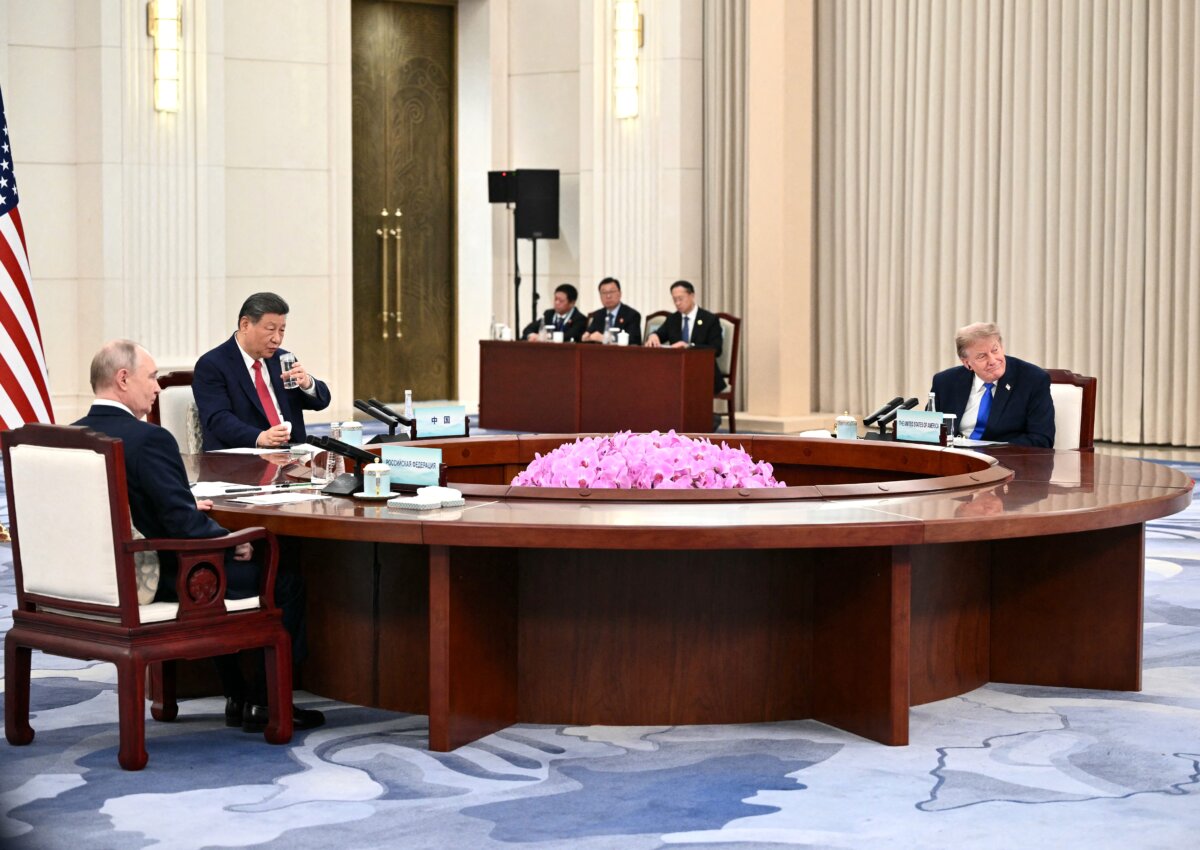

U.S. President Donald Trump is meeting with Russian President Vladimir Putin and Chinese leader Xi Jinping on Nov. 19, the first-ever sit-down of the leaders of the world’s largest nuclear powers.
Denuclearization is likely high on Trump’s agenda, an issue Beijing has resisted discussing with Washington and Moscow for years. The president is also expected to raise the wars in Iran and Ukraine.
North Korean leader Kim Jong Un didn’t show up at the summit. Trump had floated the idea of a face-to-face meeting in China with the leader of the hermit country.
The trilateral summit came after Trump’s meeting with Xi and a separate sit-down with Putin on the sidelines of the Asia-Pacific Economic Cooperation (APEC) gathering in the southern Chinese city of Shenzhen.
Ukraine was among the main topics of Putin’s brief exchange with Trump, Kremlin foreign policy adviser Yuri Ushakov was quoted as saying, according to Russian news agency Interfax. He said Putin walked out of the meeting in a good mood.
 Chinese leader Xi Jinping (C), U.S. President Donald Trump (R), and Russian President Vladimir Putin (L) take part in a trilateral meeting at Kylin Villa on the sidelines of the Asia-Pacific Economic Cooperation (APEC) Summit in Shenzhen, in China’s southern Guangdong Province, on Nov. 19, 2026. (Mandel Ngan/AFP via Getty)
Trump is in Asia for a trip that has taken him to the Philippines for a summit with leaders from across Southeast Asia. In Manila, Trump also participated in his first meeting of the QUAD, a group comprising the United States, Japan, Australia, and India.
The unprecedented gathering unfolds against the backdrop of an increasingly close strategic partnership between Beijing and Moscow. Trump enters the summit seeking common ground on shared concerns.
Denuclearization
Trump has said he wanted to discuss the “tough” subject of reducing nuclear arsenals with Putin and Xi, a target he has sought to advance since his first term in office.
The last remaining agreement limiting how many nuclear weapons the United States and Russia can deploy—the 2010 New START treaty—officially expired in February.
U.S. officials have said any successor treaties should involve China, which has accelerated expansion of the country’s nuclear capabilities. China is on track to have 1,000 nuclear warheads by the end of the decade, according to the Pentagon’s 2025 assessment, which warned Beijing’s “historic military buildup” makes the U.S. homeland increasingly vulnerable.
“If you’re going to have true arms control, it has to be triparty. It has to be the U.S., Russia, but also China,” U.S. Secretary of State Marco Rubio told reporters in July, after meeting with China’s top diplomat in Manila.
 The DF-61 intercontinental ballistic missile is seen during a military parade marking the 80th anniversary of victory over Japan and the end of World War II, in Tiananmen Square, Beijing, on Sept. 3, 2025. (Greg Baker/AFP via Getty Images)
Russia has the world’s largest nuclear stockpile, with a total inventory of roughly 5,400 warheads, followed by the United States with about 5,000, according to the latest annual assessment from the Stockholm International Peace Research Institute.
China ranks a distant third, but its arsenal is growing faster than any other country’s, the institute said. It estimated China had about 620 nuclear warheads as of January, nearly double the 320 it had in 2020.
By 2030, China could catch up to either the United States or Russia in the number of intercontinental ballistic missiles, depending on how it structures its forces, the institute said.
Wars in Iran, Ukraine
Trump has said he would raise the Iran war with the two leaders. He told reporters before departing the White House for Asia earlier this week that the United States has Iran “in very good shape” eight months after the U.S. military launched the joint operation with Israel.
China and Russia have maintained close ties with the regime in Tehran. Ahead of the U.S. naval blockade that cut off Iranian crude exports, China was Tehran’s top trading partner, taking in nearly 90 percent of its oil and providing a vital lifeline to its sanction-hit economy.
Rubio said on Nov. 10 that Iran had only “a handful of barrels of oil” that had escaped the U.S. naval blockade during the brief ceasefire and remained at sea, and that China would soon have very little oil to buy from the Middle East nation.
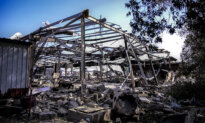
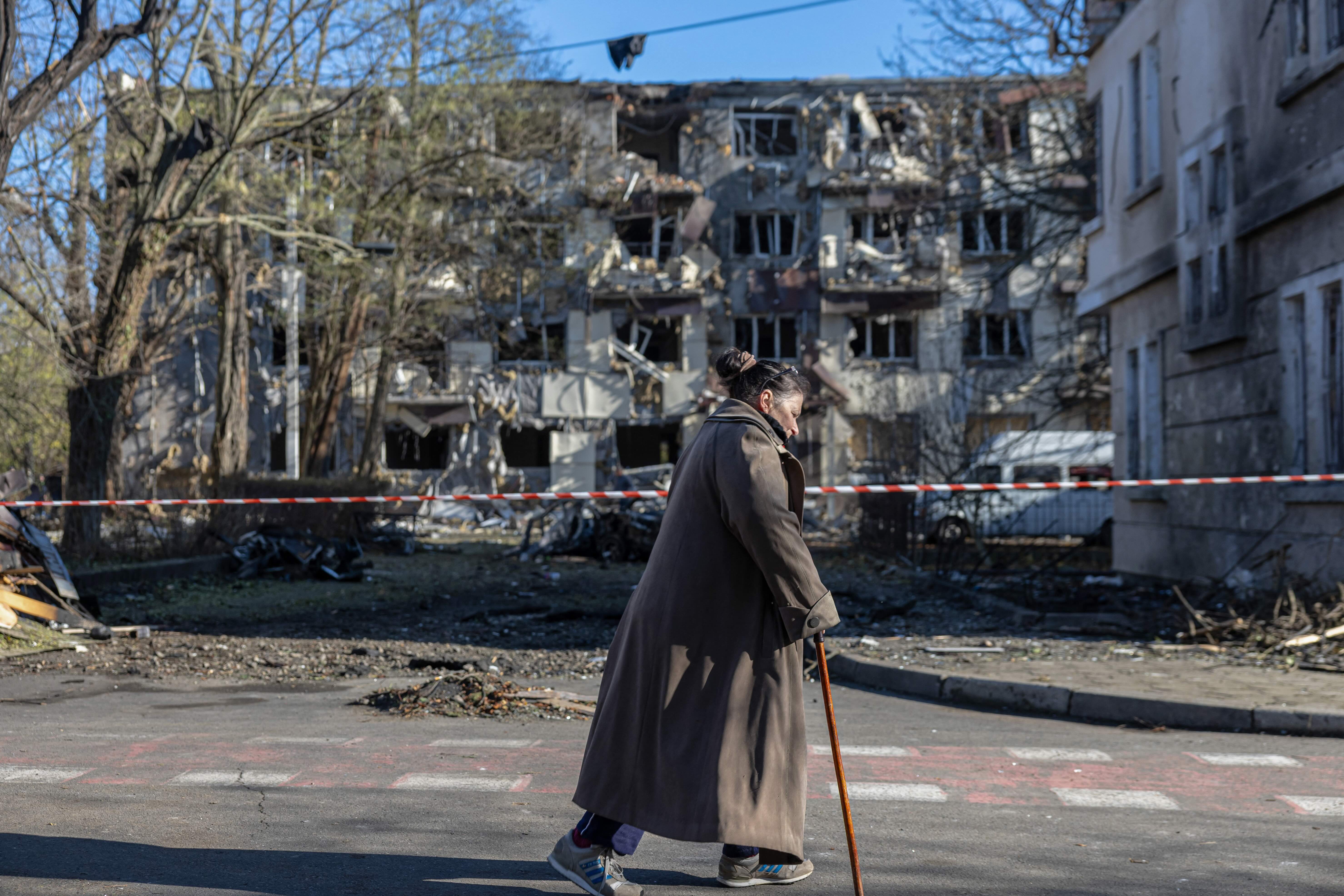 A resident walks past damaged buildings at a site of a drone strike in the city of Chornomorsk, Odesa region, on Nov. 15, 2026, amid the Russian invasion of Ukraine. (Oleksandr Gimanov/AFP via Getty Images)
Russia has moved closer to China since its invasion of Ukraine more than four years ago. Just weeks before Russia mounted its war against Ukraine, Putin traveled to Beijing to attend the 2022 Winter Olympics opening ceremony and declared a partnership with “no limits.”
Yalta 2.0?
The three-way meeting has drawn comparisons to the 1945 Yalta Conference, when President Franklin Roosevelt met with British Prime Minister Winston Churchill and Soviet dictator Josef Stalin to shape the post-World War II world.
At the time, the United States, Britain, and the communist Soviet Union were at least wartime allies, with “common interests and a certain degree of consensus,” said Shen Ming-Shih, a research fellow at the Institute for National Defense and Security Research, a Taiwanese defense ministry-funded think tank.
Now, however, Putin, Xi, and Trump have “significant differences in their respective positions, making it difficult for them to find common ground,” Shen told The Epoch Times ahead of the leaders’ gathering.
“The trilateral summit in Shenzhen is merely a meeting; it is not a formal strategic dialogue,” Shen said. “Reaching any concrete outcomes or negotiating real deals will be difficult, and even if the leaders reach any understanding, it still lacks binding force.”
 British Prime Minister Winston Churchill (L), U.S. President Franklin Delano Roosevelt (C), and secretary-general of the Soviet Communist Party Joseph Stalin (R) pose at the start of the Conference of the Allied powers in Yalta, Crimea, on Feb. 4, 1945. (STF/AFP/Getty Images)
Gordon Chang, author of “The Coming Collapse of China,” said Trump is handing Beijing a “propaganda win” by participating in the summit, according to his Nov. 16 post on X.
“Do we really think we should be boosting China’s standing at this moment?” Chang added.
Luo Ya contributed to this report.
 Friends Read Free
Copy
Facebook
Tweet