
Commentary
From early in my work life—you could once get a decent job at the age of 14—I imagined myself to be a master of laundry. I was working at a department store and I had particular interest in shaping up the men’s shirts and preparing the racks for the opening of the next day. From there, I took to ironing like an aspiring virtuoso. For years, I’ve preened as an expert.
Something shocking emerged last week. It turns out that for my entire life, I’ve been starching shirts incorrectly. Somehow I got away with this without corrections for decades. The terrible truth emerged in an iterative search for how to reproduce the hard finish of an English laundry in an American home. After years of attempting this and failing, I had largely given up.
The more I dug around, the more alarming the truth became. Apparently, “everyone knows”—or at least everyone once knew—that you do not use steam with starch. This is true whether you are using spray starch or liquid starch. Using steam defeats the whole point. It prevents the starch from setting and giving the fabric a hard finish.
If it is scalding that concerns you—I think that this has always been my top concern—the answer is to use a clean cotton handkerchief on top of the surface you are ironing. The iron should be moved quickly and with pressure but absolutely no steam. After the first round, you can remove the handkerchief and hit the fabric directly with a dry hot iron.
Utterly gobsmacked, I set up the board and dragged out my shirts to try the new system on everything. I did collars, cuffs, plackets, and even my formal wear bib. The results I simply could not believe. It’s not “Downton Abbey”-level laundry but not far from it. The collars are stiff and tall, the cuffs crisp, and even the bib on the formal shirt looks respectably hard.
Of course I’m glad for the correction and for the launch of my new life ironing correctly. Still, there is something about this entire incident that really spooks me. I’ve been ironing my entire life, even in professional settings in fine clothing stores. How is it possible that this simple and powerful truth—do not use steam with starch—evaded my notice for this entire time?
This incident has fed into a paranoid feeling I’ve had. I sometimes wonder just how much knowledge we’ve all lost in the course of the decline of educational institutions, family and community life, and multigenerational homesteads. These institutions were the way we learned and the means by which wisdom was passed down from one generation to another.
The capacity to achieve this intergenerational learning, this passing down of wisdom through the ages, is what distinguishes man from animals. I’m pretty sure that golden retrievers today have the same skillsets as golden retrievers 300 years ago, and bless them for it. But people can teach their children, and those children can teach theirs, and so on. It’s a mark of what it means to be human.
It’s inevitable that some knowledge would drop through the cracks. Historians say that the cure for scurvy was lost and found three times between the ancient world and the 19th century. The issue was that each time the problem was solved, the existence of the initial problem and solution was forgotten a bit in each passing generation.
What else have we forgotten? I worry in particular about what we call medicine and medical service today. It was a bit longer than a century ago in the United States that the professional codified what it means to be a healer. We settled on petroleum pharmaceuticals and invasive surgeries and biologics. Those mutated into every manner of psych drugs that are essentially sedatives.
What have we lost in this process? Chinese medicine is something adored all over the world and sworn by as efficacious. Most Americans know nothing about it, much less the myriad ways in which herbal cures can be better and less toxic than pharmaceuticals.
Our lives are packed with little habits that we know from family and experience, passed on from generations. But there is surely vast loss.
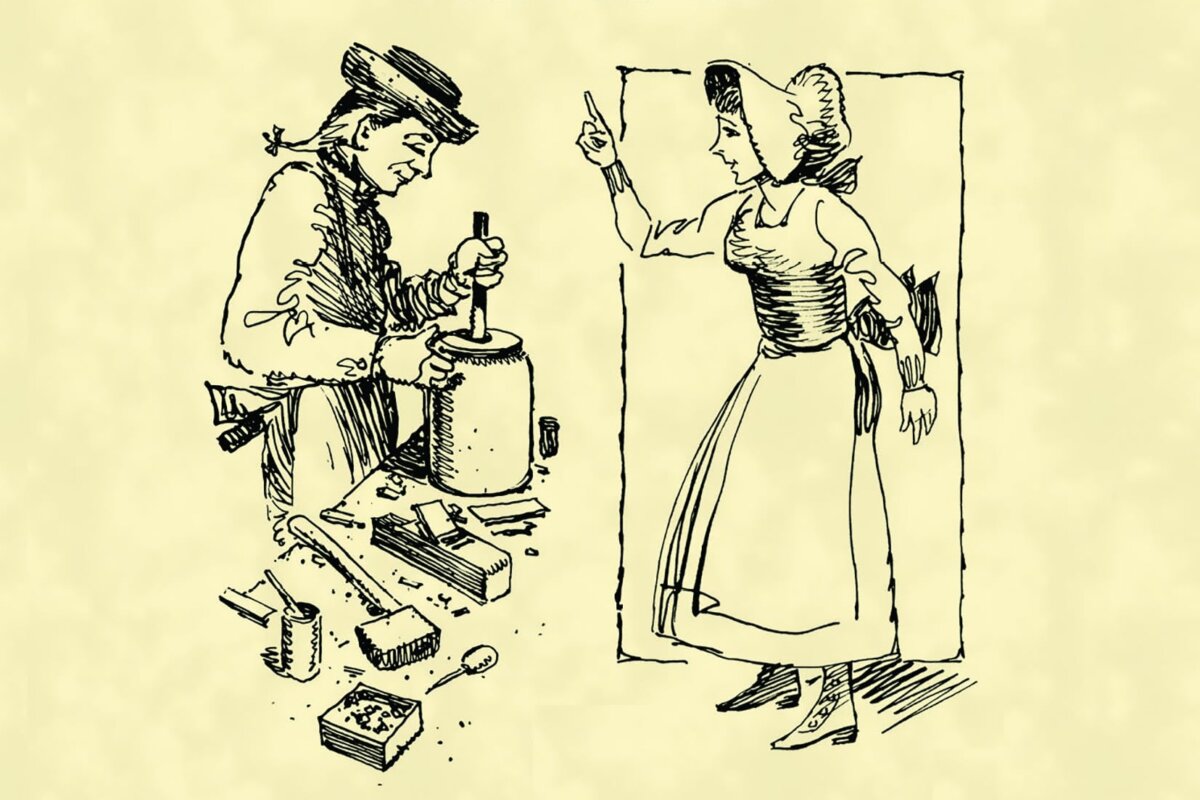
This is why I’m enjoying this delightful book by Eric Sloane: “Do’s and Don’ts of Yesterday: A Treasury of Early American Folk Wisdom.”
Some bits: Do hang a broom from a nail instead of resting it upon the floor. Letting a broom stand can give it a permanent warp within a few hours.
Do keep a bag of salt as a handy fire extinguisher. A chimney fire can be dealt with by shutting doors and putting salt upon the fire in the grate. Salt-formed gases tend to extinguish flames.
Do measure anything tall (such as a building or tree) by simply measuring its shadow at a given time. By placing a stick in the ground and waiting until its shadow length equals its own height, all other objects’ shadows will at that instant also equal their height.
Do roll newspapers into rolls by wrapping them with string. A stack of these “logs” will do almost as well in your fireplace as real wood. Newsprint is produced from wood anyway.
Do clean woodwork marred by match-scratching, etc., by rubbing it with half a lemon. Fingermarks will also disappear by this method.
Do try the simplest of sickroom disinfectants—a plate full of sliced onions.
Do clean windows with damp newspaper. The ink actually aids in cleaning and the paper is unusually absorbent.
Do make candles burn slower (as when a night light is needed) by putting salt on top till it reaches the black part of the wick. In this way the smallest candle can be made to last longer with a steady, mild light.
Don’t serve gentlemen guests at your table until all the ladies are served, including those who are members of your household.
Don’t eat soup from the end of your spoon, but from the side. Don’t gurgle or draw in your breath audibly or make other noises when eating soup. Don’t ask for a second serving of soup.
Don’t bend over your plate or drop your head to get each mouthful. Keep as upright an attitude as you can without appearing stiff.
Don’t load up the fork with food with your knife and then cart it away to your mouth; rather take upon your fork what it can easily carry and no more.
Don’t handle your knife and fork awkwardly; let the handles rest in the palm of your hand. Don’t stab with your knife or handle it as if it were a dagger.
Don’t eat fast or gorge. Always take plenty of time. Haste is vulgar.
Don’t take huge mouthfuls or fill your mouth with too much food. Don’t masticate audibly.
Don’t put your knife into the butter, into the saltcellar, or into any dish.
Don’t spread out your elbows when you are cutting your meat, but keep them close to your side.
Don’t eat vegetables with a spoon, but use a fork. The rule is not to eat anything with a spoon that can be eaten with a fork.
And so on it goes for an entire book. This is all helpful and charming, but a caution: We are not really intended to learn all of this stuff from a book but rather from family, community, and lived experiences.
This is the danger of a broken community. It robs us of practical wisdom we need in life. So much of our daily lives is marked by knowledge of which we are only obliquely conscious. We have habits, learned from our environment, practiced for generations, adopted without deliberation. That’s good and necessary.
Having good habits embedded in our daily lives is a wonderful way to live. But we need teachers, mentors, families, and communities to pass them on to us and us to the next generation.
At least I know now: no steam with starch. I cannot go back in time and correct my errors, but I can at least pledge to do it correctly from now on.
Views expressed in this article are the opinions of the author and do not necessarily reflect the views of The Epoch Times.
 Friends Read Free
Copy
Facebook
Tweet