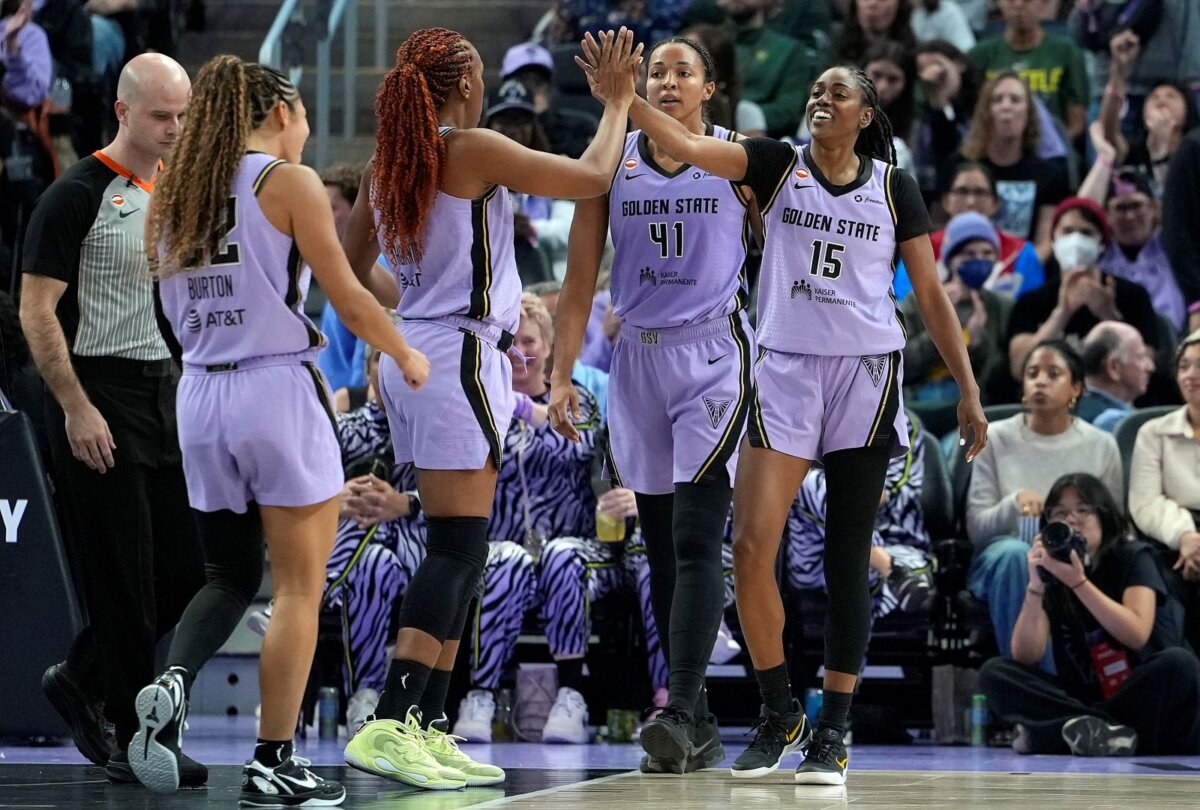

A first-time WNBA champion will be crowned at the conclusion of the 2026 WNBA Finals, which begin on Saturday with the second-seeded Golden State Valkyries taking on the fourth-seeded Atlanta Dream. This is the second year the league is using a best-of-seven format for the finals, with Golden State holding home-court advantage.
Let’s take a look at how these teams reached this point, and what we can expect come tipoff.
Both teams are led by second-year coaches and are coming off first-round playoff exits a year ago. Atlanta raced to the best record (30-14) in the East, while Golden State (32-12) was second in the West despite winning two more games than the Dream.
A dream also accurately describes Atlanta’s postseason run, as the team has been flawless. They swept the Washington Mystics in the first round, then did the same to the New York Liberty in the semifinals. Atlanta also won its last five regular season games and enters the finals on a 10-game win streak, which coincides with the arrival of DeWanna Bonner. The WNBA’s No. 3 all-time leading scorer has not lost in her 10 games with Atlanta, having joined the Dream after a late-season departure from Phoenix.
As for the Valkyries, they’ve suffered just one defeat across their six postseason games, in overtime no less. Golden State may have the single most impressive series victory of the playoffs—they dethroned the defending champion Las Vegas Aces in three games in the semis. Dating back to the regular season, Golden State has won 10 of its last 11 home games, which is important to note as it holds home-court advantage in this series.
Both teams have All-Star players, but there are arguably no superstars in the finals. In fact, this is the first finals in the 30-year history of the league that neither team has a single player who ever finished in the top three in MVP voting. One reason is that the strengths of many of the individual players reside on the end of the court that often goes overlooked—these are unquestionably the best two defenses in the league.
Golden State led the WNBA in defensive rating (100.6) in the regular season, with Atlanta second (104.5). But they achieved those ratings and rankings in different ways. The Valkyries simply smother opponents, holding foes to both the lowest field goal percentage and lowest three-point percentage. Add in that the team plays at the slowest pace in the league, and opponents struggle to convert their shots within limited opportunities on offense.
For Atlanta, a frenetic style of play is the key to success, highlighted by newcomer Angel Reese. The 2026 Defensive Player of the Year captains a unit that led the W in steals per game (9.1), with Reese finishing third in the statistic. Reese also led the league in rebounds for the third straight year, and as a whole, no team allows fewer offensive rebounds to an opponent than the Dream. You can’t score if you don’t have the ball, which is a philosophy that has the Dream knocking on the door of its first title.
On offense, Atlanta relies on a balanced approach, with five players averaging at least 13.2 points in the 2026 WNBA playoffs. The Dream are a high-octane, high-volume offensive unit that lacks efficiency at times, which could end up being their downfall. Atlanta attempts the most field goals per game but ranks just 11th in field goal percentage, while they attempt the second-most free throws per game but are just 10th in percentage from the charity stripe.
Golden State’s offense also lacks efficiency—it ranks dead last in the WNBA in field goal percentage. The Valkyries, though, are an analytics-driven squad that shuns the two-pointer—both attempting and making the fewest—in favor of the three-pointer, leading the W in both makes and attempts from downtown. They also protect the ball like no other, averaging the fewest turnovers per game, and forward Gabby Williams has taken her game to another level in the postseason. After putting up 14.4 points in the regular season, the UConn product is averaging 22.7 points in the playoffs, including a 36-point outing, a career high for her in either the regular season or postseason.
These teams met three times in the regular season, with Golden State sweeping the series, which saw two games in the Bay Area and one in Atlanta. The Valkyries were the only team that Atlanta went winless against, as the Dream scored 7.0 fewer points per game against Golden State than versus any other team. However, all three of those games came without Bonner in a Dream uniform, and Bonner did log one of her three double-doubles of the season in a win over Golden State when she was with Phoenix.
This is Atlanta’s fourth WNBA Finals appearance. The Dream and the Connecticut Sun are the only franchises to appear in the WNBA Finals without a championship. None of the players who were on Atlanta’s last finals team in 2013 are still with the club, but one of them, Tiffany Hayes, now suits up for Golden State.
Golden State just joined the WNBA in 2025, so they have fewer seasons as a franchise than the Dream have finals appearances. However, several of their players have titles with previous teams, including coach Natalie Nakase, who won a pair of championships as an assistant on the Aces. That experience on this stage, along with Golden State having home-court advantage, could be the deciding factor in this matchup, which would end on Halloween if it extends to a full seven games.
Game 1 begins at 3:30 p.m. ET from the Chase Center in San Francisco.
 Friends Read Free
Copy
Facebook
Tweet