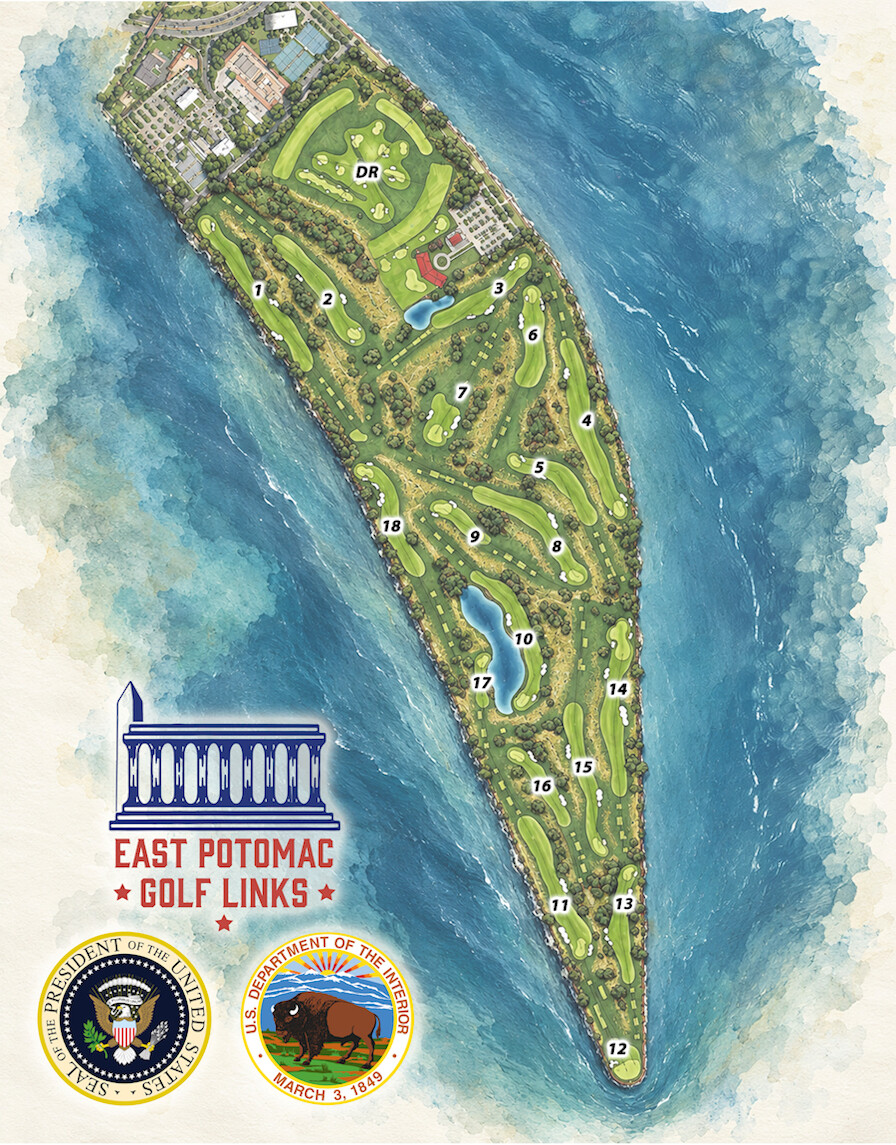

A federal judge on Nov. 14 temporarily blocked the Trump administration from closing East Potomac Park and its historic public golf course in Washington.
U.S. District Judge Ana C Reyes issued the temporary restraining order a day before the scheduled Nov. 15 shutdown.
The judge noted that the National Park Service cited safety concerns and the loss of the course operator as reasons to close the course and park area. Reyes said the National Park Service (NPS) didn’t mention that President Donald Trump plans to redesign the course, which would be the reason it was being closed.
“It cannot well admit that it proposes to close the Park solely to begin work on a redesign for which, it insists, no final plan exists,” the judge wrote.
Reyes said closing the area would mean “closing miles of paved roadway; trails and multi-use paths; fishing areas along the Potomac River and Washington Channel; the Hains Point picnic areas, playgrounds, and associated open spaces; a miniature golf course and three other golf courses; the seawall promenade; and the East Potomac Dock and Wharf Jitney.”
The White House didn’t respond to an email seeking comment.
Reyes pointed out issues with the order to close the course, citing safety concerns.
“As to safety, NPS has determined that the seawall on the Park’s perimeter presents such a hazard that it must close the Park on, again, November 15,” she wrote.
But the judge wrote that the NPS has identified the entire seawall perimeter as a safety hazard since 2019. Previously, NPS fenced off only the zone around the seawall’s unsafe portions.
“It has not adequately explained why that tried-and-true method will not work now,” Reyes wrote. “More telling, just three days before making the closure decision, NPS permitted over thirty thousand people to run a marathon around that same perimeter.”
The judge said the government responded to that question.
The government stated that a “well-organized race with thousands of people in broad daylight” didn’t pose the same safety concerns as children walking in the dark on the deteriorating seawall, or “lovebirds strolling in the evening, or anything of the other things that could happen there are fewer crowds, where there’s less supervision, where there’s less organization.”
She said the Park Service had skipped a required public notice-and-comment process and that closing the park would cause irreparable harm to the plaintiffs, who regularly use it.
The order allows limited closures near active seawall repairs and in areas where officials identify an imminent safety threat. For closures prompted by an imminent threat, the government must notify the court and the plaintiffs in writing within 24 hours. An earlier injunction restricting tree removal at the golf course remains in effect.
The dispute escalated after workers cut down trees at the golf course on Oct. 10. The plaintiffs said 529 trees were removed, while the administration put the number at 430.
The administration said the work was part of a tree management plan from a 2019 Cultural Landscape Report. Reyes found that justification was pretextual.
In an Oct. 16 motion, the Justice Department argued that Reyes showed bias by belittling a government lawyer, questioning the honesty of government counsel, and giving senior officials too little time to prepare to testify.
The department cited an Oct. 12 hearing on tree removal at the course, in which Reyes told a government attorney, “You did your absolute worst.” It also pointed to her questioning in a separate case involving the administration’s restrictions on military service by transgender people.
On Oct. 18, Reyes rejected the Trump administration’s request that she step aside.
“By any objective measure, the government fails to meet the standard for recusal,” Reyes wrote in her ruling.
 Friends Read Free
Copy
Facebook
Tweet