

WASHINGTON—Secretary of State Marco Rubio took aim at the elite of global governance in his first post-midterm election speech, warning that Marxism has survived in new forms despite the collapse of the Soviet Union.
“Even as we defeated the institution of Soviet communism, we did not triumph over the spirit of Marx,” Rubio told the Federalist Society in a Nov. 13 keynote address.
“It lives on in these new forms and doctrines, which would subordinate the national will to the menial consensus of the world,” he said. “Marxism sought to abolish the distinctions between men. The radicals of our time seek to abolish the distinctions between nations themselves.”
Rubio made the remarks 10 days after President Donald Trump designated Nov. 1 through Nov. 7 as Anti-Communism Week in an Election Day proclamation, calling Americans to “stand firm in their defense against any threat to the American way of life and to protect our burning flame of liberty from the darkness of communism.”
The secretary defended the administration’s policies, including the sanction against the International Criminal Court (ICC), describing the institution as an “unelected world tribunal” that “claims to supersede the laws and constitutions of sovereign states, even those who never signed up for it.”
He pushed back the idea that the U.S. government should restrain its actions to comply with the “rules-based order” when defending America’s national interests.
“The ultimate question of our time is whether Americans have a moral right to exist as a distinct nation and a distinct people,” he said.
Rubio named those at the ICC and the United Nations as among a “global elite,” controlling the official organs of global governance, who use international law as “an instrument to advance their interests under the pretense of universal principles.”
“We’ve heard the concept ‘international law’ invoked against nearly every major foreign policy decision or action of this administration,” he said. None of this, he said, has “anything to do with any real higher standard of justice.”
 The seat of the International Criminal Court in Den Haag, Netherlands, on March 8, 2024. (Laure Boyer/Hans Lucas via AFP via Getty Images)
Rubio said that over the past decade, the U.S. has faced a stream of claims that it violated international rules. He cited the military actions targeting drug boats in the Caribbean, the capture of then-Venezuelan leader Nicolás Maduro, the enforcement of U.S. immigration law, and the U.S. Supreme Court’s 2022 decision to overturn the 1973 Roe v. Wade opinion.
The ICC was founded in 2002 under the Rome Statute, which allows it to prosecute crimes against humanity, crimes of aggression, genocide, and war crimes.
In February 2025, President Donald Trump signed an executive order, authorizing sanctions against the ICC over alleged bias against Israel and the United States.
The decision followed the court’s 2024 arrest warrants for Israeli Prime Minister Benjamin Netanyahu and former Israeli Defense Minister Yoav Gallant, in connection with Israel’s military operations in Gaza after the Hamas terrorist group’s October 2023 invasion, which resulted in around 1,200 deaths of Israeli citizens and foreign nationals.
Neither the United States nor Israel is a member of the ICC or a party to the Rome Statute.
Rubio reiterated the objection to the court’s jurisdiction over Americans.
If it is “foolish enough to try to enforce their paper decrees on Americans,” he said, America’s answer will likely be the same as what Roman general Pompey said to those trying to invoke their cities’ charters against his legions: “Stop quoting laws to men with swords.”
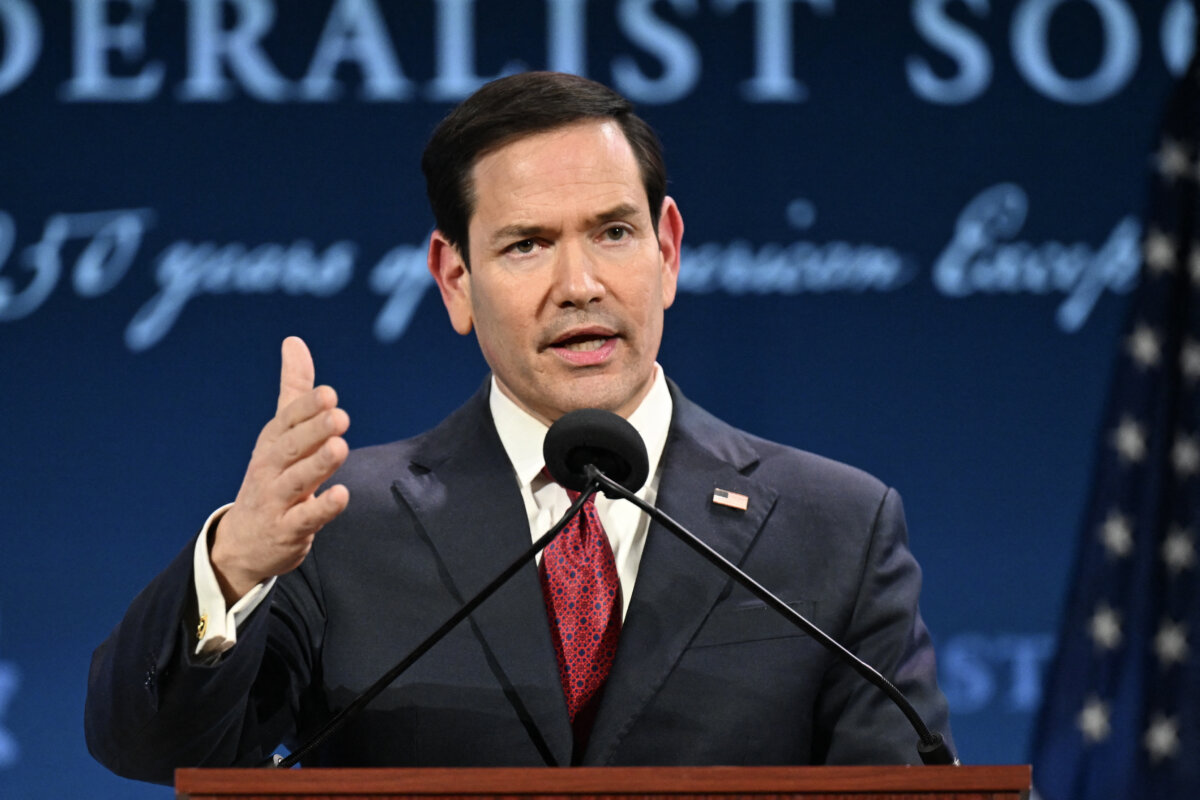
 Secretary of State Marco Rubio delivers a keynote speech at the Federalist Society National Lawyers Convention in Washington on Nov. 13, 2026. (Roberto Schmidt/AFP via Getty Images)
Rubio, who is set to accompany Trump to China for next week’s Asia-Pacific Economic Cooperation summit, said Beijing pursues what’s good for itself—and “they don’t apologize for it.”
“Our number one objective must always be what’s in the national interest of the United States,” he said. “And we shouldn’t feel guilty about it.”
 Friends Read Free
Copy
Facebook
Tweet