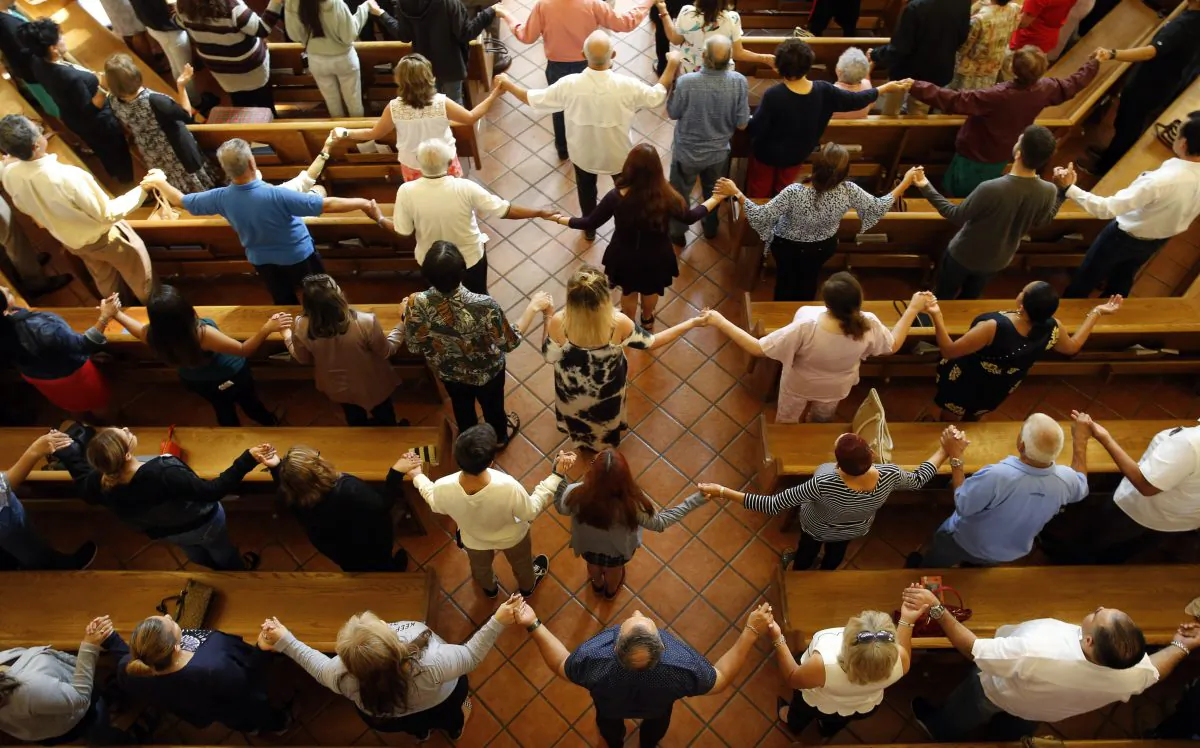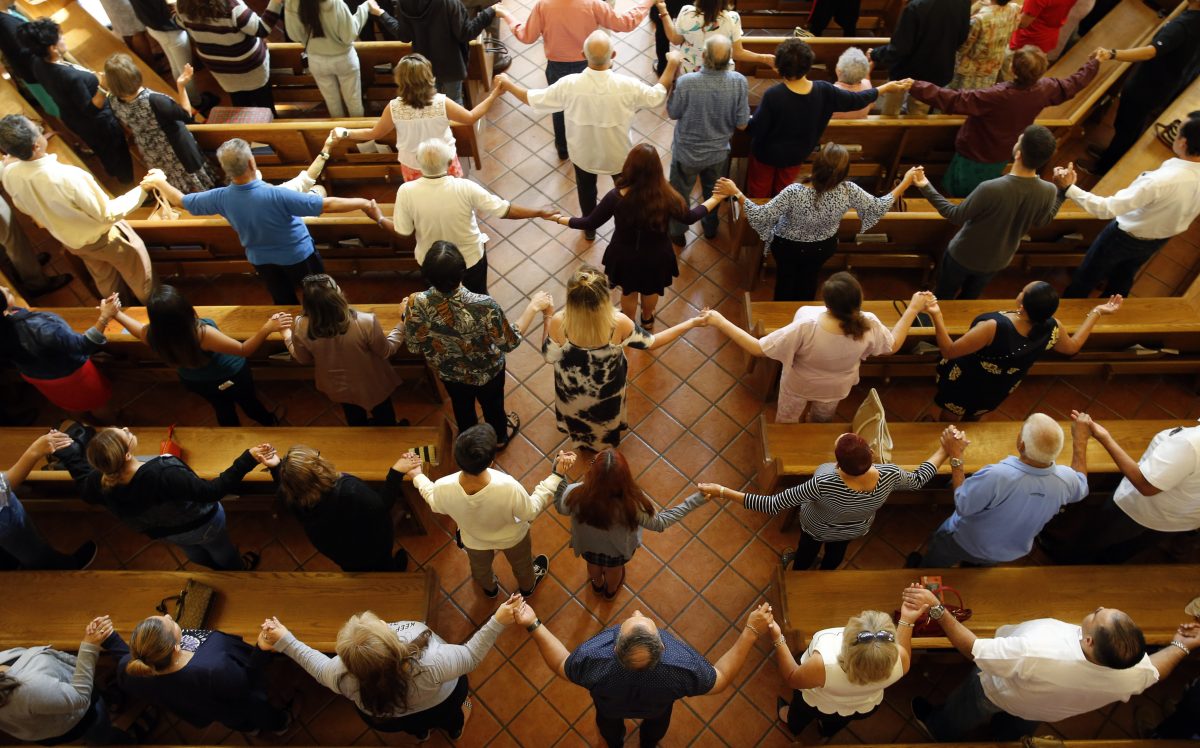

America’s youngest adults attend religious services at far higher rates than those of people just a few years older, an unexpected survey finding that challenges assumptions about younger generations abandoning organized religion.
A Pew Research Center study released on Oct. 28 found that 41 percent of adults ages 18 to 22 attend services at least monthly, compared with 27 percent of those ages 23 to 26. The younger group’s rate is about 152 percent of the older group’s rate, a 14-percentage-point difference.
“These numbers were just as striking to us,” Pew senior researcher Chip Rotolo said in an interview with The Epoch Times.
“It is striking in light of some of our former surveys to see that today’s youngest adults, ages 18 to 22, are attending at levels as high as any age group, even those in their mid to late 70s,” he said.
The findings draw on Pew’s nationally representative surveys conducted in 2025 and 2026. The research measures attendance at churches, synagogues, mosques, and other houses of worship, not just Christian churchgoing.
Rotolo cautioned that higher attendance does not establish a religious revival. Younger adults remain comparatively less religious on daily prayer, religious affiliation, and whether they consider religion very important.
“If we didn’t have that really high attendance number, we might say the religiousness of the very youngest adults today looks about like what we would expect based on past data,” he said.
Young men accounted for another unexpected finding. Among men ages 18 to 22, 47 percent reported attending services monthly, reversing the longstanding pattern in which women generally report greater religious participation.
“This is the first time we have seen this in our data, and so there’s not a particularly easy, obvious answer about why we see it,” Rotolo said.
The increase was not confined to men. Young women also reported higher attendance than women in the next older cohort, Pew found. Nor was the pattern limited to Republicans, although young Republicans attended more frequently than young Democrats.
“For those very youngest, 18- to 22-year-olds, the attendance numbers among both Democrats and Republicans are higher than what we might have expected, based on previous data,” Rotolo said.
“We can’t say that this is explicitly because of some sort of movement that’s happening in conservative politics,” he added.
The survey included 443 respondents born from 2004 through 2008, with a margin of error of 5.7 percentage points. Estimates for smaller gender and political subgroups carry larger margins.
Nevertheless, Rotolo said, the reported differences met Pew’s standard for statistical significance at the 95 percent confidence level.
“The share of 18- to 22-year-olds who attend monthly is 41 percent. That’s 14 points higher than the next cohort,” he said. “So even with the margin of error, we feel confident that those numbers are significantly different.”
Why there is such a gap remains uncertain. The surveys do not establish whether respondents attend because of faith, family expectations, social connections, or other motivations.
Rotolo cited possible influences including campus ministries and young adults continuing to attend services with their parents, but said Pew lacked evidence to establish either explanation.
“Our data can’t answer that question, but this number is certainly striking,” he said.
Pew also compared a 2019 survey of teenagers ages 13 to 17 with attendance among roughly comparable ages today. Attendance was 44 percent among those teenagers, versus 33 percent among today’s adults ages 20 to 24.
“In this case, it looks like their attendance has still gone down from those teenage years,” Rotolo said. The comparison suggests that some young adults may be retaining religious habits longer, rather than newly embracing worship.
Nationally, Pew found that religious identification, daily prayer, perceived religious importance, and monthly attendance have been broadly stable since 2020, following decades of decline.
A separate longitudinal study tracked 5,835 adults surveyed in both 2020 and 2025. It found 87 percent maintained the same religious affiliation status, while 84 percent reported no change in whether they attended services at least monthly.
Rotolo said that enduring evidence of revival would require sustained increases across several religious parameters, not simply one unusually high attendance reading.
“We would want to see changes among young people that last over time,” he said. “You would also want to see them on different measures.”
The researcher emphasized that future surveys will determine whether the youngest cohort’s distinctive attendance pattern persists as its members grow older.
“It’s definitely the case that the findings are complicated, and there is no one clear storyline, one underlying factor that seems to be causing all this,” Rotolo said.
 Friends Read Free
Copy
Facebook
Tweet