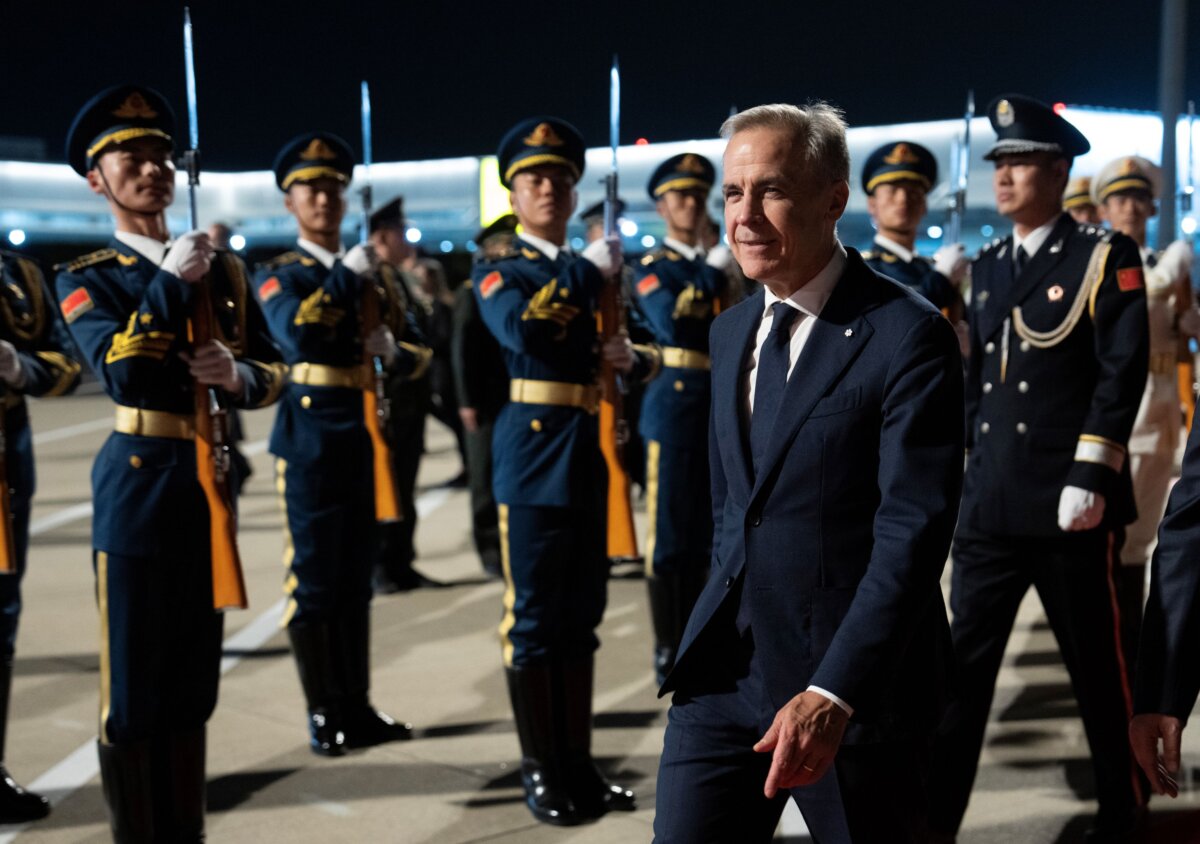
With Prime Minister Mark Carney in China this week for a summit, a number of human rights defenders are urging him to raise several key concerns with Chinese leader Xi Jinping.
Advocates say Carney should not let the pursuit of closer trade ties with Beijing sideline ongoing grave concerns over religious persecution, political prisoners, and Chinese interference in Canada.
Mimi Lee, a Toronto-based advocate for Hong Kong human rights, said she would like to see Carney raise a number of crucial rights matters with Xi.
“It’s very concerning that nobody, no countries around the world, is actually taking anything seriously with what the the Chinese government is doing,” Lee, convener of the Torontonian HongKongers Action Group, said in an interview.
She said she would like Carney to demand the release of Hong Kong democracy advocates including newspaper publisher Jimmy Lai and activist Joshua Wong, as well as speak out against China’s ongoing transnational repression of the Chinese diaspora community in Canada. She said that Chinese influence and transnational repression activities have surged in Canada in recent years.
NDP MP Jenny Kwan said she would like Carney to raise the issue of transnational repression and foreign interference when he meets Xi.
“As we know, we had a public inquiry into this matter, and the commissioner has highlighted the fact that China is one of the most aggressive actors in attacking Canada’s democratic institutions,” Kwan said.
Carney said Nov. 10 that he will raise the issue of foreign interference with Xi when he meets with him this week at the Asia-Pacific Economic Cooperation (APEC) Economic Leaders’ Meeting in Shenzhen, China.
“There will be an opportunity to strengthen the importance of not allowing foreign interference in Canada. I will raise that with him,” Carney said in French.
The prime minister’s office did not respond to a request for comment from The Epoch Times on whether he would also raise human rights issues with Xi.
The prime minister’s assertion that he will bring up foreign interference with Xi came in the wake of a recently released report from human rights group Safeguard Defenders indicating that China maintains over a dozen “liaison” points in Canada that work with police and judicial bureaus in China, and are engaged in transnational repression and monitoring activities in Canada.
According to government statements, Carney and Xi are expected to talk about growing Canada-Chinese economic cooperation, including in agriculture, energy, and financial services, building on several recent announcements including China’s Nov. 9 launch of up to CA$846 million in yuan-denominated green sovereign bonds in Canada.
Carney last visited China in January, where his government signed a number of memorandums of understanding agreeing to stronger ties with China including on law enforcement and energy.
During the visit, Carney said Canada’s closer bilateral relations with Beijing “sets us up well for the new world order.”
‘Bring Relief to Suffering Families’
Human rights concerns were also brought up by the Falun Dafa Association of Canada, with national director Grace Wollensak calling on Carney to seek the release of six family members of Canadians illegally arrested in China for practising Falun Gong.
“As Canada pursues trade with China, the safety and basic rights of people in Canada must remain a priority,” Wollensak said at a Nov. 16 press conference on Parliament Hill in Ottawa.
“By raising these issues directly with Xi Jinping, Prime Minister Carney can bring relief to suffering families and show that Canada defined its own sovereignty and Canadians’ freedom.”
Falun Gong, also known as Falun Dafa, is a spiritual practice that involves meditation and adherence to moral principles of truthfulness, compassion, and tolerance. It has been severely and widely persecuted by the ruling Chinese Communist Party (CCP) since it launched a campaign to eradicate the practice in 1999.
Wollensak said Carney should demand an end to the CCP’s persecution campaign against Falun Gong as well as an end to its transnational repression of the Chinese diaspora community in Canada, adding that her association has documented over 100 incidents of transnational repression against Falun Gong practitioners in Canada.
She said these incidents include threats, assault, intimidation, and pressure campaigns against politicians and cultural organizations to sideline Falun Gong, adding that a number of these concerns were brought up in a Nov. 9 letter sent to Carney.
The press conference included a Montreal woman who said her 81-year-old mother is currently serving a four-year sentence in prison in China’s Shandong province for practising Falun Gong, after being sentenced in 2023.
Another participant in the press conference said his younger brother is illegally imprisoned in Gansu province after being sentenced to seven years behind bars for having information on Falun Gong on his phone.
“This is the second imprisonment for his faith. He previously endured three years of imprisonment and torture for refusing to renounce Falun Gong,” the man said of his brother’s case.
The man added that his elderly parents are living in “anguish” and that he himself was previously held in a Chinese prison where he almost died.
“I know about Chinese prison. During my three and a half years of imprisonment, I was tortured with electric batons, doused with freezing water in winter, and subjected to brutal physical punishment,” he said.
Wollensak brought up a number of threats against Chinese classical dance company Shen Yun Performing Arts, which she said had been targeted by over 20 bomb threats during its 2026 Canadian tour. New York-based Shen Yun, whose artists practice Falun Gong, has a mission to revive China’s traditional culture.
She also referenced a Sept. 22 incident outside the Chinese Consulate in Toronto, where a man wearing a jacket with a communist Chinese flag assaulted two Falun Gong practitioners taking part in a peaceful protest and also threatened to kill them.
Wollensak stated that police have issued an arrest warrant for the the alleged attacker but said he appears to have returned to China.
“I think the Chinese regime is pushing the limit, and they are testing waters here and seeing what our Canadian government will do,” she said. “I don’t think we should step back. Rather, we really need to to face this issue seriously.”
Raising the Issue of Human Rights
China expert and former senior federal official Margaret McCuaig-Johnston said current gestures from Carney signal that he may not raise the issue of human rights when meeting with Xi.
Referring to Carney’s remark that he would raise the issue of foreign interference with Xi, she said that’s a positive development, “but it suggests he will NOT raise human rights in China or those unjustly detained.”
A Nov. 10 editorial published in the Chinese state-run China Daily warned Carney not to bring up human rights.
“Nor should differences over regional security in the Asia-Pacific and so-called ‘human rights issues’ repeatedly be elevated at the expense of bilateral progress,” the editorial stated, adding that “Ottawa should avoid strategic miscalculation on these issues, which could affect the broader China-Canada relationship.”
McCuaig-Johnston said the warning was a “clear threat” to Carney ahead of his visit.
 Friends Read Free
Copy
Facebook
Tweet