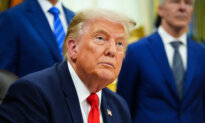

U.S. President Donald Trump warned on Aug. 31 that the U.S. military will resume attacks on Iran after the regime launched missiles at U.S. bases in Jordan.
“We’re going to hit them hard,” Trump told Fox News. “There will be a response.”
All of the Iranian missiles were intercepted except one, Trump said on Aug. 31. He noted that the United States allowed that missile to pass through airspace without intercepting it because officials had determined that it was not going to hit anything significant.
The president told Fox News that Tehran wanted to meet with the United States but that he was not sure whether Iran would make a deal.
The Iranian Foreign Ministry claimed on Aug. 31 that the armed forces of the Islamic Republic of Iran carried out “defensive and crushing strikes” against U.S. military bases in Jordan, according to the Iranian state-run Islamic Republic News Agency. Iranian officials said the strikes were in response to the U.S. attack on Larak Island on Aug. 30.
The Iranian military said on Aug. 30 that several of its soldiers and civilians were killed or wounded in U.S. airstrikes targeting Larak Island, which is about 410 miles east of Kharg Island. Tehran denounced the strikes as an “act of aggression” and vowed to retaliate.
U.S. Central Command (CENTCOM) rejected Iran’s claim that those strikes were an act of aggression, saying that they were intended to prevent Tehran from placing mines in the Strait of Hormuz, a critical waterway for a large share of global oil and gas shipments.
“U.S. forces took limited, precise action against [Islamic Revolutionary Guard Corps] minelaying forces posing an imminent threat in the Strait of Hormuz,” CENTCOM said in a post on X.
“In essence, Iran created the threat, and the U.S. military eliminated it to protect civilian mariners, commercial shipping, and the free flow of global commerce.”
Tehran later said it targeted U.S. military bases at Al Minhad Air Base in the United Arab Emirates with “dozens of explosive drones” in response to U.S. airstrikes on Larak Island, the Islamic Republic News Agency reported.
The UAE Ministry of Defense rejected Iran’s claim as false and urged its residents to get information only from official sources.
In a subsequent post on X, the UAE Ministry of Defense said its air force intercepted an Iranian drone over its territorial waters, noting that its forces are on high alert and will respond to any threats.
The UAE Ministry of Foreign Affairs condemned the drone incident as a “hostile Iranian attack” that represented a “dangerous escalation, an unacceptable act of aggression, and a direct threat to the UAE’s security, stability, and territorial integrity.”
The Aug. 30 strikes on Larak Island marked the first U.S. attacks on Iran since late July, when the U.S. military launched a major wave of strikes against Iranian targets in response to Tehran’s attempted missile attacks on a U.S. military base.
CENTCOM had carried out strikes against Iran for 13 consecutive days before Trump ordered a pause in military strikes to create space for negotiations.
Earlier in August, Trump announced that there were no peace talks ongoing or scheduled with Iran after the end of the 60-day negotiating window outlined under the memorandum of understanding that was signed by both the United States and Iran on June 17.
The United States has attempted to isolate and weaken Tehran through new sanctions under Operation Economic Outcast.
“Iran is officially a Failed Nation. IT IS DEAD!” Trump wrote in a Truth Social post on Aug. 31. “They have no Navy, they have no Air Force, they have no currency, they are not paying their soldiers or police, Inflation is at 300%, and their leadership is in total disarray and incapable of properly representing the country.”
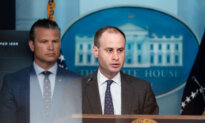
U.S. Treasury Secretary Scott Bessent told reporters on Aug. 31 that Iran’s strikes on U.S. bases in Jordan showed that the regime was “lashing out kinetically because [it was] losing economically.”
On Aug. 30, Trump shared what appeared to be an artificial intelligence-generated video depicting major explosions on Tehran’s key oil export hub.
“Kharg Island being blown to smithereens!!!” Trump said in a Truth Social post without providing details.
The 10-second video showed military personnel watching from an aircraft as oil facilities on the island exploded and were engulfed in fire.
Kharg Island, which is 16 miles off Iran’s coast in the Persian Gulf and roughly 300 miles northwest of the Strait of Hormuz, carries about 90 percent of Iran’s oil exports.
There has been no indication that Kharg Island was actually attacked. The U.S. Department of War did not immediately respond to a request for comment.
Asked about the president’s Truth Social post on Aug. 31, U.S. Vice President JD Vance reiterated to reporters at Joint Base Andrews that Trump has said he does not announce military actions on social media. Instead, Vance suggested that Trump was “sending a message to the Iranians” with the Kharg Island video.
“Look, we know that they continue to shoot at commercial shipping. We continue to have a lot of tools at our disposal to prevent them from doing so, or at least cut down on them from doing so,” he said.
“And … what the president is saying is: ‘Look, you guys are shooting at commercial shipping. You guys are behaving like a terrorist country. You’ve got to stop, or [there’s] going to be some consequences.’”
On March 13, Trump said in a Truth Social post that U.S. forces had “totally obliterated” all military targets on Kharg Island in what he described as “one of the most powerful bombing raids in the history of the Middle East.” The strike spared Iran’s oil infrastructure on the island.
The targets included naval mine storage facilities, missile storage bunkers, and multiple other military sites on the island, according to CENTCOM.
Trump said in June that the United States would seize Kharg Island and take control of Iranian oil and gas “in the not too distant future,” likening the potential move to the U.S. operation on Jan. 3 that ousted Venezuelan leader Nicolás Maduro and gave the United States control over the country’s oil industry.
 Friends Read Free
Copy
Facebook
Tweet