
Nvidia CEO Jensen Huang resigned on Nov. 12 after being accused of having an affair with alleged Chinese spy Alice Huang, who is not a relative of the ex-tech boss.
The relationship between the tech billionaire and the alleged Chinese spy sparked national security concerns after reports that his mistress was allegedly recruited to influence his company into making more advanced AI chips available to Chinese customers even though some are restricted from being exported from the United States.
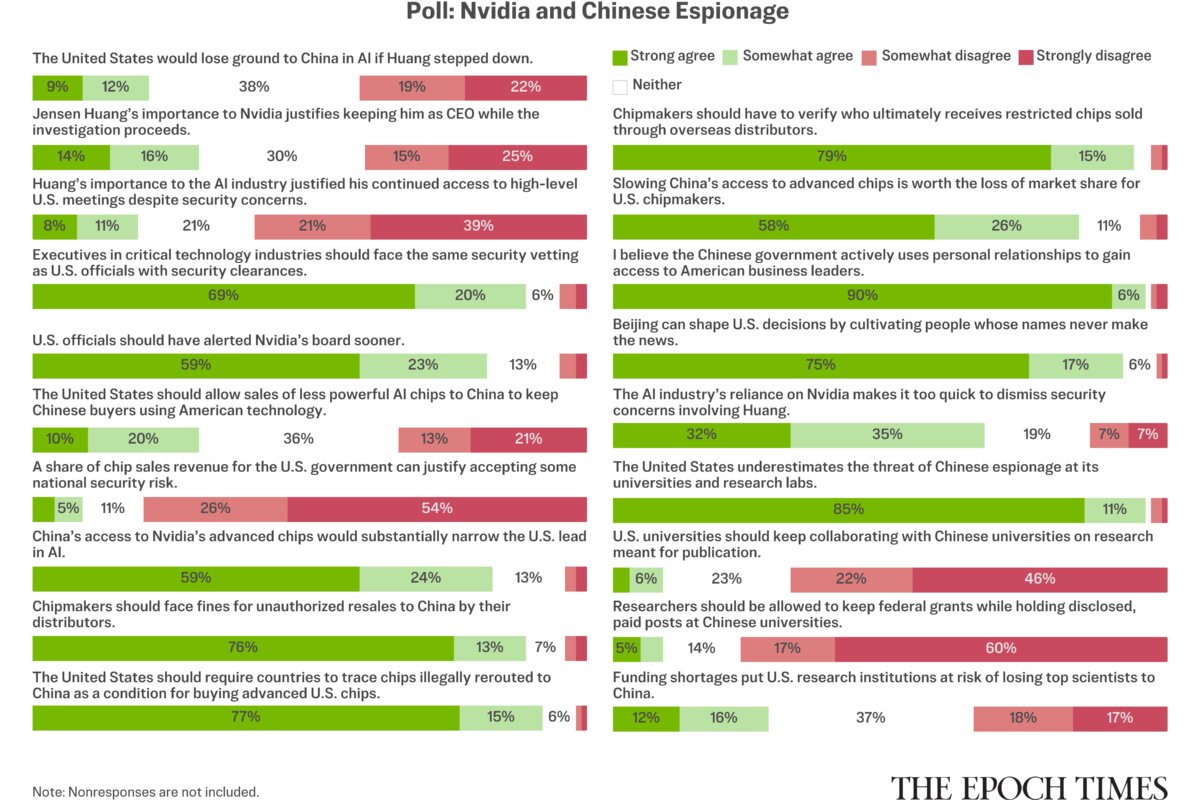
A new Epoch Times survey of 461 readers shows strong support for tighter controls on chip exports to China and stronger measures against Chinese espionage.
Here are the results.
Huang’s Resignation
Huang gave no indication he planned to step aside after news emerged of the first affair with the alleged Chinese spy and only announced his resignation after he was accused of a separate affair with Kimberly Powell, Nvidia’s vice president of healthcare.
When the sample group was questioned about whether the United States would lose ground to China in AI if Huang stepped down, 41 percent of survey respondents disagreed, 21 percent agreed, and 38 percent neither agreed nor disagreed.
When asked whether Jensen Huang’s importance to Nvidia justifies keeping him as CEO while the investigation proceeds, 30 percent of survey respondents agreed, 40 percent disagreed, and 30 percent said neither.
The sample group was also questioned about whether Huang’s importance to the AI industry justified his continued access to high-level U.S. meetings despite security concerns, and 60 percent of poll participants disagreed, 19 percent agreed, and 21 percent neither agreed nor disagreed.
When asked whether executives in critical technology industries should face the same security vetting as U.S. officials with security clearances, 89 percent of poll takers agreed, 5 percent disagreed, and 6 percent said neither.
 A photo shows Nvidia CEO Jensen Huang with a woman confirmed by a Reuters source to be Alice Huang in Taipei, Taiwan, released on June 7, 2024. (Obtained by Reuters/via Reuters)
Government
Attorney General Todd Blanche said an investigation into concerns surrounding the incident is underway but said neither the Department of Justice nor the FBI have confirmed whether the woman associated with Huang was a Chinese spy.
When asked if U.S. officials should have alerted Nvidia’s board sooner, the vast majority of Epoch Times readers agreed (82 percent), while only 5 percent of those polled disagreed, and 13 percent said neither.
Survey-takers were split when asked whether the United States should allow sales of less powerful AI chips to China to keep Chinese buyers using American technology, with 30 percent agreeing, 34 percent disagreeing, and 36 percent neither agreeing nor disagreeing.
The majority of Epoch Times readers disagreed that a share of chip sales revenue for the U.S. government can justify accepting some national security risk (80 percent disagree), while just 9 percent of those surveyed agreed and 11 percent neither agreed nor disagreed.
Chips
Most survey respondents agreed that China’s access to Nvidia’s advanced chips would substantially narrow the U.S. lead in AI (83 percent), with just 4 percent of readers surveyed disagreeing and 13 percent neither.
A large number agreed that chipmakers should fine distributors for unauthorized resales to China (89 percent agree), while only 4 percent disagreed and 7 percent neither agreed nor disagreed.
Most readers agreed that the United States should require countries to trace chips illegally rerouted to China as a condition for buying advanced U.S. chips (92 percent), with just 2 percent of poll takers disagreeing and 6 percent neither.
When asked for the opinion of survey-takers on whether chipmakers should have to verify who ultimately receives restricted chips sold through overseas distributors, 94 percent of respondents agreed, 3 percent disagreed, and 3 percent neither agreed nor disagreed.
When those polled were asked if slowing China’s access to advanced chips is worth the loss of market share for U.S. chipmakers, 84 percent of polled readers agreed, only 5 percent disagreed, and 11 percent said neither.
Participants almost unanimously agreed that the Chinese government actively uses personal relationships to gain access to American business leaders (96 percent of respondents), with only 3 percent of poll participants disagreeing and 1 percent neither.
When asked if Beijing can shape U.S. decisions by cultivating people whose names never make the news, an overwhelming number of readers agreed (92 percent), while just 2 percent of those polled disagreed and 6 percent neither agreed nor disagreed.
Most survey respondents agreed that the AI industry’s reliance on Nvidia makes it too quick to dismiss security concerns involving Huang (67 percent of readers surveyed), while 14 percent disagreed and 19 percent neither agreed nor disagreed.
Universities
Participants almost unanimously agreed that the United States underestimates the threat of Chinese espionage at its universities and research labs (96 percent of those surveyed), with just 3 percent of respondents disagreeing and 1 percent neither.
When asked for the opinion of survey-takers on whether U.S. universities should keep collaborating with Chinese universities on research meant for publication, 68 percent of polled readers disagreed, only 9 percent agreed, and 23 percent neither agreed nor disagreed.
Around three out of four people surveyed disagreed that researchers should be allowed to keep federal grants while holding disclosed, paid posts at Chinese universities (77 percent of people polled), while just 9 percent agreed and 14 percent neither.
Survey respondents were divided when asked if funding shortages put U.S. research institutions at risk of losing top scientists to China, with 28 percent of the sample group agreeing, 35 percent disagreeing, and 37 percent neither agreeing nor disagreeing.
The Epoch Times conducted this reader survey on Nov. 11–12, 2026, by email and social media, generating 461 responses. Friends Read Free
Copy
Facebook
Tweet