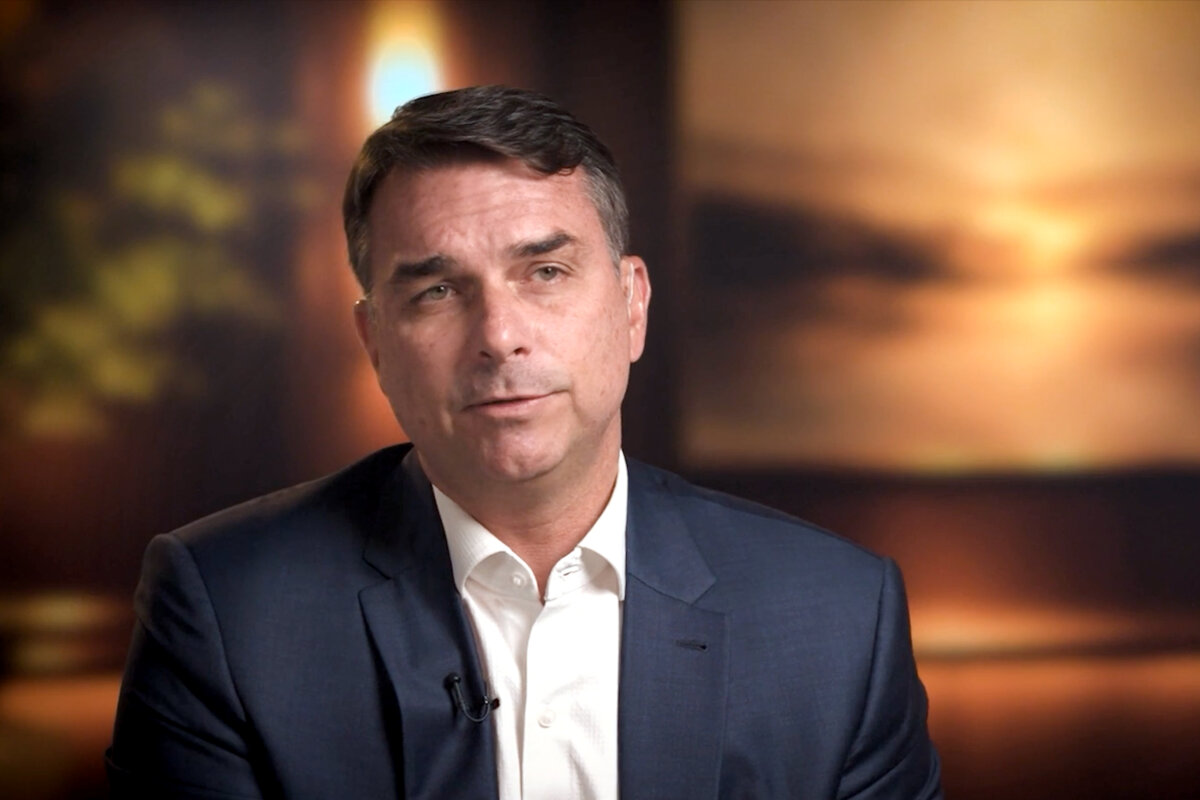
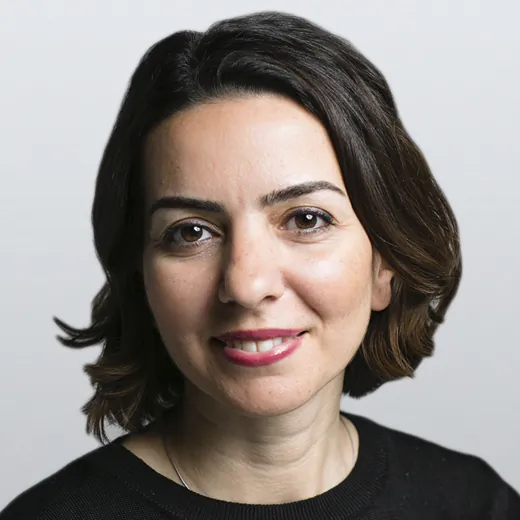

Flávio Bolsonaro was visiting his father, who is under home detention, a day after Brazil’s presidential election. His father, former Brazilian president Jair Bolsonaro, walked him to the door to see him off.
Outside, Flávio Bolsonaro was met by the federal police. They served him with a notice barring him from leaving the country and ordering him to turn over his passports.
In an exclusive interview with The Epoch Times, Flávio Bolsonaro recalled his father’s eyes filling with tears as he asked his son: “You already know where they want to take this, right?”
“Yes, I know, and I know what I have to do,” Flávio Bolsonaro replied.
It was the morning of Oct. 26, the day after Flávio Bolsonaro, 45, lost the presidential runoff to 81-year-old incumbent Luiz Inácio Lula da Silva. Just seven minutes after the race was called for Lula on Oct. 25, federal police signed a request to seize Flávio Bolsonaro’s passports, citing a risk that he would leave the country, as he is under investigation for suspected money laundering and illicit transfers of funds abroad.
Supreme Court Justice Alexandre de Moraes granted the request on election night. Flávio Bolsonaro denies wrongdoing in the investigation.
Moraes, who is widely regarded by critics as being close with Lula, is the same justice who led the criminal investigation and trial against Jair Bolsonaro, and the five-justice panel sentenced him to more than 27 years in prison for attempting to overturn the 2022 presidential election.
Determined to avoid a similar fate, Flávio Bolsonaro embarked on a 5,000-mile journey involving four countries. He and his family managed to elude Brazilian authorities and his whereabouts were unknown to his closest allies and media for more than 24 hours.
Flávio Bolsonaro declined to discuss the details of his escape to protect those who helped him.
“I can’t give details because they will be persecuted wherever they are,” he said, noting that many of the people who may have helped didn’t even know he was nearby during certain stretches.
On Oct. 27, Flávio Bolsonaro and his family had crossed into Argentina. The next morning, their plane landed in South Florida.
“I can imagine what went through my father’s mind: He knows he’s already unjustly imprisoned, sentenced to more than 27 years without having done anything wrong,” Flávio Bolsonaro said as he recalled that last meeting with his father.
The former president, 71, is serving his sentence at home due to health reasons. He and his supporters claim the trial was politically charged and contend he didn’t get due process.
Flávio Bolsonaro, former presidential candidate
Flávio Bolsonaro and his family are in the United States on humanitarian parole. Here, he was reunited with his brother, Eduardo Bolsonaro, a former congressman who also left their home country claiming political persecution.
The Brazilian senator says he wants to stay until the situation changes back home.
“I will remain in the United States, I will regularize my immigration status, and I will continue working for Brazil from here in America,” he said.
Flávio Bolsonaro said he “didn’t flee Brazil, but left for Brazil,” and compared his exile to historical figures such as France’s Charles de Gaulle and Venezuela’s María Corina Machado.
“I will lead the opposition from here. I’ll say what you can’t say, and I’ll take the risks you can’t take,” the letter states.
Lula called Flávio Bolsonaro’s escape “shameful.”
“He should have turned in his passport. The Federal Police should already suspect that he would leave Brazil, he has an investigation going,” the Brazilian president said in an Oct. 27 speech.
Claims of Election Irregularities
In the evening of Oct. 25, as the elections were called for Lula, Flávio Bolsonaro stood outside his campaign headquarters surrounded by allies and refused to concede.
The dispute partly stemmed from a last-minute ruling on Election Day just after polls closed at 5 p.m—a time mandated by the country’s electoral law.
Lula’s electoral coalition asked the high court for an extension to voting hours in areas experiencing public transit disruptions. Supreme Court Justice Cristiano Zanin, who previously served as Lula’s lawyer, granted this request but applied extended hours nationwide.
As voting stations got the message, many of them were already closed and couldn’t reopen due to technical constraints, resulting in uneven voting hours across the country.
The extension delayed the vote count for two hours, Bolsonaro said during the interview. He alleged that during that time, his party’s two poll watchers were removed for roughly 40 minutes from the Superior Electoral Court’s vault room.
About 35,000 votes were cast in the extended time window, and Flávio Bolsonaro suspects meddling could have occurred.
The Superior Electoral Court rejected those claims in an Oct. 26 statement, stating that the vault room is not a space open to visitors but two party representatives remained inside the authorized monitoring area observing the vote tabulation process.
Flávio Bolsonaro also raised questions about vote numbers, which he calls “mathematically inexplicable and statistically impossible.”
In the first round of Brazil’s presidential election on Oct. 4, Flávio Bolsonaro led with about 47 percent of the vote, while Lula received 45 percent. Because neither candidate secured an absolute majority, both advanced to a second-round runoff held on Oct. 25.
Three other candidates in the first round endorsed Bolsonaro, giving him a strong advantage heading into the runoff.
Lula ultimately staged a historic comeback, becoming the first candidate since the end of Brazil’s military dictatorship in 1985 to lose the first round and win the runoff. He added nearly 10.4 million votes between rounds, a 19.26 percent increase that secured him the victory.
Flávio Bolsonaro told The Epoch Times that his disbelief increased due to rapid gains by Lula in conservative-leaning states.
On Oct. 26, Flávio Bolsonaro’s Liberal Party accepted the election results but said in a statement that “the questions raised need to be properly clarified.”
Flávio Bolsonaro contends his party and allies won’t push forward election-related fraud allegations for fear of reprisal.
In November 2022, Brazil’s Superior Electoral Court fined the Liberal Party 22.9 million reals (about $4.3 million) after the coalition, Coligação Pelo Bem do Brasil, challenged the results and electoral process following Jair Bolsonaro’s election loss.
“So obviously, now in 2026, if the president of the party says he does not recognize the elections, he would be, once again, a victim of relentless persecution,” Flávio Bolsonaro said about his party accepting the results.
He says he now plans on trying to void Lula’s win through other legal pathways, challenging what he calls economic and political abuses.
He accused Lula of using government funds to buy votes, pointing to an expansion of welfare payments announced before the elections, and early payment of benefits just before the runoff.
Brazilian outlet O Estado de São Paulo reported that the Lula administration introduced 51 populist measures throughout the 2026 election year, totaling nearly 405 billion reals (roughly $70 billion dollars).
As the early payments were reported, the Lula administration said in a press release they were needed because of problems caused by El Niño weather conditions and were meant to help people facing extraordinary woes.
The Electoral Court said the elections happened normally and within constitutional requirements.
Democracy
Flávio Bolsonaro said that besides his claims on the elections and political persecution, his home country’s institutions are eroding.
“Brazil no longer lives in a full democracy,” he said in the interview.
He said congressmen in Brazil suffer legal consequences for speeches, interviews, and political opinions, which runs contrary to the immunity they’re granted in Brazil’s constitution.
The Organization of American States’ Inter-American Commission on Human Rights conducted an inquiry into the allegations of free speech being curbed in Brazil and wrote in their 2025 report that some elected officials in congress were fearful of speaking freely.
Flávio Bolsonaro also called on Supreme Court justices and others to be investigated.
Geopolitical Concerns
The Brazilian election reversed a recent trend in the Western Hemisphere, where conservative politicians, often supported by U.S. President Donald Trump, won victories Chile, Colombia, Honduras, and Peru.
Flávio Bolsonaro said that Brazil’s election will also have geopolitical consequences.
Flávio Bolsonaro, former presidential candidate
He voiced concerns about the direction Brazil is taking under Lula’s leadership, warning about the growing influence of narco-terrorists in the country. In June, the U.S. government designated Brazil’s two most violent criminal groups as foreign terrorist organizations.
While portraying himself as an American ally and Lula as the opposite, Bolsonaro said that China is expanding its economic footprint in Brazil.
“The fact is that Brazil today is heading fast toward becoming a narco-state in a marginalized way, the Brazilian economy is set to collapse, and China’s influence will grow in Brazil and across Latin America,” Flávio Bolsonaro said.
China replaced the United States as Brazil’s largest trading partner in 2009, under a previous Lula administration—the incumbent also governed the country from 2003 to 2010. Lula has maintained close ties to Beijing, as the United States and Brazil face diplomatic disagreements on tariffs, security coordination, and international legal affairs.
In November 2024, Lula and Chinese leader Xi Jinping signed 37 agreements and cooperation documents, furthering the Chinese Communist Party’s footprint in the region. Chinese state-aligned companies currently hold key contracts in telecommunications, utilities, and other strategic industries in Brazil.
Some China analysts point to Lula’s electoral victory as a lifeline for Beijing’s declining influence in the Americas amid Washington’s renewed focus on the region. Brazil has the largest economy, population and territory of all Latin American countries.
Flávio Bolsonaro believes Lula’s policies will drive the economy toward collapse.
Party’s Future
Flávio Bolsonaro remains hopeful for his party’s future. In congressional elections in October, his Liberal Party became the largest single party in both chambers of the National Congress.
“We elected 17 of the 27 governors in Brazil, and all 17 are right-wing. And we elected the largest bloc of federal deputies and senators of the center-right in the history of our country,” he said.
With a strong right-wing presence in both the lower house and the Senate, Flávio Bolsonaro predicts that Lula could face impeachment.
He cited former President Dilma Rousseff, who was in office from 2011 until the Senate impeached and removed her in 2016. She faced accusations of manipulating government accounts and moving funds between state banks to hide a growing budget deficit before her reelection.
Flávio Bolsonaro suggested Lula could face impeachment for electoral crimes or economic mismanagement, adding that his situation is “much worse” than Rousseff’s.
“I have no doubt that within four years at most, Brazil will again have a more right-wing government, perhaps sooner,” he said.
The younger Bolsonaro plans to run in the 2030 presidential election, or earlier if Lula is impeached or if his legal challenges to the election succeed, though he considers this unlikely.
Gratitude to America
Since arriving in the United States, some Democratic lawmakers have sought to pressure the administration to repatriate the Brazilian senator. In a recent letter, Rep. Robert Garcia (D-Calif.), who is the ranking member of the House Oversight Committee, demanded Secretary of State Marco Rubio to facilitate Flávio Bolsonaro’s return to Brazil to “face justice.”
Flávio Bolsonaro, former presidential candidate
Flávio Bolsonaro responded to Garcia’s statement, calling it a “hallmark of the global left” adding that he has more faith in the U.S. justice system than in Brazil’s system.
When asked if he had seen or spoken to Trump since his arrival in the United States, Flávio Bolsonaro said: “At the right time, I do hope to have a word with him.”
The self-exiled politician said he felt honored by the support he’s received from Americans, who’ve approached him in the streets and restaurants expressing their solidarity.
“That gives me more strength, more energy, and some of them even thank me for being here. … And I tell them I am the one who should be thanking the American people,” he said.
“I am very grateful to the American people and to President Donald Trump for opening the doors of America to me and my family.”
 Friends Read Free
Copy
Facebook
Tweet