



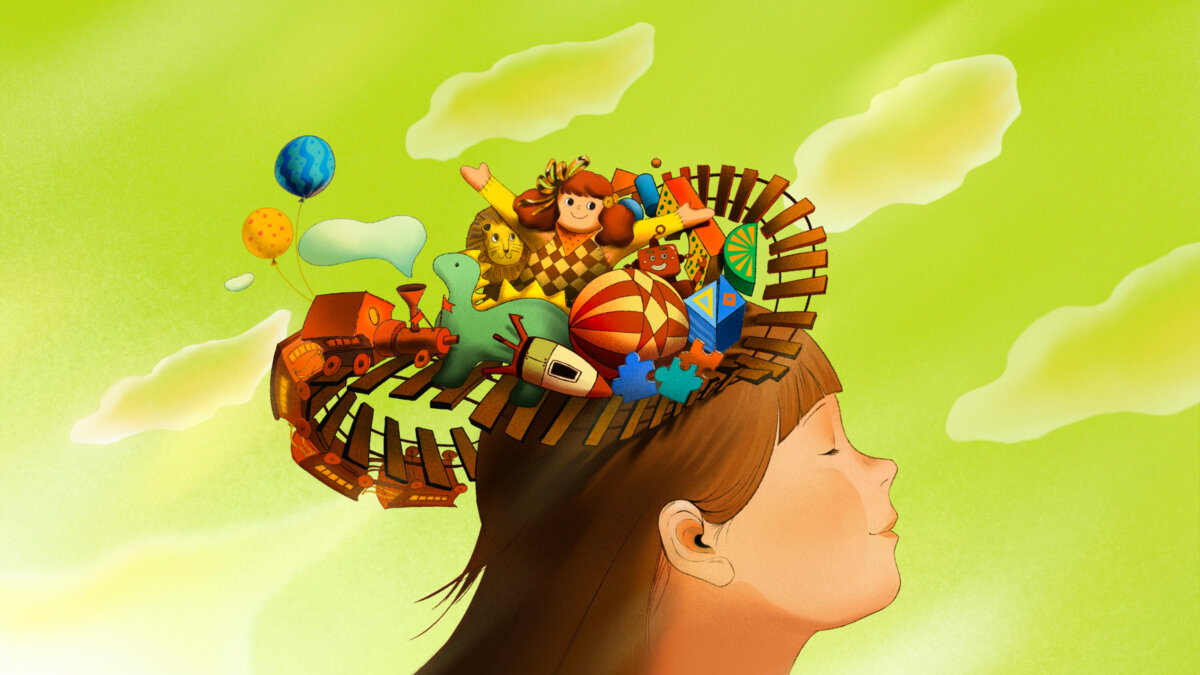
Children have always played. Across cultures and generations, certain kinds of toys are constants: blocks, dolls, and puzzles that invite children to build, pretend, and experiment. That is no accident.
Toys engage many of the ways the human brain learns. “You’re active, you’re engaged, you make it meaningful—not by someone else’s design, but by your agency,” Kathy Hirsh-Pasek, a professor of psychology and director of the Infant Language Laboratory at Temple University, and a senior fellow at the Brookings Institution, told The Epoch Times.
Toys that once occupied children’s attention now have a powerful competitor: the screen. Pixar’s “Toy Story 5” portrays that competition playing out inside the toy box. But a deeper concern is around what skills children miss out on developing when screens displace hands-on play with toys.
“I started working with patients back in the mid-’90s,” Sandra Whitehouse, a veteran child psychologist and associate director of the Anxiety Disorders Center at the Child Mind Institute in Manhattan, told The Epoch Times. “That was really pre-iPhone, pre-screens, and I’ve seen a real change.”
The difference became particularly striking after the pandemic; she saw children whose social and communication skills seemed different from those she had seen earlier in her career. “Some had missed opportunities for play during important developmental periods,” she said.
What Whitehouse has watched unfold over three decades is something developmental scientists have spent decades exploring: the invisible work of toys.
Every Toy Builds Something Different
The best toys require the child’s input: blocks without a blueprint or a stuffed animal with no name or backstory until a child gives it one.
That openness is what gives toys their power, Roberta Golinkoff, a professor of psychology at the University of Delaware and director of the Child’s Play, Learning, and Development Lab, told The Epoch Times.
“Toys release the imagination. If you give kids physical things they can manipulate, and they get to think about scenarios with them, they’re going to use their imaginations,” said Golinkoff, who, with Kathy Hirsh-Pasek, co-authored “Einstein Never Used Flashcards,” a landmark book on child development.
Imaginative thinking is not separate from learning. It is learning, especially in early childhood.
“Play—it’s like an elixir,” Hirsh-Pasek added. “It’s teaching you all this stuff.”
Different toys invite different kinds of thinking.
Eventually, the biggest challenge isn’t fitting block pieces together. It’s figuring out another person.
When play includes other children, a different kind of thinking begins. Children negotiate, take turns, resolve disagreements, and begin to see situations from others’ points of view.
They also have to manage their own impulses and emotions when the play doesn’t go their way. Those small conflicts give children practice staying engaged with others even when things are frustrating.
“You want your children to have social relationships,” Golinkoff said. “That’s how they’re going to learn what to do as an adult.”
This creates a stark contrast with the screen. A 2023 study of more than 7,000 children found that children with more screen time at age 1 were more likely to experience developmental delays in communication, fine motor skills, problem-solving, and personal-social skills by ages 2 and 4.
Thinking Through the Body
The physical world is not just the setting for learning. It is one of the teachers.
“To swap out the physical world for an iPad and assume it won’t profoundly affect brain development is a mistake,” Lillard said.
The reason has to do with what researchers call embodied cognition – the idea that thinking is shaped by the body’s interactions with the physical world. Looking at screens, no matter how interactive the game is designed to be, cannot replace playing with a physical object.
Children do not fully understand the size, weight, or shape of an object simply by looking at it, Lillard said. They learn by picking it up, rotating it, fitting it into another object and discovering what happens next.
Children’s hands are not separate from their thinking. “By engaging with objects, children learn about the world,” Lillard said.
A block that feels unexpectedly heavy or a toy car that rolls faster down one ramp than another teaches lessons no one has to explain. Those small surprises become information, helping children build an intuitive understanding.
Lillard often illustrates the idea with a merry-go-round. Ask children whether every part moves at the same speed, and they confidently say yes. But after pushing it from different positions, they discover that the outside travels faster than the center.
Some lessons, she said, are easiest to understand with the body before they can be understood with words.
From Play to Real Life
Play prepares children for life – and children need opportunities to put those skills to use.
In one series of experiments, Lillard and her colleagues asked preschoolers whether they would rather pretend to bake cookies or help make real ones, pretend to feed a baby or feed a real one, pretend to drive a car or ride in a real one. Given the choice, children consistently preferred the real activity.
The children didn’t say the pretend versions were less fun. They said they wanted to do something that mattered.
“They want to have a purpose,” Lillard said.
Children are ready to participate in the real world when they are given age-appropriate responsibilities. Four-year-olds can learn to set the table or unload the dishwasher.
That desire does not disappear as children grow — the real world asks more of them. Whitehouse sees what can happen when children have had too few opportunities to practice the skills required by more meaningful activities.
Developmental skills gained through ordinary childhood play help with more advanced activities, such as learning to ride a bike and playing team sports, as children get older.
Without those experiences, children can find themselves caught in a difficult cycle. Real-world activities feel frustrating because they are hard. Digital ones feel rewarding because they offer quick successes and familiar routines.
“Minimal things can get kids’ imagination going,” Golinkoff said. Often, the less a toy dictates, the more a child has to imagine, decide, and create.
Research suggests the same may be true of the number of toys available. In one study, toddlers were given either four toys or 16 toys to play with in a room. When fewer toys were available, children played with each one about twice as long and in more varied, imaginative ways.
“The other problem is the marketing pushes for really expensive toys. Jacks is not expensive — neither is hopscotch,” Whitehouse said.
“You don’t need a lot.”
Even older teenagers in therapy gravitate toward simple games.
The games themselves aren’t remarkable — but they create not only fun and imagination but rapport as two people focus on the same goal.
“No matter how old you are,” Whitehouse said, “There’s an opportunity for everybody to reconnect and play.”