
Commentary
It is comforting from time to time to get confirmation that communist regimes, wherever they take power, have a greater interest in prestige than in genuine economic prosperity. The regime in Beijing clearly is no exception.
Though at one time Chinese economics seemed to rise above this general rule, more recently—and especially under Chinese leader Xi Jinping—it has returned to this destructive standard.
In China today the communist authorities pour money and effort into a technological race with the United States in robotics, in artificial intelligence (AI) and in space while initiating what at best are only half measures to help its severely ailing economy—“just enough,” in the words of Larry Hu, chief China economist at Macquarie, to achieve the year’s modest growth targets.
Even considering the way Beijing manipulates public statistics, China’s economic picture looks grim.
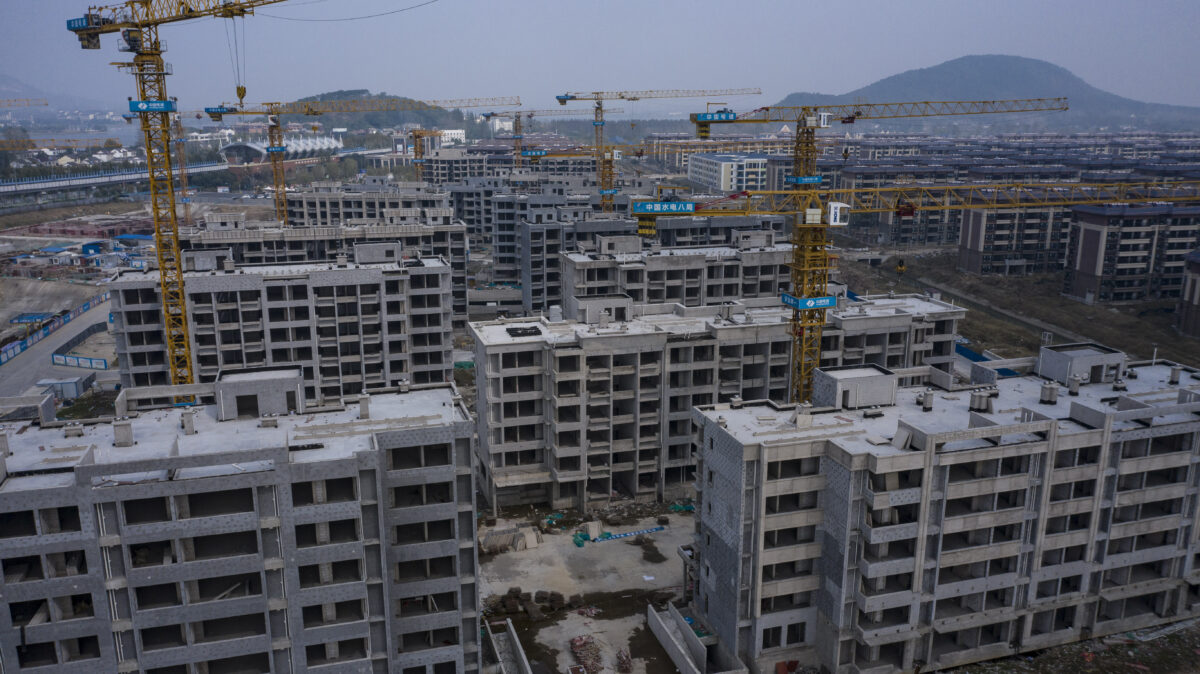
The property crisis that began about six long years ago rolls on unabated by the half measures the authorities have offered to alleviate it. Housing prices continue to decline, falling 6.2 percent over the year ended last March and every year since 2021 for a total decline of some 22 percent. Home sales have declined every year for the past six years as has residential construction activity.
Nor are property market woes China’s only problem. Consumer spending has remained weak. Retail sales expanded a mere 1.2 percent during the twelve months ended this past July, the most recent period for which complete data are available. This performance is barely above inflation and slower than the 4.0 percent advance in consumer spending for all of 2025, hardly a strong showing in itself.
No doubt the decline in real estate values has had an effect by eroding household net worth. Chinese consumers also have worries about job security brought on by the lockdowns and quarantines imposed during the COVID epidemic and the zero-COVID policies that followed.
Such uncertainties might have drifted from memory by now except that the economy’s sub-standard growth rate since COVID serves to remind people of their financial insecurities, especially compared with the economic boom of earlier in the century.
And China’s business community shows a similar lack of enthusiasm. Capital spending on efficiencies, improvements, and expansion has languished for some time. Such spending fell 10.4 percent over the twelve months ended last September and has declined every month for the last three and a half years.
The financial repercussions of the property crisis lie behind some of this less-than-impressive behavior by severely limiting the amount of risk capital available to private businesses especially.
Meanwhile, the attenuated pace of overall growth hardly demands an expansion of capacity. The reluctance to spend on expansion no doubt also explains the high youth unemployment rate, especially among recent college graduates.
China’s manufacturing purchasing managers index (PMI) for October showed a level of 49.3. Anything less than 50.0 indicates an outright contraction. The index for services came in only barely over 50 and well down from earlier in the year.
Yet, Beijing, even as it pours money and effort into its tech competition with the United States, has offered only half measures to deal with this broad array of economic shortfalls—measures that Dan Wang, China director at Eurasia Group, aptly describes as “limited” to say the least.
True, Finance Minister Lan Foan recently promised more public spending and broader subsidies to get the economy moving, but his statements follow on many such promises over the years, all bringing such little substance that they have hardly had any effect.
One of the subsidies recently promised, for instance, offers support for first-time home buyers. It amounts to 1.0 percentage point and only applies to homes of less than 120 square meters that are valued at less than the equivalent of $223,000. This means that it can only apply to some 12 percent of housing sales at most, far too limited to turn around the effects of the property crisis.
He has also promised tax reform to improve local government finances. Even radical reform, however, will have an uphill battle repairing damaged local finances that in some cases cannot even support provincial obligations to their residents.
The People’s Bank of China has cut interest rates a few hundredths of a percentage point from time to time to help stimulate economic activity. Again, not enough. In the last six years, cumulative rate cuts have amounted to less than a percentage point, hardly the stuff to rock otherwise beleaguered financial markets.
Last September, Beijing injected the equivalent of $54 billion into Chinese financial markets. That followed a slightly larger injection last year. These amounts are small in an economy the size of China’s.
What is more, most of these funds went to state-owned banks that are bound to support Beijing’s technology drive and so have done little to meet the needs of the struggling broader economy.
These are only a sample of the measures Beijing has put in place over the years, but they are nonetheless indicative of the pattern. No measure, even the sum of them, comes near answering the economy’s needs.
The emerging story for China has two themes. One is that Beijing is either unwilling or unable to provide the support the economy needs to regain even a portion of its former growth momentum. The other is that Beijing is more interested in prestige and perhaps military ability than it is in the well-being of the Chinese people.
And the upshot, for all the bright lights, skyscrapers, and proudful announcements, is that China’s economy has underperformed for some time and will likely continue to do so however much the officials in Beijing rig the figures to look better than reality.
Views expressed in this article are the opinions of the author and do not necessarily reflect the views of The Epoch Times.
 Friends Read Free
Copy
Facebook
Tweet