
Commentary
“Great that you finally got a decent pair of shoes,” my friend said to me when I was in college. “Make sure you always use a shoehorn so that the leather on the back does not break down.”
Like most people of my generation, I did not have a shoehorn. I probably thought they were unnecessary, just another fussy item from the past that modernity has somehow replaced and displaced. I didn’t need one. I would just loosen the laces and shove my foot in. No big deal.
Sure enough, the heel broke down over time. Not immediately, just a bit every time I shoved my foot in there. Eventually it became mushy. I took them to get re-soled. The cobbler said don’t bother. I had already ruined the shoes beyond repair.
Did I learn my lesson? Nope. I did not get a shoehorn. I kept trying to game the system, doing without, eschewing old technology and replacing it with unjustified confidence in my skills at putting my shoes on and pulling them off without damaging them. Surely I don’t need this silly tool.
So it began, a very long personal history of ruining shoes without really taking personal responsibility. Sure, every once in a while I would remember my friend’s advice. It haunted me, but I still defaulted to my assumption that the shoehorn is for the old world, whereas I live in the new.
Then one day I was shopping at a thrift store. I found a pair of shoes that stunned me, the best make and style I had ever seen. They were my size, a dream come true. The store priced them at $20, whereas the same pair new was $850. I had hit the jackpot. A treasure, unmerited good fortune.
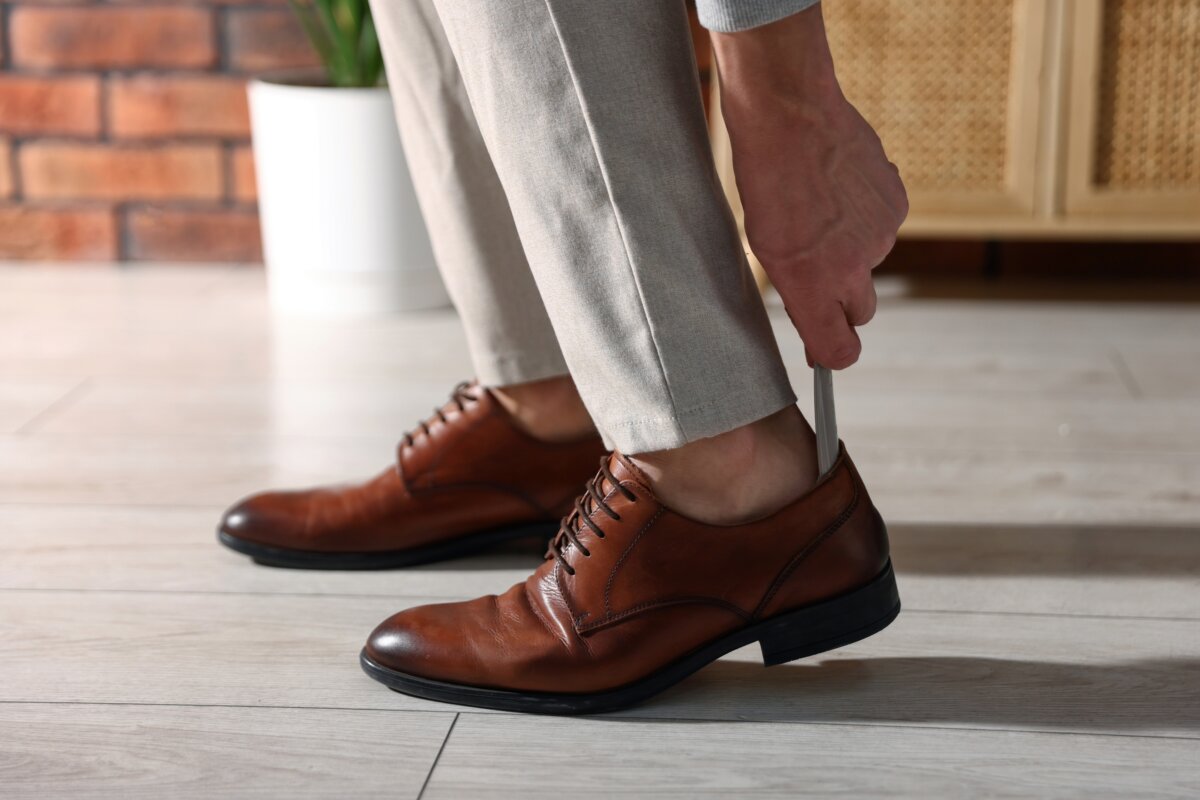
At long last, I was convinced that I needed a shoehorn. I was not going to ruin these, and so I ordered one. There are no words to describe the revelation that followed. It’s a simple tool and quite beautiful. It sits there right next to the chair you typically use for putting on shoes. You pick it up and stick it in the heel. Put your foot in.
To my astonishment, this simple tool eliminates all friction. The foot slips in beautifully without disturbing any aspect of the shoe’s structure. No more wriggling one’s foot around, shifting weight, and yanking up the back part to make it work. It was only then that I realized that the shoe and the shoehorn go together like salt and pepper or man and wife.
Why did I previously think we had somehow entered the Age of Aquarius in which such old-world tools were no longer necessary? This might be a generational conceit. We have the internet. We have streaming music and movies. We have lights and air temperature you can control with an app. Why would we need something so old-fashioned as a shoehorn?
The answer is that shoe technology has hardly changed. It is a form that fits around one’s foot. There is always a problem here because the foot has an odd shape and the shoe is built to be worn on the foot. But getting it on is always and everywhere something of a challenge, especially if we are talking about hard leather. Hence, the magic of the shoehorn.
They became rather mainstream in civilizational history, as with most such tools, in the high Middle Ages and beyond. Shoehorns were made from animal horns, of course, then sometimes shells and bones, until industrial history figured out how to make them from brass, silver, and steel. Now they are made of plastic, which is inauthentic but serviceable.
Shoehorns became necessary as the hard leather shoe replaced the moccasin as standard footwear. The history here alone is fascinating. Indeed, there is a Shoehorn Museum in West Covina, California, that looks like it is worth a visit.
“The Shoehorn Museum is dedicated to the history and art of the shoehorn. The collection has been amassed over decades from around the globe,” its website states.
“Visiting the Museum is a one of a kind experience, a trip through the function, art and history of the humble shoehorn. Your docent is typically the collector himself—Dr. Forest Tennant—a world renowned physician and the city’s chief historian.”
So there we go: a well-to-do doctor got obsessed with collecting shoehorns and decided to start a museum. God bless him. We need people like this. This is why America is home to so many wonderfully specialized museums, such as the Carousel Museum and the National Watch and Clock Museum.
The Shoehorn Museum has the largest displayed collection of shoehorns in the world. It even has the world’s first “signed” designer editions. Between 1593 and 1613, a maker named Robert Mindum produced more than 20 known English shoehorns, all signed, dated, and engraved with their owner’s name—“THIS IS AMBRES BVCKELLS SHOING HORNE MADE BY ROBART MINDVM ANNO DOMINI 1598.” One is inscribed “JANE HIS WIFE.”
I’ve taken to my shoehorn so strongly that I travel with it. At airport security, if I have to take off my shoes, I leave my shoehorn in an accessible spot in my luggage. I pull it out ostentatiously and use it while shaming everyone else for wearing sloppy shoes or ruining good ones.
A bit of trivia from shoehorn history follows. In the Elizabethan period, there were men known as shoehorns who had a specific job. They were to attend parties with young women seeking a mate. Potential suitors would become jealous of the man with a woman who suddenly seemed more desirable; they would then start competing for her hand. Such was the job of the shoehorn. So you get the metaphor here.
Of course you know the phrase “horning in” when someone shoves his way into business that is not his own. This is the plausible origin of the phrase that is still in common use, but hardly anyone thinks about the root meaning.
These days, older people use shoehorns to great benefit. Long-handled and telescoping models (up to 37 inches) exist so the elderly, expectant mothers, postsurgical patients, and people with bad backs can put on shoes without bending. It’s a genuine dressing aid, sold right alongside buttonhooks, the shoehorn’s historical partner tool.
Oh and just by the way, so impressed am I with the utility of the shoehorn that I bought a buttonhook. It just sits there. I cannot seem to find a use for it, but it’s there just in case.
What’s the lesson? The analog world still exists. We still have bodies, and bodies have feet, and feet need shoes. The best shoes are hard leather, and those need the aid of a very old and unchanged tool to put on. Never forget it. Maybe we eventually get flying cars and telepathy, but we will always need a shoehorn.
Views expressed in this article are the opinions of the author and do not necessarily reflect the views of The Epoch Times.
 Friends Read Free
Copy
Facebook
Tweet