
Commentary
When President Donald Trump hosts Chinese General Secretary Xi Jinping at the White House on Sept. 24, public attention, when it comes to supply chain and rare earths, will inevitably fixate on the visible bargaining chips: tariff adjustments, mutual purchasing commitments, and tactical trade truces. Yet lurking behind the headlines is a contest over time: an American administration maneuvering to buy the runway needed to rebuild domestic industrial capacity and supply chains, sitting across from a Chinese Communist Party acutely aware that its most potent economic weapon is an asset with an expiration date.
For three decades, Western capitals outsourced the dirty, caustic business of rare earth refining to China under the gospel of global market efficiency. It was a Faustian bargain: the democratic world offloaded environmental degradation and capital intensity, while Beijing cornered over 90 percent of the chemical separation and sintered magnet capacity required to build modern civilization. From electric vehicle drivetrains and wind turbines to guided missiles and precision radar, the free market decided that the cheapest path was the smartest path.
The illusion shattered in April 2025 when Beijing started pulling the trigger. Through aggressive export licensing on medium and heavy rare earths like dysprosium and terbium, shipments plunged, assembly lines stalled, and Western boardrooms confronted an existential reality: inexpensive material that can be revoked overnight is not an asset, it’s a liability.
Those Western economists calling the maneuver self-defeating mercantilism, fail to grasp the nature of the regime wielding the weapon. To the Chinese Communist Party (CCP), commercial integration was never about mutual prosperity; it was an asymmetric staging ground. The era of cheap rocks is dead, and the West has finally discovered a slice of its industrial and defense future is held hostage by an adversary that views industrial supply chains as a theater of war.
The Allied Blueprint and Its Chokepoint
Faced with the chokepoint, the democratic world reached for a counterweight that already existed: the Australia–Malaysia corridor anchored by Lynas Rare Earths. Ore from Mount Weld in Western Australia is separated at Gebeng, on the Malaysian coast. It is still the only commercial-scale separator of consequence outside China. In fiscal 2026, Lynas sold more than seven thousand tons of neodymium-praseodymium oxide, added dysprosium and terbium the year before, and poured its first samarium in March 2026. Malaysia renewed the plant’s operating license for 10 years.
Yet digging ore out of the ground does not quite equal industrial sovereignty. It is the first rung of a ladder that runs mine to mixed concentrate to separated oxide to metal and alloy to sintered magnet. True leverage sits on the last three rungs. Those remain overwhelmingly inside China. Planned magnet plants in the United States, Europe, Korea, and Japan will fail if they cannot buy separated heavies and metals that are not subject to a Beijing license.
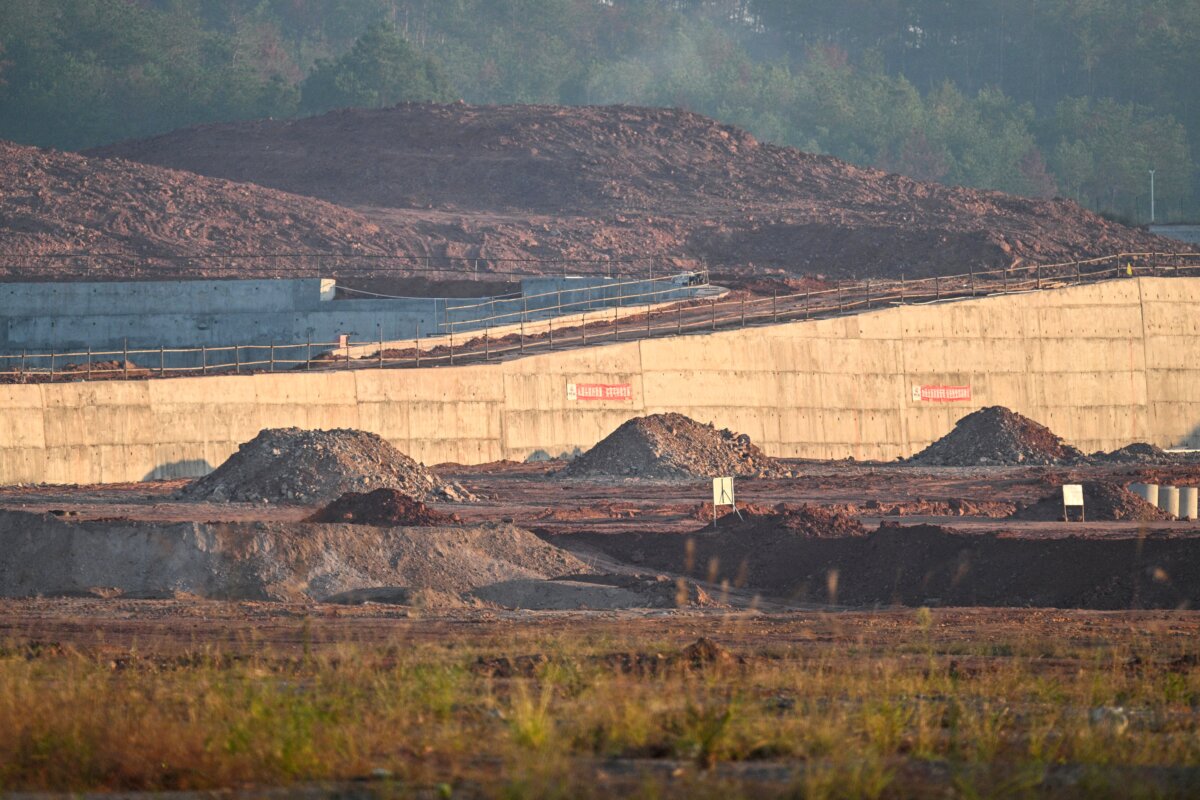
Two Australian projects are finally climbing the ladder. Iluka’s Eneabba refinery is more than half built, backed by a A$1.65 billion non-recourse sovereign loan, and aimed at commissioning in mid-2027, with a first automotive offtake already signed. Arafura’s Nolans project took a final investment decision in 2026 and is pointed at first oxide around 2029—Australia’s first fully integrated ore-to-oxide operation. In California, Mountain Pass has a second life: the same deposit that bankrupted Molycorp after China slashed prices in the mid-2010s is now the core of a Pentagon-backed mine-to-magnet bet, complete with a 10-year neodymium-praseodymium price floor of $110 a kilogram and a guaranteed magnet offtake. Tokyo independently arrived at the same number, locking a $110 floor into a 12-year Lynas contract.
Critically, free-market economics could not solve the problem on their own. No private financier would back a multi-billion-dollar refinery knowing Beijing could flood the market, slash prices, and force bankruptcy before commissioning. Washington, Tokyo, and Canberra stepped in with sovereign loans, equity, strategic reserves, and offtake contracts with floors. Survival required a pivot the West had spent a generation preaching against—state-backed industrial policy—just to stay in the game. It is important to note here that this is happening because China under the CCP is not a free market economy, so the state-level actions by Western powers are a correction to China’s state-backed economy, not the other way around.
The Myth of ‘Buying Time’
Washington’s tariffs, waivers, and pauses rest on a comforting premise: diplomacy can buy eight to 10 years while allied mining and processing reach commercial scale.
That premise has already been tested. After the 2010 Senkaku crisis, when China informally cut rare earth shipments, Japan “bought time.” JOGMEC and Sojitz put hundreds of millions into Lynas in 2011. Tokyo funded substitutes, recycling, and stockpiles. Fifteen years later it had cut its China share of imports from roughly 90 percent toward the 60s—and was still hostage on the heavies and on sintered magnets when the 2025 licenses hit. If a manufacturing power with a 15-year head start could not fully break the choke, an eight-year buffer is not yet a plan. It is a hope.
The hope is mirror-imaging. Western planners usually treat the CCP as a trading state that husbands leverage through restraint. A Leninist party-state is animated by perpetual struggle—dòuzhēng—in which treaties and licenses are tactics. Dual circulation, military-civil fusion, and the 2020 Export Control Law are not the vocabulary of a price-taker.
Buying time only works if the other side lacks agency. Beijing banned export of extraction and separation technologies in December 2023, then magnet know-how. In October 2025 it added equipment and process controls and an extraterritorial rule: foreign-made items with trace Chinese-origin rare earths, or made with Chinese process technology, would need a Beijing license to move between third countries. A late-2025 understanding suspended that October package until November 2026. The April 2025 element licenses were not lifted. The weapon was only holstered.
Feedstock moved with it. When southern China cleaned up its ionic-clay mines, the heavy trade reappeared in Kachin, Shan, and Laos. Burma plus China now supply the great bulk of mined dysprosium and terbium. Vietnam is keeping rock at home to capture refining, not opening an alternative pool. Beijing sanctioned a leading supply-chain monitor; some Chinese suppliers then refused U.S.-bound cargoes rather than sit inside the diligence. That is coercion of the audit architecture a non-Chinese chain needs to be bankable.
Democracies flinch when a plant pauses. A party-state can absorb idle factories if the prize is an adversary’s autonomy. Recycling and leaner magnet grades help at the margin. They may not, this decade, replace separated heavies or sintered magnets at defense and electrification scale. Believing the West controls the schedule presumes the adversary will passively watch its leverage dissolve. Beijing knows the monopoly expires. It will not wait politely for allied refineries to qualify product.
Riding the Tiger
By brandishing its mineral monopoly as an explicit weapon, Beijing has trapped itself in an ancient dilemma: qí hǔ nán xià (骑虎难下)—he who rides a tiger finds it perilous to dismount.
Monopoly leverage is most potent as an unexercised menace. Kept in reserve, the implicit threat keeps consumers docile, chills Western capital investment, and smothers non-Chinese competitors under artificially depressed prices. But the moment the CCP pulled the trigger it triggered the paradox of economic coercion: leverage used is a diminishing asset.
Every shipment withheld proved to allied treasuries that Chinese supply is an uninsurable risk. That realization demolished the market barriers shielding China’s dominance, unlocking the sovereign price floors, subsidized offtakes, and defense mandates that private markets could never have mounted alone.
More damaging still, the move sabotages Beijing’s broader industrial ambition. The Party never intended to remain the world’s low-margin, polluting quarry; its goal was to leverage mineral dominance to pull the entire advanced manufacturing chain eastward, forcing the world to buy Chinese-assembled drivetrains, robotics, and electric vehicles. Instead, by treating raw inputs as a geopolitical weapon, Beijing triggered preemptive firewalls against its high-end exports, stranding capacity at home just as domestic growth falters.
Yet Beijing finds it hard to dismount. Trapped by domestic nationalist expectations, Xi’s codified retaliatory doctrines, and the ideological imperative to punish external rivals, the regime feels compelled to stay on the beast—striking outward even as it destroys the very leverage that made it formidable.
The 2-Clock Finale
As Trump and Xi sit down in Washington, the conflict narrows to a contest between two clocks.
Clock A belongs to the West: a slow, complex, seven-to-twelve-year industrial mobilization to permit facilities, refine heavy chemistry, and scale domestic sintered magnet production.
Clock B belongs to Beijing: a rapidly closing window where its monopoly on separated heavy oxides and permanent magnets still wields a painful bite.
This creates a strategic peril. If the CCP calculates that Western and allied capacity will achieve meaningful resilience by the mid-2030s, its monopoly ceases to be an asset to preserve. A rational move for an ideologically driven, struggle-oriented regime facing an acute crisis—over Taiwan, regional dominance, or internal economic strain—is not patient diplomacy, but striking before the weapon rusts.
Treating bilateral summits as opportunities to comfortably “manage the timetable” is a gamble. The West is running an emergency industrial mobilization that, on present plans, still leaves most civilian magnet demand and a non-trivial share of defense demand inside the license regime. If they assume they control the pace of decoupling, they may find that when the Party next plays its hand, Western assembly lines are better insured than they were in 2025—yet still not quite defensible.
Views expressed in this article are the opinions of the author and do not necessarily reflect the views of The Epoch Times.
 Friends Read Free
Copy
Facebook
Tweet