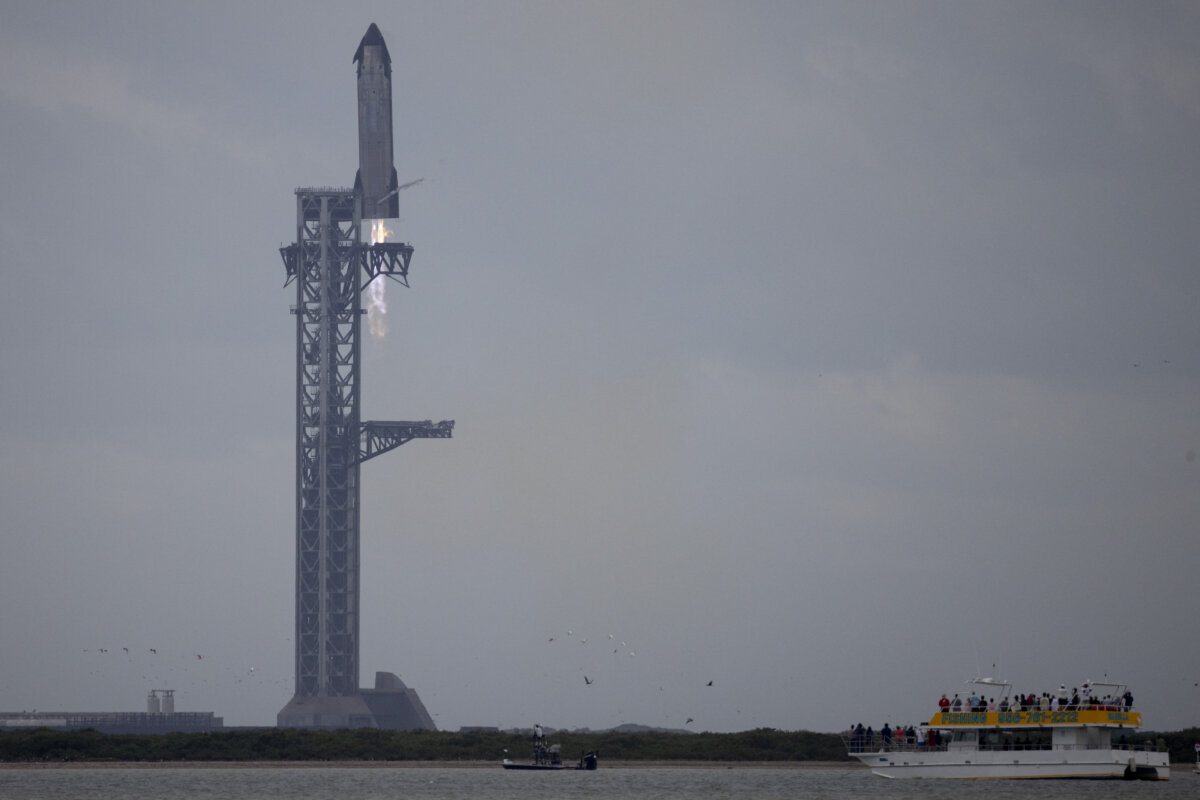

SpaceX’s first attempt to return Starship to the launch tower was a success.
After a 22.5-hour mission, the Starship upper stage dropped through the clouds over Starbase, Texas. A crowd of hundreds on-site erupted in celebration as Starship 42 fired its Raptor engines, slowed to a hover, and eased itself into the catching arms of the tower, known as Mechazilla.
Chants of “USA! USA!” could be heard in the background as the engines cut off and sealed a new chapter of spaceflight history. SpaceX’s Starship has become the first rocket to prove that it can make a controlled return to the launch pad in its entirety, with each half returning successfully—albeit on two separate flights.
No recovery teams off in some distant corner of the globe. No time lost in the additional travel time needed to return the spacecraft from its landing site back to the spaceport. SpaceX has demonstrated that the world’s largest rocket in operation can lift off a launch pad, place the super-heavy booster back on that same launch pad through a controlled automated return maneuver, and have the second half return as well to be caught by the tower. Ultimately, those tower arms would place the Starship back on the booster for another flight.
This 15th Starship mission began in the evening of Nov. 13. Immediately after launch, the super-heavy booster was also supposed to return for a catch back at the launch pad. However, during its return, its automated systems found it off course and aborted the return, opting for a soft splashdown just off the coast. The booster has completed a successful “catch” and return on previous missions.
Starship’s journey home began around 21 hours and 35 minutes after liftoff, when mission controllers reignited one of its Raptor engines for a de-orbit burn. This maneuver slowed Starship down enough to pull it out of orbit and undertake a controlled, gradual fall back to Southeast Texas.
The spacecraft began re-entering the Earth’s atmosphere just past the 22-hour mark of the flight. The black and silver hull glowed a bright purple as it penetrated the layers of gases and used the pressure to slow down.
Three separate checkpoints were added into the 14-orbit flight plan to allow Starship to make an early return back to Earth, and it passed all three with flying colors. After the de-orbit burn, flight controllers held a final Go/No-Go for Starship’s return to the launch pad. If a No-Go had been issued, Starship would have been set up for another ditch into the ocean.
Starship passed over land, from the Pacific, over northern Mexico, back toward Starbase, Texas, and out over the Gulf of America before making one final “swoop” maneuver to line up for a final approach. Just as it came back over the Gulf, on-board autonomous systems had time for one final evaluation and to make the call to ditch into the water instead. But all systems remained nominal.
What was once only the subject of computer-animated renderings is now reality. Both Starship’s super-heavy booster and upper stage have demonstrated they can return to their launch point, ready for reuse.
It marks a major development milestone for what is promised to be the world’s first entirely reusable launch vehicle, and it comes at a very fast-moving point in American spaceflight. Work continues to make the Kennedy Space Center fit to handle Starship. A SpaceX Gigabay is under construction near NASA’s Vehicle Assembly Building, with plans to build a facility similar to Starbase’s Starfactory in development, and modifications are being made to the historic Launch Pad 39A.
A SpaceX Starship will launch from Florida’s Space Coast as part of NASA’s Artemis III mission in 2027.
 Friends Read Free
Copy
Facebook
Tweet